
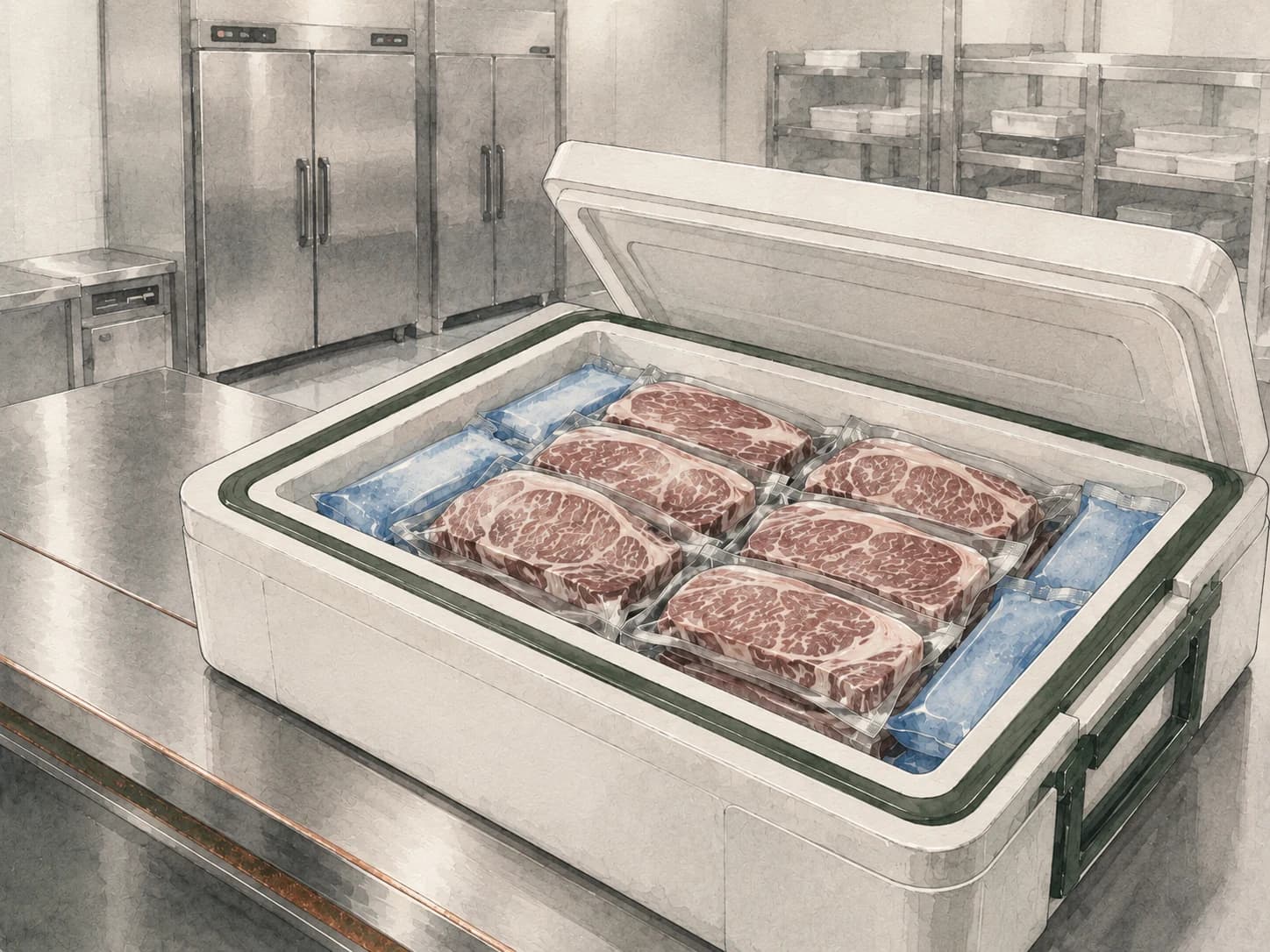
The problem is not the beef. It is the day count.
If you buy chilled premium beef into Hong Kong, you already know the shape of this: a consignment clears, moves to the cold store in Kwai Chung or Tsuen Wan, and by the time it reaches the kitchen there are fewer usable days left than the menu cycle needs. The response is always one of three things — mark the dish down, freeze what is left, or trim harder and write off the difference. None of them show up as a purchasing error. They show up as food cost percentage, and you explain them to the GM.
The instinct is to blame clearance or the airline. In our experience shipping Japanese Wagyu by cut, that is rarely where the days go. The number of usable days at the pass is largely fixed before the box leaves Japan — by the packing date and by which cut you ordered. A vacuum-packed striploin primal and a set of portioned steaks leave the same plant on the same flight and arrive with very different amounts of runway. That difference is a purchasing decision, not a logistics accident.
This article is a way to count. It gives you a worksheet you can fill in before you place an order, a cut-by-cut view of which items tolerate a long window and which do not, and a decision rule for the cases where the arithmetic does not work.
Why cut selection decides the window
Chilled beef in vacuum ages while it travels. That is not a defect; for whole-muscle primals it is part of why the product is worth buying. What determines how gracefully it ages is mostly geometry and pack integrity.
A whole primal — striploin, ribeye roll, chuck roll — has a small cut surface relative to its mass, sits in a single vacuum seal made once at the plant, and is not opened again until your butcher opens it. The exposed surface is a thin band at each end. It carries a long window well.
Portioned steaks are the opposite. The same kilogram of meat has been divided into many pieces, each with two large cut faces, each in its own seal, and the total exposed surface is many times greater. Every additional seal is another chance for a slow leak, and a lost vacuum on a chilled item is not a partial problem — that pack is gone. Portioning also happens after the primal has already been sitting, so the clock on a portioned pack has usually been running longer than the pack date suggests.
Tenderloin sits in between and deserves its own note. It is a small muscle with a large surface area for its weight, it is tapered so the thin end behaves differently from the butt, and it is the cut buyers most often want in the smallest quantity. Small quantity means it gets ordered as a piece or two rather than as part of a full carton, which is exactly the pattern that leaves it sitting in a consolidation window before it flies.
The practical consequence: two orders with identical packing dates and identical flights can produce very different numbers at the pass, and you can predict which is which before you order.
The day-count worksheet
Fill this in for one specific order, not for your supply in general. Each line is a date or a number of days that you can obtain by asking someone — your supplier, your broker, your cold store. Nothing here is a rule of thumb.
Step 1: Get the two fixed dates
- A. Packing date. The date on the pack, from the plant. Ask your supplier to confirm it at the time of order, not after shipping. If the answer is a range, use the earliest date in the range.
- B. Menu start date. The day the dish goes on the pass. This is yours, and it is usually the least movable number on the sheet.
Step 2: Get the elapsed days between them
Ask for each of these separately. Suppliers who quote you a single door-to-door figure are averaging over steps that vary independently.
- C. Packing to departure. Includes consolidation — the time your cut waits for the rest of the shipment. This is frequently the largest single number on the sheet and the one buyers most often forget to ask about.
- D. Flight and arrival handling. Wheels-up to the point the consignment is available for clearance.
- E. Clearance allowance. Import requirements for chilled beef in Hong Kong are set by the Centre for Food Safety; check the current requirements and the list of approved source establishments at cfs.gov.hk before you build a plan around a number. For the worksheet, use the allowance your own broker tells you to budget for a chilled Japanese beef consignment, not a best case.
- F. Cold-store transfer and receipt. Arrival at your 3PL, temperature check, put-away, and the time until you can actually draw stock. If you store in-house this may be hours; through a 3PL with a booking window it may not be.
Step 3: Do the arithmetic
Elapsed days before service = C + D + E + F.
Arrival-at-kitchen date = A + (C + D + E + F).
Usable days at the pass = (the last date you would serve this cut) − (arrival-at-kitchen date).
For the last date you would serve a given cut, use your own house standard — the same one you already apply to Australian or US chilled beef — or the supplier's stated window for that pack format, whichever is shorter. Ask for it in writing, per cut, as a number of days from packing date.
Step 4: Compare against the menu cycle
Write your menu rotation length next to the usable-days figure. If you run a four-week rotation and the cut gives you fewer usable days than the stretch you need to cover, the order is already wrong at the point of placing it. No amount of expediting fixes it, because the days were spent before departure.
The decision rule
When usable days at the pass fall short of what the menu cycle needs, you have three moves, in this order:
- Move up one primal size. Order the whole muscle instead of the portioned format and cut in house. This buys back the portioning surface and the extra seals, and it usually removes some consolidation time as well because a full primal is easier to ship on its own.
- Shorten the front end. Ask what C looks like if your cut ships without waiting for consolidation. If the gap is only a few days, this is often where they are.
- Move that cut to frozen. Not the whole order — that cut. This is the point most buyers get wrong: chilled versus frozen is not a decision you make once for a supplier. It is a decision you make per cut, per rotation.
A mixed order is normal and it is not a compromise. Running striploin and ribeye roll chilled as whole primals while taking tenderloin frozen is a coherent plan, and it is usually cheaper in total waste than forcing everything into one temperature state.
Two things that quietly break the count
Minimum order quantity. If the quantity you want for a cut is smaller than the smallest unit that can ship without breaking a primal, that cut will be held for consolidation, and your C value grows. Ask for the minimum order quantity per cut in the same conversation as the lead time. The two numbers are connected and quoting one without the other is not useful.
Pack format. "Vacuum packed" is not a specification. Ask what the pack is for each cut, how many pieces per bag, and what window the supplier will state for that format. If a supplier will not put a per-cut window in writing, your worksheet has a hole in it and you should assume the shorter figure.
What to do with this
Run the worksheet once on a shipment you have already received, using the real dates. Most buyers find the days went somewhere they were not looking — usually before departure. That single retrospective count tells you more about your waste than a season of arrival inspections.
Then run it forward on the cuts you are considering. If the numbers work for whole-muscle primals and not for portioned items, you have your answer, and it is a specific one: chilled Wagyu by cut is operationally realistic for you on some cuts and not others.
The worksheet only closes once you have two things we hold: the real packing-to-departure lead time on our Hong Kong air lane, and the pack format and minimum order quantity for each cut we can ship. Those are conditions, not a price list.
Tell us your menu rotation length and the cuts you are looking at, and we will map which of them can run chilled on your cycle and which should go frozen. Get in touch and bring the dates you already know.
Regulatory note: Hong Kong import requirements for chilled beef, and the list of approved Japanese establishments, are maintained by the Centre for Food Safety and can change. Verify current requirements at cfs.gov.hk at the time you plan a shipment. Lead times and pack formats referred to above reflect our own current shipping practice and are not measured averages; confirm them with us for your specific order.