
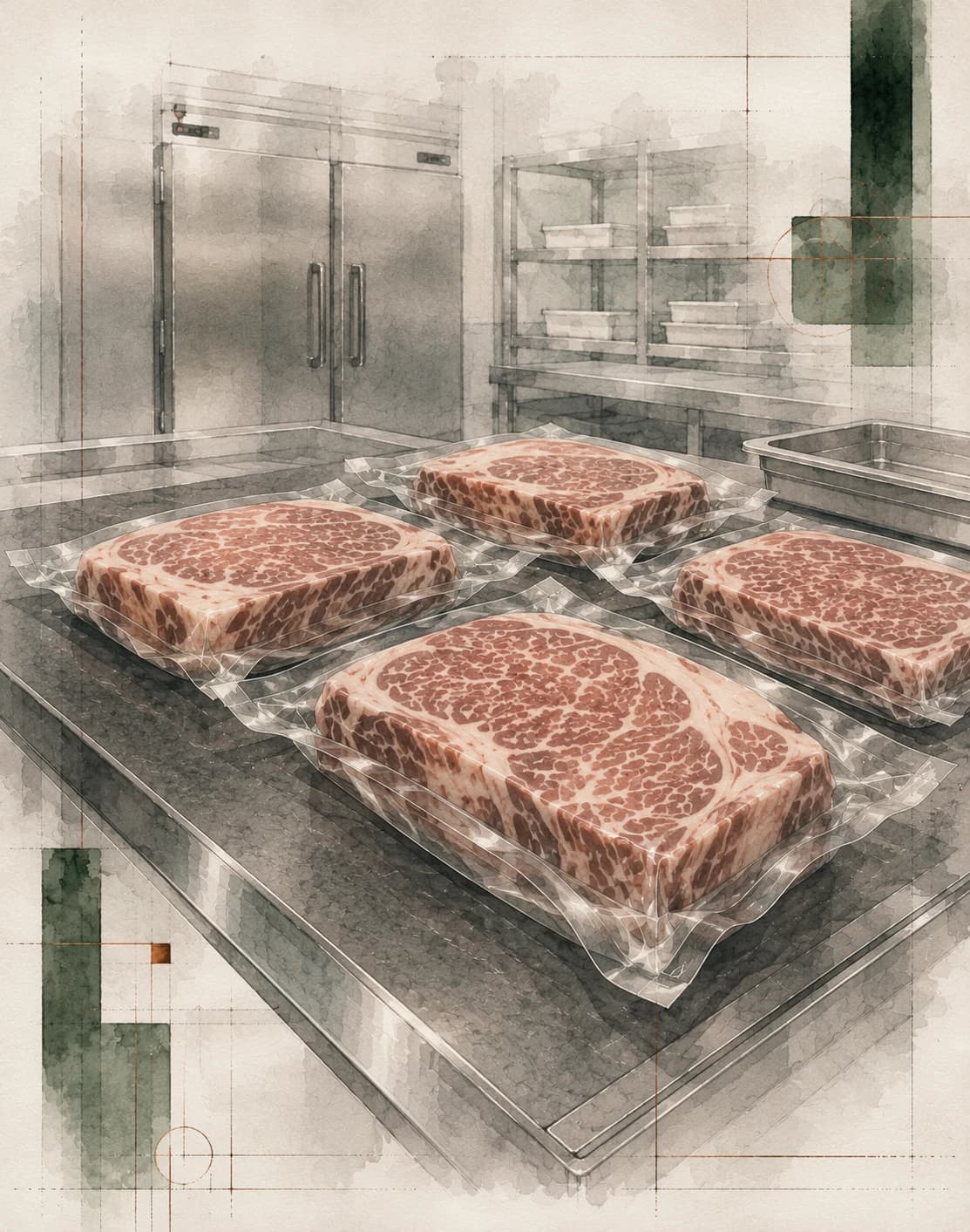
If your Japanese Wagyu shipments keep stopping at a Saudi port, the problem is usually not whether the beef is halal. It is that the fields describing it — the certifying body's approved scope, the slaughter establishment number, the cut description printed on the carton, the wording on your purchase order — do not say the same thing about the same carton. That divergence is almost always created at PO stage, weeks before anything is loaded, and it is far cheaper to remove there than to appeal at the border.
This article covers one thing: a field-level mismatch audit you run before you issue the PO, cut by cut, for Saudi clearance. It is deliberately narrow. If you want to understand how physical chain of custody is kept continuous after slaughter, that is covered in Saudi Wagyu halal custody continuity per cut. If you are already ready to order and simply need to know which halal slaughter documents exist and what each one is for, read Japanese Wagyu halal slaughter documentation. And if your market is the Emirates rather than the Kingdom, the general PO consistency check is in UAE Wagyu PO document consistency. What follows assumes you know halal certification is required — you are asking why the paperwork keeps failing on specific cuts.
Why the failure clusters on cuts, not on shipments
A hold rarely applies to an entire container in the abstract. It applies to a line: a pallet of chuck roll, a carton run of short plate. The reason is structural. Halal documentation is issued at the level of the slaughter event and the establishment; your PO is written at the level of commercial cut names; the carton label is printed by the plant using its own product nomenclature; and the HS line is chosen by the forwarder from a tariff description. Four different vocabularies describe the same box.
For a whole-muscle primal with a stable name, these vocabularies usually converge. Ribeye is ribeye. The mismatches cluster where the naming is loose:
- Chuck roll and shoulder clod — plant nomenclature, English trade names and Arabic label text frequently diverge, and a label that says "shoulder" against a PO that says "chuck roll" invites a question at inspection.
- Short plate and short rib — thin-cut yakiniku material is often described by its intended use rather than its anatomical origin, which does not survive a document check.
- Trimmings and portion-cut items — these may be produced on a different date, or in a different room, than the primal they came from, which puts pressure on the slaughter date and certificate serial fields.
- Mixed chilled/frozen lines on one PO — storage mode and shelf-life wording differ per line, and a single document set covering both is where the shelf-life window stops matching the carton.
So the unit of audit is the cut, not the consignment. One row per cut on the PO.
The twelve fields to cross-check
Build a sheet with one row per cut line and these twelve columns. The point is not to collect documents — you already have them — but to read the same fact off four different pieces of paper and see whether it reads the same each time.
- Certifying body and its approved scope. Not just the name of the body, but what the body is approved to certify: species, plant, and in some cases product category. A valid certificate from a body whose scope does not cover that establishment is the most common fatal mismatch.
- Slaughter establishment number. It must appear identically on the certificate and on the carton or its accompanying documentation. Transcription differences — a leading zero, a hyphen — are enough to trigger a query.
- Slaughter date. Must be consistent with the certificate serial and must precede the production and packing dates on the carton.
- Certificate serial / reference. One serial should trace to a defined set of cartons. If you cannot say which cartons a serial covers, you cannot answer an inspector's question.
- Carton label description. The literal printed text, in the literal language(s) printed.
- PO description. Your own wording. This is the field you control most easily, and therefore the one to change first when there is a gap.
- HS line. Chilled versus frozen, bone-in versus boneless, and whether the classification is consistent with the storage mode declared elsewhere.
- Net and gross weight. Per line, not only per shipment.
- Consignee legal name. The registered legal name, character for character, not a trading name or an abbreviation used internally.
- Port of entry. Named consistently across certificate, PO and transport documents.
- Storage mode. Chilled or frozen, stated the same way on label, PO and transport paperwork.
- Shelf-life window. Production date plus the stated life, and whether that window is still reasonable on the projected arrival date for that specific line.
Mark each cell match, mismatch — fatal, or mismatch — correctable.
Which mismatches are fatal and which are correctable
The distinction that matters operationally is not how serious the error looks, but who can fix it and when.
Fatal mismatches are those that require the issuing authority or the slaughter plant to act, and that cannot be remedied once the goods have left Japan. Scope of the certifying body, the establishment number, the slaughter date and the certificate serial all sit here. If the body's scope does not cover the plant, no amount of relabeling helps; if the establishment number on the certificate is not the number under which the meat was produced, the document is simply describing something else. These need a re-issued certificate from the origin, which means they need to be caught before production — in practice, before the PO is accepted.
Correctable mismatches are those you or your supplier can resolve with a document amendment or a labeling instruction prior to shipment. PO description wording, consignee legal name, port of entry, HS line selection, and in many cases carton label text fall here — provided the instruction reaches the plant before the cartons are printed and sealed. After sealing, a correctable mismatch becomes expensive even if it is not fatal.
The practical consequence: run the sheet twice. Once at quotation, to find fatal rows while the order can still be reshaped. Once again after the supplier confirms the production plan but before labels are printed, to close the correctable rows.
Decision rules for an open row
When a row will not close, there are only three moves, and they are ordered by cost.
Amend the PO. Cheapest and fastest. If the carton label will read "chuck roll, boneless, chilled" and your PO says "shoulder," change the PO to the plant's nomenclature rather than asking the plant to change its label. Your PO is an internal commercial document; the label and the certificate are not.
Request a re-issued or re-scoped certificate. Necessary when the fatal fields are wrong. This takes origin-side time and may require the plant to schedule production under a different approval. Treat it as a reason to move the shipping window, not as something to chase while the container is already booked.
Re-label before shipment. Possible only while the goods are still at origin and the cartons are not yet sealed and palletized. Specify the exact label text you need, per cut, in writing, and confirm the language requirements for your port of entry before production.
What you must re-verify every cycle
Recognition of halal certifying bodies and approval of individual foreign establishments are administered by the Saudi authorities and are revised from time to time. For that reason this article deliberately does not list approved bodies or establishment numbers: any such list would be a snapshot, and a snapshot used as a standing reference is exactly how a scope mismatch gets built into a PO. Re-verify, at each PO cycle, that the certifying body named on your documents is currently recognized for the plant in question, and that the plant's approval currently covers the product you are buying. Confirm the current position with the Saudi Food and Drug Authority and with your certifying body directly, and record the date on which you checked at the top of your sheet.
The same applies to tariff classification and to carton label language requirements, which may be applied differently in practice at different ports. Where we have no current confirmation, the honest instruction is to verify with the authority and with your clearing agent before the PO is issued, rather than to assume continuity from the last shipment.
Running the sheet in practice
In our own export handling, the rows that stay open longest are almost always the ones where a commercial cut name has no clean equivalent in the plant's product list — this is an observation from how we work with buyers, not a measured figure. Those rows are worth raising with the supplier early, because the answer determines whether the cut can be ordered as described at all.
A workable sequence: list every cut on the intended PO; fill the twelve columns from the documents and label proofs you can actually obtain; mark each cell; isolate the fatal rows; decide amend / re-issue / re-label for each; and only then fix quantities, price and shipping window.
Next step
When your sheet has rows you cannot close from your side — a certifying body scope you cannot confirm, a carton description that does not match how you need to sell the cut, a shelf-life window that is tight for your arrival port — send the filled sheet to the supplier before anything is committed. The question to ask is specific: can the Japanese plant issue certificates and print carton labels matching these exact cut descriptions, under an approval that is currently valid for Saudi Arabia?
If you would like to put that question to us directly for the cuts you are planning to buy, contact us to confirm conditions before any PO or price is fixed. We would rather resolve a field-scope question at this stage than discuss it after a hold.