
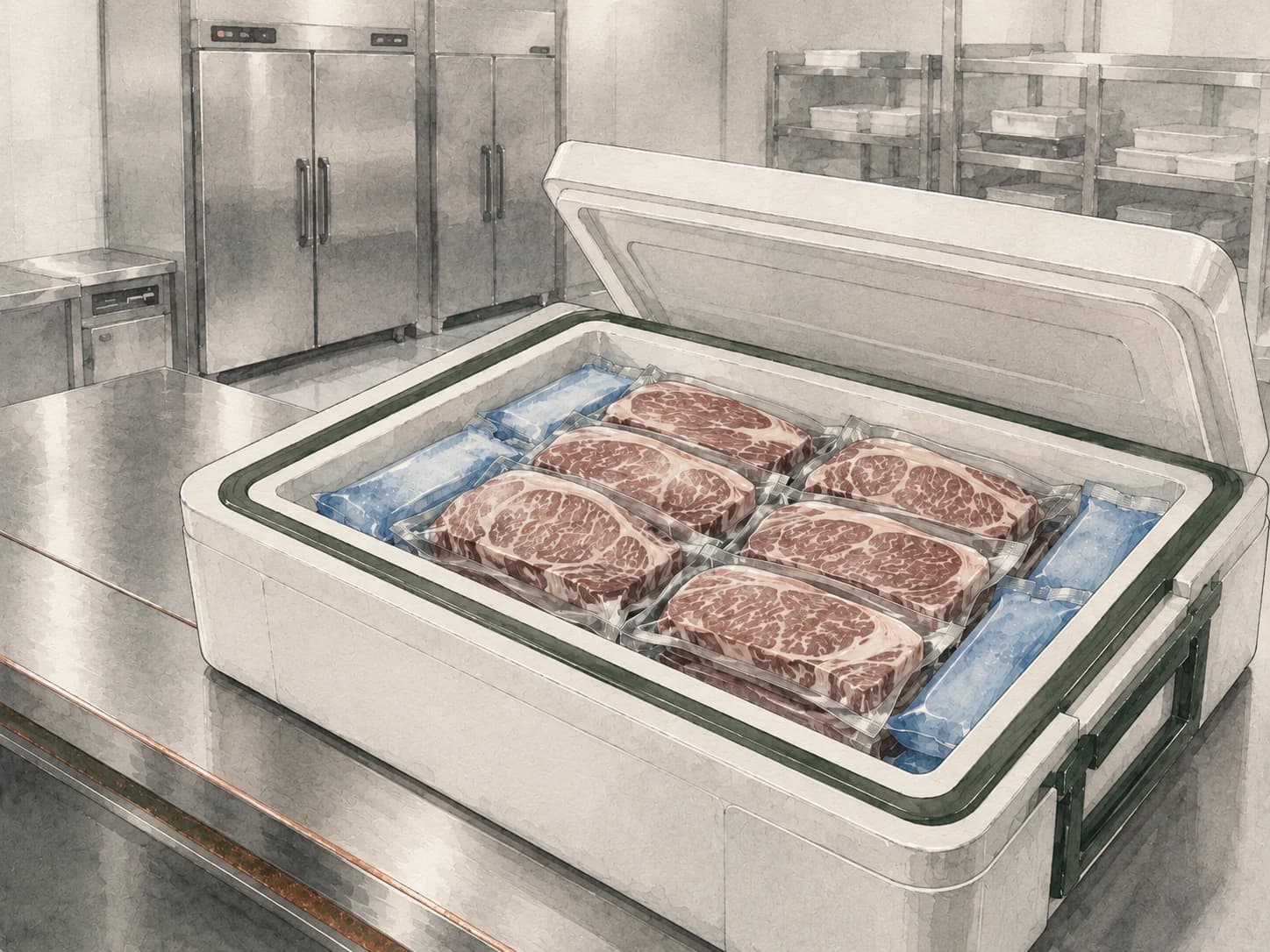
For B2B buyers, chilled versus frozen Japanese Wagyu is not simply a quality debate. It is an operational choice that affects freight method, remaining shelf life, inventory risk, customer promise, and landed cost. A fine-dining account may prefer chilled product for a tightly controlled menu, while a distributor or e-commerce operator may need frozen inventory to support stable replenishment.
Both formats can work commercially when the cold chain is designed around the product. The mistake is treating chilled as automatically better or frozen as automatically lower grade. Japanese Wagyu can be sourced in either format, and the right choice depends on how the buyer will store, sell, portion, and replenish the meat.
Buyer takeaway: Choose chilled when freshness positioning and rapid sell-through justify the air-freight premium; choose frozen when shelf-life control, multi-channel distribution, or retail inventory stability matters more.
What Chilled and Frozen Mean in Export Practice
Chilled Japanese Wagyu is normally handled under refrigerated conditions, commonly around 0-4 C, from processing through export and receipt. It is often shipped by air because the shelf-life window is short and every day in transit reduces the buyer's remaining sales window.
Frozen Japanese Wagyu is held at -18 C or below and can be shipped by air or sea, depending on the order size, destination, and commercial timeline. Frozen product is more flexible for stockholding because vacuum-packed beef can maintain quality for a much longer period when temperature is stable.
Decision factor | Chilled | Frozen |
|---|---|---|
Temperature target | 0-4 C refrigerated | -18 C or below |
Typical freight | Air freight | Air or sea freight |
Commercial strength | Freshness positioning | Inventory stability |
Main risk | Short remaining shelf life | Temperature fluctuation or poor thawing |
Best fit | Fine dining, high-end foodservice | Distribution, retail, e-commerce, sliced packs |
Shelf Life Is a Commercial Constraint, Not Just a Food Safety Detail
A chilled shipment can be attractive, but it requires a buyer who can forecast demand, clear customs quickly, and move product into paying accounts without delay. If a buyer receives chilled Wagyu and then spends two weeks finding customers, the program has already lost much of its value.
Frozen Wagyu gives importers more time to build demand, allocate inventory, and support repeat orders. This is why frozen formats are common for retail, e-commerce, shabu-shabu packs, yakiniku packs, and distributor programs that need many small accounts rather than a few immediate restaurant deliveries.
Quality Considerations: Does Freezing Damage Wagyu?
Freezing can affect texture if the process is slow, if packaging is poor, or if the product experiences repeated temperature fluctuation. That matters because Japanese Wagyu has a high level of intramuscular fat, and the eating experience depends on clean fat texture and careful handling.
In a properly managed commercial frozen program, however, the quality difference can be commercially acceptable for many channels. The key is not the word frozen; it is whether the product was vacuum packed, frozen quickly, stored below -18 C, and thawed slowly under refrigeration before use.
Cost and Channel Fit
Chilled Wagyu usually carries a higher logistics burden because air freight and tight timing are part of the model. That can be justified when a buyer sells to premium restaurants that require chilled product and accept the associated price.
Frozen Wagyu usually gives the buyer more options. It can support sea freight for larger orders, longer warehouse holding, retail-ready packs, and e-commerce cold-chain delivery. For many first-time importers, frozen is the lower-risk starting point because it reduces pressure to sell every kilogram immediately.
- Use chilled for accounts with confirmed demand and rapid menu placement.
- Use frozen for multi-account distribution, retail, e-commerce, and sliced-pack programs.
- Avoid mixed promises, such as selling frozen product as if it were never-frozen.
- Confirm remaining shelf life from the processing date, not just the arrival date.
Buyer Checklist Before Choosing a Format
Before placing an order, buyers should confirm storage temperature, packaging type, processing date, expected transit time, destination inspection flow, and sell-through plan. The best format is the one that matches the buyer's infrastructure and customer promise.
- Can your cold room reliably hold the required temperature?
- Will customs and veterinary inspection reduce the usable shelf-life window?
- Do your customers explicitly require chilled, or do they mainly require authenticity and grade?
- Will the program sell as primals, portioned steaks, or sliced packs?
- Do you need temperature logger data for shipment verification?
FAQ for B2B Buyers
Is chilled Japanese Wagyu always better than frozen?
No. Chilled can be valuable for freshness positioning, but frozen is often better for inventory control and broader distribution. The right answer depends on channel, lead time, and handling discipline.
Can frozen Wagyu be used in premium foodservice?
Yes, if it is handled correctly and thawed slowly under refrigeration. Many premium buyers use frozen Wagyu when the supply chain is long or demand is spread across many accounts.
Should a first-time importer start with chilled or frozen?
Frozen is usually the more forgiving first program. Chilled should be considered when there is confirmed demand, reliable customs flow, and short delivery distance after arrival.
Related Wagyu Guides
- Cold chain, shelf life, thawing, and handling
- Japanese Wagyu ordering formats
- Japanese Wagyu price drivers
- Building a distributor Wagyu program
- Japanese Wagyu export flow
Sources and Verification Points
Use these sources as starting points for document checks, trade planning, and supplier conversations. Current import rules, certification status, and pricing should always be confirmed before purchase.