
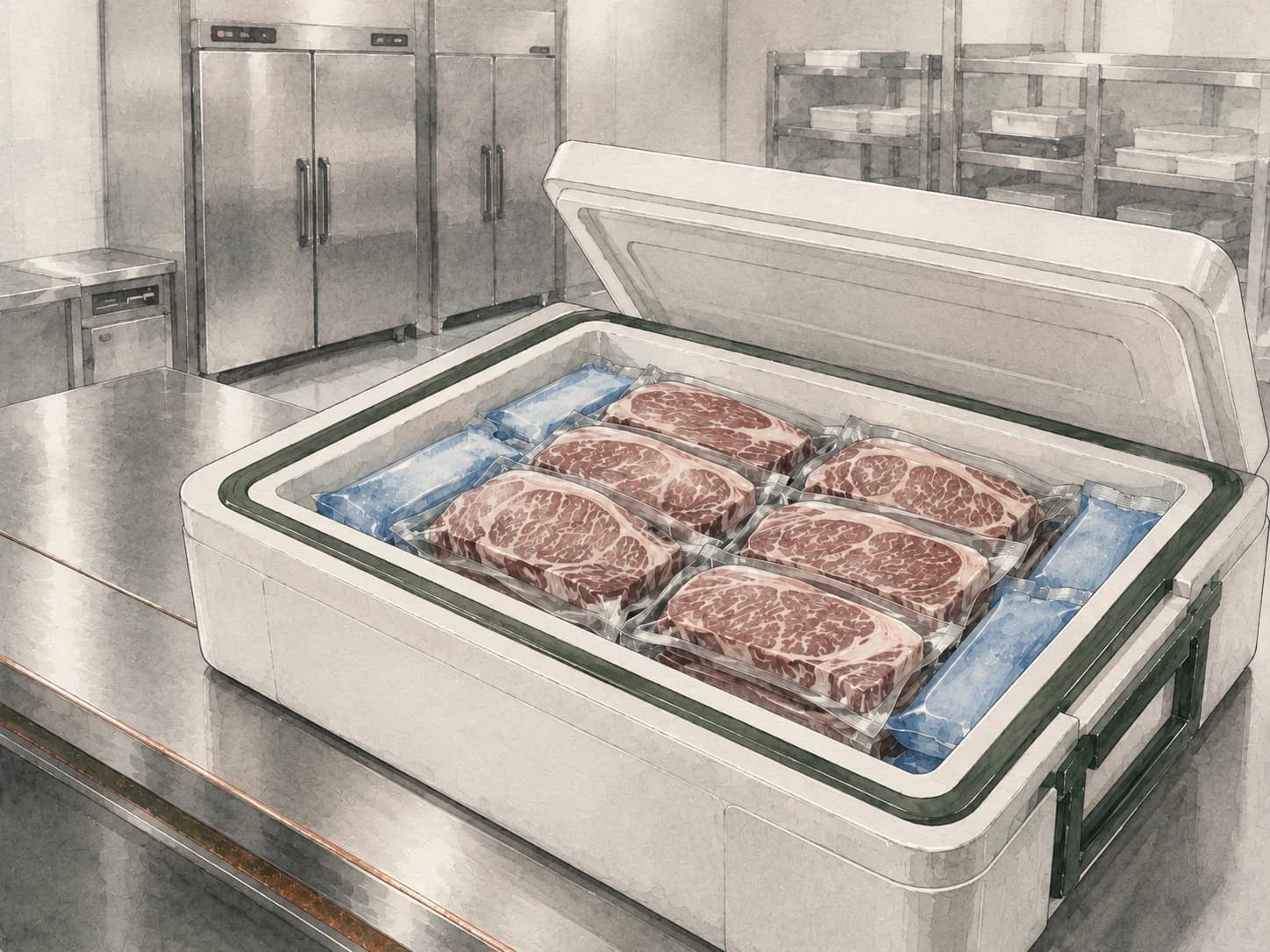
Most UAE peak-season shortfalls are not supply failures. They are commitment-deadline failures on two or three specific cuts. A hotel group books "400 kg of Wagyu" for a Ramadan banquet program, the striploin allocation cannot be filled chilled in time, and the kitchen receives frozen product four days before the first service. The purchasing manager is blamed for a decision that was actually made — or not made — eight weeks earlier.
This article is about timing: how far ahead each cut has to be committed for a UAE peak window, and which cuts should travel chilled by air versus be pre-positioned frozen. It does not cover paperwork alignment on a single purchase order — that is handled in our article on UAE Wagyu PO document consistency. Halal custody continuity, a compliance question in a different market, is covered in the Saudi per-cut halal custody article, and the mode comparison itself — air-chilled versus sea-frozen, cut by cut — is worked through for a steady-state reorder pattern in the Singapore air-chilled versus sea-frozen piece. What follows assumes you have already made those mode choices and asks a different question: on what date does each cut have to be locked?
Why total kilos is the wrong unit for a peak PO
Ordering by total volume feels efficient. It hides the only variable that matters during a peak: whether the specific cut your menu is built on can be allocated, graded, cut, and flown within the window you have left.
In our handling experience (an operating observation, not a measured study), loin cuts — striploin, ribeye, tenderloin — are the hardest to secure late in a peak window, because they are the cuts most export destinations ask for in the same weeks and only a limited quantity comes off each carcass. Shoulder, chuck roll, short plate and brisket behave very differently: they are easier to add or adjust close to the date, and they tolerate a frozen route without the menu suffering.
So a single PO line reading "Wagyu, 400 kg" collapses two completely different risk profiles into one number. When supply tightens, your supplier resolves that ambiguity for you — usually by substituting a cut or a form (frozen instead of chilled) that you never approved.
Fix your peak windows before you count backward
UAE demand does not peak evenly. For most hotel and restaurant groups in Dubai and Abu Dhabi, the recurring pressure points are the Ramadan iftar and suhoor program, the Eid banquet run immediately after it, the Q4 hotel and leisure season, and major exhibition weeks at venues such as DWTC that fill rooms and restaurants simultaneously.
Ramadan shifts earlier in the Gregorian calendar from year to year, so a calendar built once cannot be reused unchanged. Rather than relying on a rule of thumb, take the current-year and next-year dates from an official UAE source — the announcements published by the UAE government and the local moon-sighting committee — and rebuild the calendar annually. Treat the first date as provisional until confirmed locally, and give yourself a few days of margin at the front.
Write down, for each peak window, one thing: the first service date. Every deadline in the rest of this method is counted backward from it.
The Peak Commitment Calendar
The worksheet has one row per cut you actually use — not per supplier, not per PO. Six columns:
- Covers forecast for the window. Banquet seats plus à la carte covers across the full peak, not a daily average.
- Kilograms required. Covers multiplied by your own portion weight, plus your own trim and cooking loss allowance. Use your kitchen's figures, not a generic yield.
- Chilled shelf life remaining on arrival. Ask your supplier what remaining chilled life each cut will carry on the day it clears customs, and confirm it against the packing and transport method quoted. This number, not the total shelf life printed on the label, is what determines how early you can receive.
- Required mode. Chilled by air, or frozen. Decide per cut, not per order.
- Latest PO lock date. The date after which the supplier can no longer guarantee that cut in that form for that window.
- Approved fallback cut and price delta. Decided now, in writing, by the chef and the buyer together — not by whoever answers the phone on the day.
Filling this in gives you one date per cut and one explicit frozen-buffer volume you commit to in advance.
How to compute the lock date for each cut
Do not accept a single blanket lead time. Build the number yourself, per cut, by asking your supplier for each interval and adding them:
- Allocation and confirmation time on the Japanese side for that specific cut and grade during the export months covering your window.
- Cutting, packing and documentation time after allocation is confirmed.
- Door-to-door transit to DXB or AUH for the mode you chose — ask the freight forwarder for the current figure for the exact routing, and ask separately what it becomes in the weeks when air capacity into Dubai is tightest.
- Customs clearance and any inspection at import. Ask your customs broker for their observed range at peak, and use the slow end.
- Your own internal time: cold-store intake, quality check, portioning, and distribution to each property.
Add those intervals, then add a buffer you are willing to defend in a meeting. Subtract the total from the first service date. That is the lock date for that cut. Do it separately for chilled and for frozen, because the two will not be close to each other, and the chilled deadline is always the binding one.
For frozen pre-positioning, the deadline is set by a different constraint: not the flight, but the pallet space in your cold store. Work backward from the date the store is full with other peak inventory, and place the frozen buffer before that date.
Splitting the order: what to lock early, what to keep flexible
Once the rows are filled, the split usually organizes itself.
Lock earliest, chilled by air: the loin cuts that carry your signature dishes and your banquet centerpiece. These are the rows where late equals no. Commit the full window volume, not a first tranche, and accept that you are buying certainty rather than flexibility.
Commit a frozen buffer in advance: a defined kilogram figure, per cut, that sits in your cold store before the window opens. Its purpose is to absorb a partial chilled shortfall without a menu change. If it is never touched, it rolls into normal trading after the peak, which is exactly why it should be a cut that moves in your regular business.
Keep flexible: shoulder, chuck roll, short plate, brisket and similar cuts used in braises, curries, sliders and staff-facing items. These absorb late covers and late changes, and they let you scale a banquet up without touching the loin allocation.
Turning the calendar into a quote request
The calendar is only useful if it becomes a commitment on both sides. Once you have per-cut kilograms, a required form, and a lock date for each row, ask whether those exact quantities can be held for those exact dates — cut by cut, with the chilled and frozen portions separated, and with the approved fallback priced alongside.
That is a materially different request from "what is your price for Wagyu striploin." It gives your supplier the information needed to reserve allocation instead of quoting a spot number, and it gives you a written answer you can take to your F&B director before the window opens.
If you would like your peak window quoted this way, send us your per-cut volumes and dates for a wholesale quote. Bring the worksheet filled in as far as you can; the rows you cannot complete are the ones worth discussing first.