
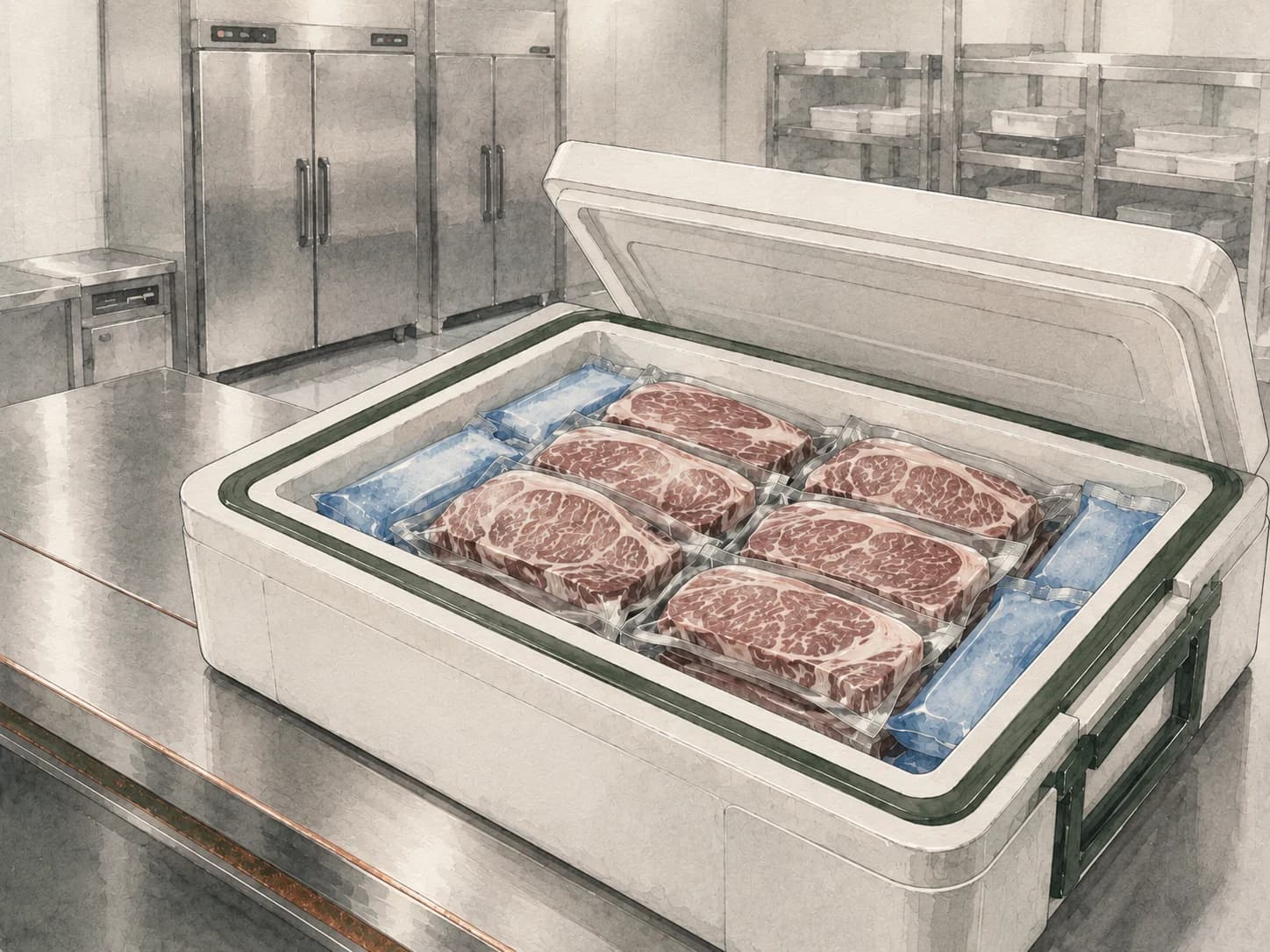
Your landed cost per portion of Japanese Wagyu moves between shipments, and you have probably blamed the yen, the grade, or the freight forwarder. More often the cause is simpler: every cut on the purchase order travels the same way, because the shipping mode was decided once for the whole order and never revisited per cut.
This article is about that choice — chilled by air versus frozen by sea, decided cut by cut for Singapore, and expressed as one number you can defend to a GM: landed cost per portion. It is the decision that comes before shelf-life management. If you have already committed to the chilled air channel and want to count remaining days on arrival, we have separate pieces for that: counting shelf-life days on chilled Wagyu arrivals in Hong Kong and the day-loss ledger for chilled Wagyu in Taiwan. If your issue is that the paperwork on the PO does not match the carton, that is covered in PO document consistency for Wagyu into the UAE. Here we assume nothing about the channel and put both modes side by side.
The assumption worth breaking: one order, one mode
Most Singapore buyers we deal with order Wagyu the way they order everything else — one PO, one shipping mode, one arrival. Chilled air if the group is premium and menu-led; frozen sea if procurement is under pressure on food cost. The whole basket moves together.
But a ribeye and a short plate are not the same product economically. The ribeye is a center cut sold at a high portion price, turning over in days on a busy grill menu. The short plate is an input — sliced for shabu-shabu, ground into a patty program, or trimmed for a bowl item — sold at a lower portion price and consumed unevenly across the month. Freight per kilogram is roughly the same for both when they sit in the same air-cargo carton. The revenue each kilogram carries is not.
That mismatch is where money leaks. Air freight per kg is a fixed charge that lands hardest on the cut with the lowest selling price per kg. Meanwhile, the cut with the highest selling price per kg — the one that could easily absorb the air premium — is often padded out with frozen stock because someone tried to economize on the whole shipment.
What each mode actually costs you
Four cost lines separate the two modes. Only the first is normally on the invoice.
1. Freight per kilogram
Chilled air freight is charged per kg on chargeable weight and is a large multiple of sea freight per kg on a full or consolidated reefer container. We are not publishing a rate here on purpose: air rates for the Japan–Singapore lane move with fuel, capacity, and season, and any number printed today would mislead you next quarter. Use your own forwarder's current quotation, and note the month you obtained it. If you do not have both quotations side by side for the same lane, that is the first thing to request.
2. Shelf life and the write-off it forces
Chilled vacuum-packed beef arrives with a finite remaining life, and that life is consumed by transit, customs clearance, and your own distribution to outlets. Frozen product effectively removes this constraint for the planning horizon you care about. The cost difference is not theoretical: any chilled portion not sold before the use-by date is a full write-off at landed cost, not at cost of goods.
The honest way to handle this is to measure it yourself rather than accept an industry figure. Take the last six months of chilled Wagyu receipts, per cut, and compute the kilograms discarded, discounted, or diverted to a lower-value menu item as a share of kilograms received. That percentage is the input the worksheet needs. In our own handling experience the spread between fast center cuts and slow processing cuts on this line is wide enough to change the mode decision on its own — but your kitchens' number is the one that matters, not ours.
3. Re-order lag and buffer stock
Air freight has almost no re-order lag: if a cut runs short mid-month you can be topped up within days. Sea freight cannot do this. A frozen sea shipment has a door-to-door cycle measured in weeks — booking, sailing, arrival, clearance, and release — so the practical consequence is that every sea-freight cut requires buffer stock in your freezer, and that buffer has a carrying cost: freezer space, capital tied up, and the risk of a menu change stranding it.
Ask your forwarder for the current door-to-door figure on your lane including clearance, and treat it as an input, not a constant. Then convert it: weeks of lag × monthly kg ÷ 4 = the buffer kilograms you must hold per cut.
4. The regulatory floor, which does not change with mode
Both modes face the same Singapore import conditions. Meat and seafood may only be imported from establishments accredited by the Singapore Food Agency, by a licensed importer, with the required veterinary health certificate and permit. The requirements and the approved-establishment list are published by SFA at sfa.gov.sg; conditions are updated from time to time, so verify the current text and the establishment list with SFA before you place an order. Background on Japanese beef export policy and market conditions is published by MAFF at maff.go.jp and by JETRO at jetro.go.jp.
The point for this article is narrow: the paperwork burden is not a reason to prefer one mode. Choose on cost per portion.
The Cut-by-Cut Mode Split Worksheet
One page, one row per cut. Build it in a spreadsheet; it takes about an hour once you have the freight quotations.
Inputs you enter per cut
- A. Monthly kilograms used — actual consumption, averaged over the last three months, not the order quantity.
- B. Average portion weight in kg — the plated or packed weight after trimming.
- C. Product cost per kg, FOB or ex-works — identical under both modes for the same cut and grade.
- D. Chilled air freight per kg — from your forwarder, plus handling, this month.
- E. Frozen sea freight per kg — same basis, allocated from the container rate over the kilograms you actually ship.
- F. Duty, clearance and inland per kg — enter separately for each mode if they differ.
- G. Loss rate, chilled — write-off plus markdown plus trim, as a decimal, from your own receipts.
- H. Loss rate, frozen — same measure, usually lower on the wastage side, sometimes higher on drip loss after thawing. Measure it.
- I. Weeks of sea lead time — door to door, including clearance.
- J. Freezer carrying cost per kg per month — your storage rate, or an internal allocation if you own the freezer.
Outputs the worksheet computes
Landed cost per portion, chilled air = (C + D + Fair) ÷ (1 − G) × B
Landed cost per portion, frozen sea = [(C + E + Fsea) ÷ (1 − H) × B] + buffer carrying cost per portion
where buffer carrying cost per portion = J × (I ÷ 4) × B, using the fact that you hold roughly I ÷ 4 months of stock as buffer.
Dividing by (1 − loss rate) is the step most buyers skip. It is what converts a write-off percentage into money on the plate: if you throw away one kilogram in twenty, every kilogram you actually serve carries the cost of the one you did not.
Reading the result
Subtract one from the other. A cut where frozen sea comes out cheaper per portion belongs in the container. A cut where chilled air comes out cheaper — or comes out marginally more expensive but protects a menu item you cannot serve from frozen — belongs on the plane. Two things drive the answer:
- Portion price. The freight premium per portion is fixed in dollars; it is a small share of a high-priced center-cut portion and a large share of a low-priced processing-cut portion.
- Turn speed. Fast turn means the chilled loss rate G stays low and the shelf-life constraint never binds. Slow turn pushes G up until air freight is paying to import product you will later discard.
The break-even volume line
The question "at what monthly volume does the answer flip?" has a specific mechanism behind it. Sea freight per kg falls as you fill more of the container, and the buffer stock you must hold is proportional to monthly usage — so at low monthly volume per cut, sea freight is expensive per kg (you are paying LCL or under-filling) and the buffer is a large share of your inventory. At high volume, sea freight per kg drops and the buffer becomes a routine, well-turned layer of stock.
To find the line for a given cut, re-run the frozen-sea formula at several monthly volumes using the sea rate your forwarder quotes at each volume band. Plot the two costs per portion against monthly kg. The crossing point is your break-even. Do this once per cut per year, or whenever your forwarder re-rates the lane.
A worked example, four cuts
The following uses illustrative structure only — the numbers are placeholders for yours, not observed market rates. What matters is the shape of the answer.
Take a mid-size Singapore hotel group buying four cuts in 20–50 kg lots per cut per month:
- Ribeye — high monthly kg, high portion price, turns in days. Chilled loss rate low. Chilled air almost always wins on portion economics, and the menu depends on the chilled texture. Air.
- Striploin — similar profile, slightly slower turn. Usually air, but check the loss rate: if outlets are cutting steaks unevenly and trim is high, the gap narrows fast. Air, verify G.
- Chuck roll — moderate volume, lower portion price, used across braises, sukiyaki and set menus with uneven weekly pull. The freight premium per portion is large relative to the menu price. Sea.
- Short plate — the clearest case. Low portion price, processed rather than plated, frozen handling is standard in the kitchen anyway. Buffer stock is easy to hold because the item is on the menu year-round. Sea.
The pattern generalizes: the split follows portion price and turn speed, not grade. An A5 short plate does not become an air-freight cut because it is A5.
What changes when you split the order
Three practical consequences, worth planning before the first split PO.
Two arrival calendars. The air cuts arrive weekly or fortnightly; the sea cuts arrive on a multi-week cycle. Your ordering discipline has to handle both, which usually means the sea cuts move to a standing schedule while the air cuts stay demand-driven.
Freezer capacity becomes a constraint. Confirm you have the space for the buffer before you commit — a sea-freight decision that forces emergency third-party cold storage can wipe out the freight saving.
Documentation stays per consignment. A split order is two consignments with two sets of certificates and permits, even if it is one PO and one price agreement. Make sure the cut descriptions, establishment numbers and weights on each set match what actually ships in that consignment; that is where split orders go wrong, and the linked UAE article walks through the checks.
Get the real numbers into the worksheet
Once the worksheet is built, the only soft cells left are the ones we can fill: per-cut prices and current lead times under both modes. We can quote split-mode on a single order — chilled air for the center cuts, frozen sea for the rest — so the break-even line stops being an estimate and becomes a decision.
Send your cut list and monthly kilograms per cut, and we will return per-cut wholesale pricing under both chilled air and frozen sea, with current lead times and MOQ per mode for the Singapore lane.