
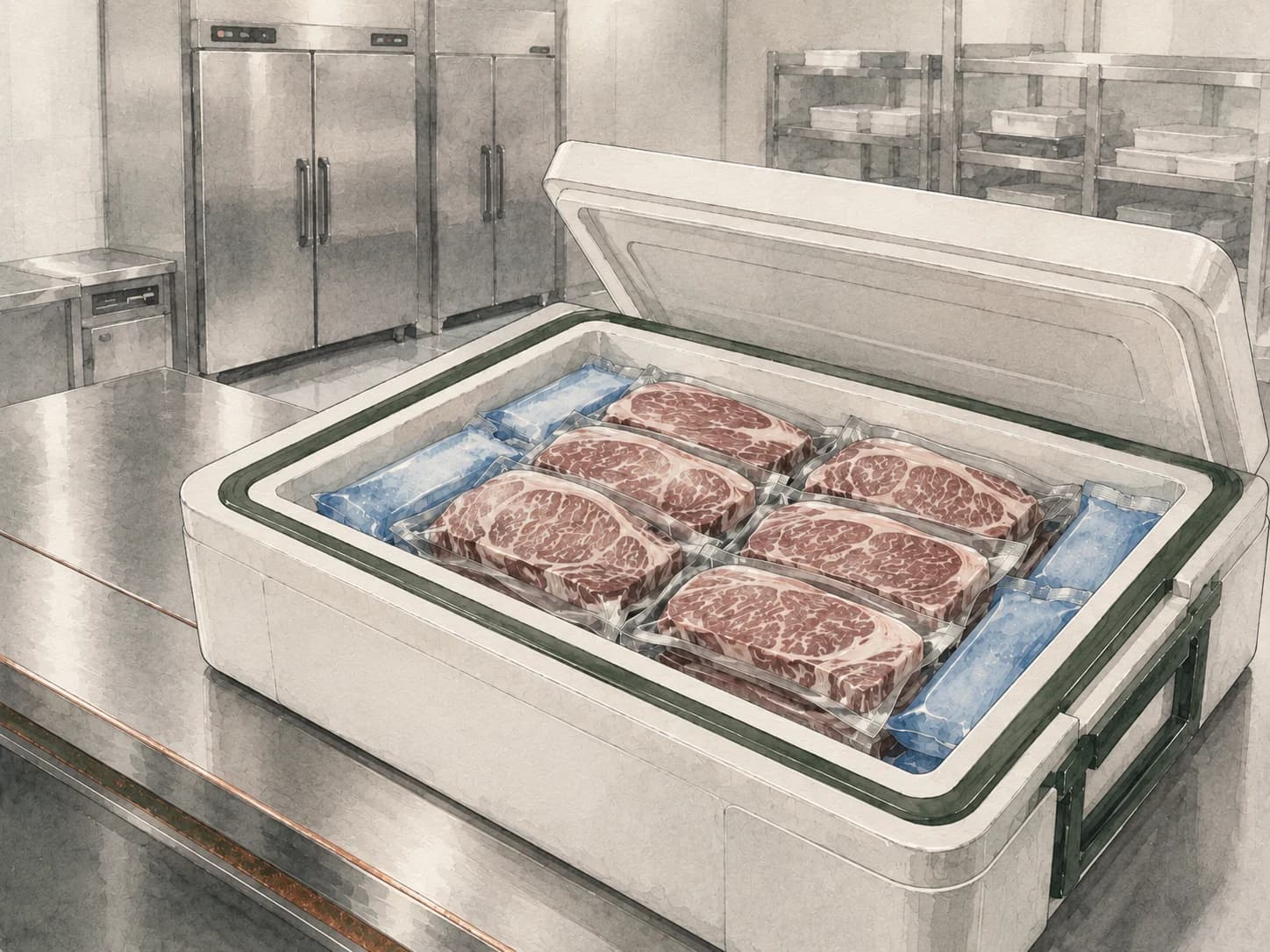
If you buy Japanese Wagyu by the cut and air-freight it chilled into Taipei, the frustrating part is rarely the average. It is the variance: one ribeye lot gives your banquet kitchen a comfortable window, the next arrives with three or four fewer workable days, discolors on the surface before it is portioned, and turns into trim weight you paid air freight for.
This article is about where those days are going inside steps you control — cut selection, pack format and lot size, departure day relative to Taiwan clearance rhythm, and whether anyone records a temperature before the meat reaches your own cold room. It is Taiwan-specific: longer inland runs to Taichung and Kaohsiung, hotel and banquet buyers with mixed-cut POs, and clearance behavior around weekends and national holidays all change the answer. If what you need is the arithmetic of counting remaining shelf-life days on the short, high-frequency Hong Kong lane, that is covered separately in our Hong Kong chilled Wagyu day-count article. If your issue is that the PO and the shipping paperwork disagree with each other, see PO and document consistency for UAE Wagyu shipments. Grading, marbling and health-certificate content is not repeated here — you already know it, and it is not what is costing you days.
The claim: the flight is not the main variable
Flight time from Japan to Taiwan is short and does not vary much. What varies is everything wrapped around it. In our own handling experience — this is operational observation, not measured data — the difference between a chilled lot that performs and one that does not usually traces back to four decisions that are already visible on the purchase order before anything is packed:
- Which cuts travel chilled and which travel frozen. A mixed-cut chilled PO is effectively priced and planned at the pace of its shortest-lived cut.
- Pack format and lot size per cut. A 40 kg line broken into fewer, larger vacuum packs behaves differently in your kitchen flow than the same weight in sub-lots sized to one portioning session.
- Departure day relative to Taiwan clearance and the holiday calendar. A lot that lands into a quiet window is not the same product as a lot that sits waiting for offices to reopen.
- Where temperature is first recorded. If your first reading is taken in your own cold room, every hour before that is unmeasured and therefore unarguable.
Only the first two are decided at PO time with the supplier. The third is partly yours and partly your forwarder's. The fourth costs almost nothing and is the one most often skipped.
Why fatty primals set the pace
Ribeye and chuck roll carry more exposed fat surface than striploin or short plate, and surface fat is where oxidation and color change show first. A chef rejecting a loin is usually rejecting an appearance, not a safety condition — but a rejected loin is a lost loin either way. Practically, this means the fatty primals in a mixed chilled shipment are the constraint. If your ribeye needs to be portioned within a tight window and your short plate does not, sending both chilled on the same terms means you are paying chilled economics on cuts that did not need it, and running the chilled clock too close on the ones that did.
We are not going to publish per-cut usable-day numbers for the Japan–Taiwan lane, because the honest answer is that they depend on your handling, your inland leg and your clearance experience, and any single figure would be guesswork dressed as data. The point of the next section is that you can measure your own.
The Taiwan chilled day-loss ledger
This is a one-page worksheet. Go back to your last three POs and fill one row per cut line. Do not estimate; use the label, the broker's timestamps and your kitchen's own records.
Columns to log, per cut line
- Cut and lot weight — as written on the PO line, not as a shipment total.
- Pack date / kill date from the label — record exactly what is printed, including the format. If your receiving staff cannot read the convention with confidence, note that too; it is a fixable supplier-side problem.
- Departure flight day — the actual departure, not the booked one.
- TPE arrival timestamp and clearance release timestamp — two separate fields. The gap between them is the number you are looking for.
- Temperature at first receipt — measured where you or your agent first physically take custody. Note the location.
- Inland arrival — at your cold room in Taipei, Taichung or Kaohsiung.
- Date actually portioned — the day the cut was broken down for service or resale, not the day it was allocated.
- Trim and discard weight — kilograms removed for discoloration, purge or spec mismatch, and the reason.
The two numbers you calculate
Usable days on hand = (date actually portioned) − (clearance release date). This is the window your operation really had, as opposed to the window implied by the pack date.
Discard rate = trim and discard weight ÷ lot weight, expressed as a percentage, per cut. Track it per cut, never as a shipment average — the average hides exactly the cut that is hurting you.
Then add up the gaps: pack date to departure, departure to arrival, arrival to clearance release, release to inland arrival, inland arrival to portioning. Across three POs, one of these gaps will be consistently larger than you assumed. That is the gap worth attacking, and in our experience it is more often the release-to-portioning stretch than anything in the air.
The decision rule
Once the ledger is filled, apply a rule rather than a judgment call:
- If usable days on hand is below your normal portioning cycle for that cut — move it to frozen on the next PO, or keep it chilled but cut the lot into sub-lots sized to a single portioning session.
- If there are slack days — keep it chilled, and consider whether a larger chilled lot on that line improves your landed cost per kilogram.
- If discard rate is above what your margin tolerates on a specific cut — that cut is a frozen candidate regardless of how the days look, because the loss is being driven by handling exposure, not by the calendar.
Splitting a PO this way normally recovers more usable days than any routing change a forwarder can offer, because it removes the mismatch between the cut's tolerance and your kitchen's pace instead of shaving hours off transit.
What you must verify locally, and when
Clearance handling for chilled consignments of animal origin, inspection and sampling practice, and the effect of weekends and national holidays are all things that change, and we will not state current timings as fact here. Ask your own customs broker three questions in writing, and re-ask them whenever your routing or your broker changes:
- What is our realistic release window for a chilled animal-origin consignment arriving on a weekday, and how does that shift for a Saturday, Sunday or national holiday arrival?
- How often have our consignments been held for inspection or sampling in the past twelve months, and for how long?
- Where is the consignment physically held between arrival and release, and at what temperature?
Confirm any procedural change with the Taiwanese authorities or your broker at the time you read this; do not plan a chilled program on a timing you were told two years ago. Re-run the ledger at least every six months, and immediately after any change in inspection procedure or forwarder routing.
Turning the ledger into a PO
The output of the worksheet is a short list, one line per cut: cut — chilled or frozen — lot size — target portioning window. That list is precisely what a Japanese supplier needs in order to plan packing, because the chilled/frozen split has to be decided before the cut is packed, not after it lands. A supplier quoting against a generic "mixed-cut chilled" request has no way to size sub-lots to your portioning cycle or to sequence the fatty primals differently from the lean ones.
So the conversation belongs at quote stage. Send us your cut-level line list and ask for a per-cut price and a packing plan built around your portioning window, rather than a single blended chilled price for the whole shipment.
Next step: request a cut-level wholesale quote with your chilled/frozen split and target lot sizes attached. If you are unsure how one specific cut will behave in your own kitchen flow before committing the mix, a small chilled trial lot of that cut is a reasonable first move — but the quote request is where the day-loss problem actually gets solved.