
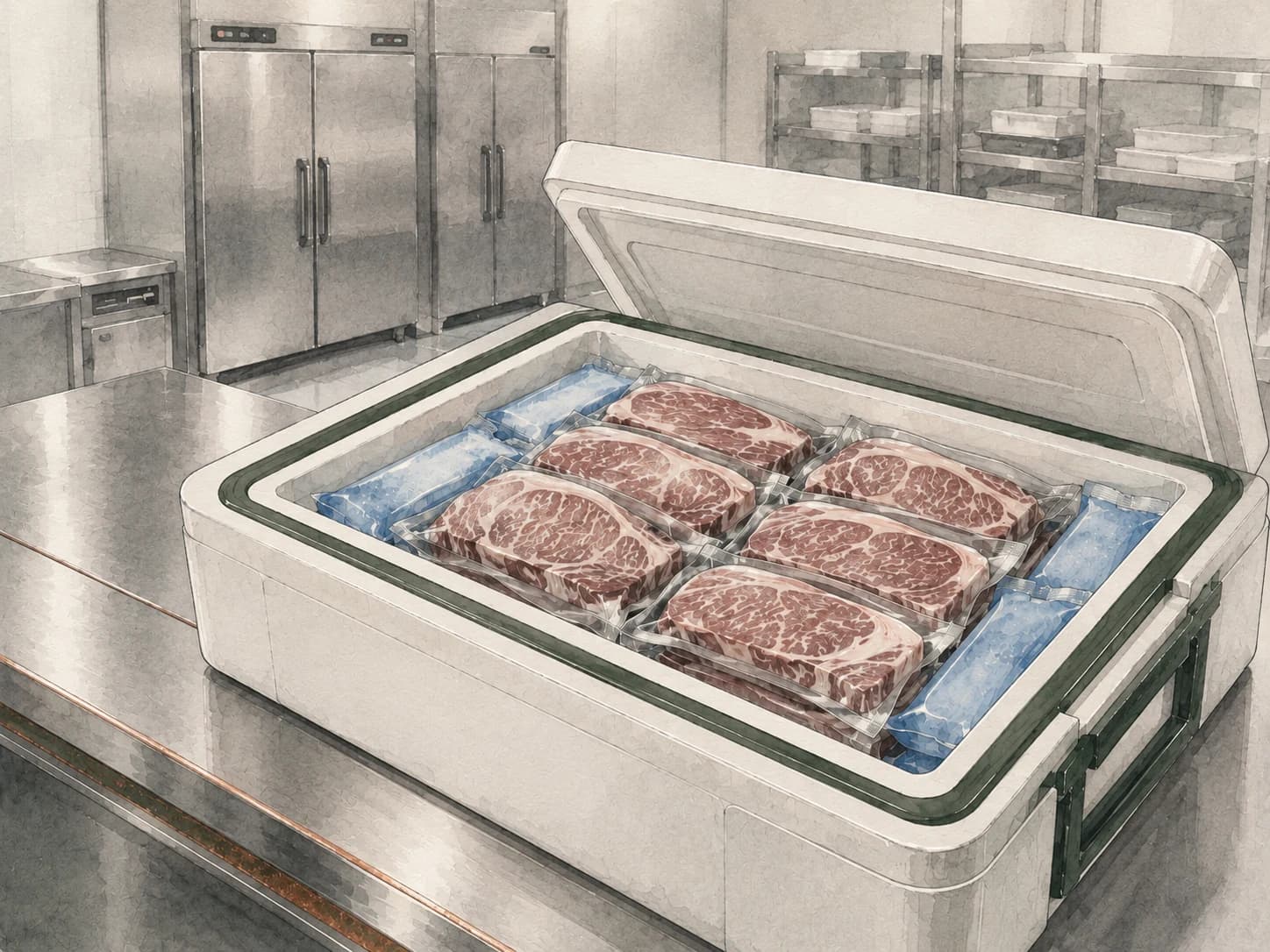
Most Wagyu stockouts in Macau are not supply failures. They are timing failures: a ribeye promised to a banquet is unavailable for two or three weeks because the reorder was released against last week's consumption rather than against the real replenishment lead time for that cut in that temperature state. This article is about replenishment timing over a rolling season — how far ahead each cut must be re-released, and how much safety stock keeps a cut from swinging between banquet shortage and frozen dead stock.
Two neighboring articles cover decisions that sit next to this one but do not answer it. The Macau PO field-lock sheet governs what is written on a single purchase order, and direct shipment versus Hong Kong transit governs the routing and consignee decision for one shipment. If your question is Hong Kong rather than Macau, read the Hong Kong cut-mix reorder cadence article instead — clearance handling, consignee structure and outlet density differ enough that the day counts do not transfer.
Scroll sideways to see the whole diagram
Why a single blanket cadence fails in Macau
Many procurement teams run one order rhythm for all Wagyu: a weekly order, sized from last week's usage. That works only when every item shares one lead time. Wagyu does not.
- Temperature state splits the lead time. A chilled cut moving by air and a frozen cut moving by sea are not the same item on a replenishment calendar, even when the cut name is identical.
- Routing splits it again. A direct consignment to Macau and one transiting Hong Kong accumulate different handling and document steps, and the difference is measured in days, not hours.
- Demand visibility is longer than the order rhythm. Integrated-resort banquet volumes are generally confirmed well before the event date, while reorders are placed weekly. Ordering against last week's draw throws away forward information you already hold.
- Cut mix is not demand-neutral. Loin items move with cover counts; secondary cuts move with menu decisions made at a different pace. One cadence applied to both produces shortage on one side and freezer accumulation on the other.
The fix is not ordering more. It is ordering each cut on its own clock.
The Macau per-cut reorder-point ledger
Build one row per cut and temperature state — chilled ribeye and frozen ribeye are two rows. Columns:
| Column | What goes in it | Who supplies the number |
|---|---|---|
| Cut and temperature state | e.g. ribeye / chilled; chuck roll / frozen | Buyer |
| Supplier processing days | Days from order confirmation to the cut being packed to your spec | Supplier |
| Consolidation cut-off day | The weekday after which an order rolls to the next departure | Supplier / forwarder |
| Transport leg days | Separate entries for chilled air direct, frozen sea, and Hong Kong transit | Forwarder |
| Macau clearance and document days | Import handling including health-certificate and inspection steps | Your broker |
| Outlet holding days | Days between warehouse receipt and the cut being usable at the outlet | Buyer |
| Total lead time (days) | Sum of the above | Calculated |
| Weekly consumption (kg) | Rolling average over a period you choose | Buyer |
| Demand variability band (kg) | Spread between a normal week and a heavy week | Buyer |
| Reorder point (kg) | Stock level that triggers release | Calculated |
| Latest safe release date | Consumption date minus total lead time | Calculated |
| Cut-off / holiday flag | Fires when the release date lands in a Japanese holiday or cut-off week | Calculated |
Scroll sideways to see the whole table
Every day count above is a buyer-supplied input. We deliberately do not print standard figures here: processing calendars, air and sea schedules, clearance handling and Japanese holiday cut-offs shift through the year, and a number copied from an article will be wrong at the moment it matters. Fill the ledger from your own brokers, forwarders and supplier confirmations, and re-verify at least twice a year.
The arithmetic
Work in kilograms and days, per row.
- Total lead time (L) = supplier processing + days lost to the consolidation cut-off + transport leg + Macau clearance and documents + outlet holding.
- Daily consumption (D) = weekly consumption ÷ 7.
- Lead-time demand = D × L. This is what you will draw down while the replenishment is in motion.
- Safety days (S) = a buffer you choose per cut. Size it from the variability band: a cut whose heavy week runs far above its normal week needs more safety days than a steady one. Items on the longer frozen sea leg usually warrant more safety days than short-leg chilled items, because an error has longer to compound.
- Reorder point = D × (L + S). When on-hand plus on-order for that row falls to this figure, release.
- Latest safe release date = required consumption date − L. Anything later is an expedite, not a reorder.
A worked illustration, with invented inputs purely to show the mechanics: if a chilled cut has L = 14 days, weekly consumption of 42 kg (D = 6 kg/day) and you set S = 4 days, the reorder point is 6 × 18 = 108 kg. Substitute your own measured values; the figures here carry no claim about actual lead times.
The banquet overlay
Reorder points assume demand is a flowing average. Banquets are not — they are known, dated blocks. Add an overlay row beneath each cut:
- List confirmed event volumes for that cut with their service dates.
- Deduct those volumes from available stock before testing the reorder point. Stock earmarked for a confirmed banquet is not available cover for the à la carte outlets.
- For each event, check the service date against the latest safe release date. If today is past it, the event needs a separate order line now, not inclusion in the next weekly cycle.
This single step removes most emergency substitutions, because it converts forward booking information — which your banquet team already holds — into a procurement trigger.
The cut-off and holiday flag
The flag column is what prevents the recurring failure mode. A reorder point can be perfectly calculated and still miss, if the release date lands in a week with no departure or a closed processing calendar. Maintain a simple forward calendar of supplier cut-off days, Japanese holiday periods and any Macau handling closures, and flag any row whose latest safe release date falls inside one. Flagged rows are pulled forward, not expedited later. Confirm the current calendar with your supplier and forwarder each season rather than assuming last year's pattern holds.
Dead stock is the same calculation, inverted
Frozen accumulation on secondary cuts is usually the mirror image of the stockout: a safety buffer sized for banquet-peaked loin demand, applied to a cut whose demand is flat. Review each row's actual draw against the safety days you assigned. Where a row has never approached its reorder point in a full quarter, the buffer — not the cut — is the problem. Reducing safety days on stable rows funds the extra buffer that volatile rows need, which is how the ledger improves service without raising total inventory.
Reviewing the ledger
Treat the ledger as a living document. Re-verify day counts at least twice a year, and immediately after any change in Macau import documentation handling, Hong Kong transit practice, or your own routing decision between direct and transit consignments. Changes to import rules should be confirmed with the Macau authorities and your broker directly; do not carry forward a day count whose basis you can no longer name.
Getting the inputs you cannot generate internally
Three columns in the ledger can only come from the supply side: per-cut processing days, consolidation cut-off days, and minimum order quantities by cut and temperature state. Without those, the reorder point is a guess with decimal places. Minimum order quantities matter as much as the days — a reorder point of 40 kg against an MOQ of 100 kg is not a reorder point, it is a different ordering policy.
First Agri can review your actual cut mix and provide indicative wholesale pricing together with the per-cut lead-time and MOQ information needed to complete the ledger. Lead times, order quantities and shipping terms are confirmed per inquiry rather than quoted as standard figures. Discuss your requirements.