
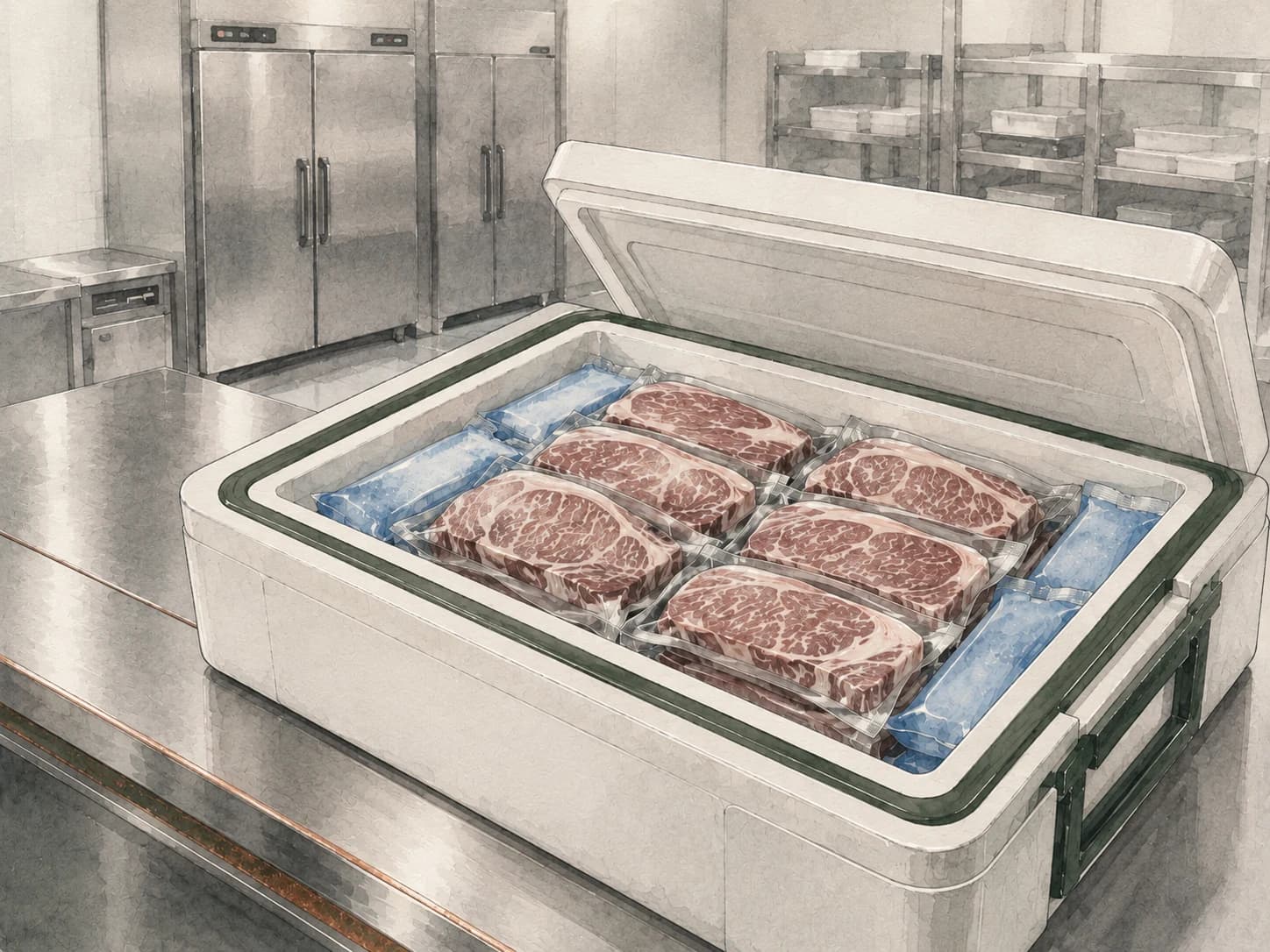
Your ribeye and striploin are gone by week two. The chuck roll, short plate, rump and tenderloin tails are still in the chiller when the usable days run out, so they get frozen down or discounted — and meanwhile you are paying for an emergency air-freight top-up of the cuts that sold. This is a recurring pattern in Hong Kong Wagyu programs, and it is usually not a demand problem. It is a cut-mix and cadence problem.
This article covers the multi-cut question: what ratio of premium to secondary cuts to order, and how often, so that the whole basket clears before its chilled window closes. It does not re-derive how many usable days a single chilled shipment has — for that, see the Hong Kong chilled Wagyu shelf-life day count. If you are weighing transport modes rather than mix, air-chilled versus sea-frozen per cut (Singapore) and the Taiwan clearance day-loss ledger handle those. Here the unit of analysis is the order as a basket across a carcass, and the output is a repeatable interval, not a shelf-life number.
Why the freezer goes unbalanced
Three things collide in a Hong Kong chilled Wagyu order.
First, the carcass does not split the way your menu does. A Japanese supplier releasing Wagyu by the cut is working from real carcasses. Loin cuts are finite per animal; secondary cuts are not optional by-products the supplier can make disappear. If you buy premium-heavy every cycle, someone has to take the rest — and in a long-running account relationship, some of it comes to you, bundled into the same booking so that the shipment is worth flying.
Second, you size the order by the fastest-moving cut. The buyer's instinct is to order enough ribeye so it does not run out. But the box that arrives with "enough ribeye" carries a proportional volume of chuck roll and plate, and that volume is sized to ribeye demand, not to chuck roll demand. The slower cut then sits.
Third, the interval is irregular. Orders get placed when someone notices a shortage. An irregular interval means each order has to cover an unknown span, so it gets padded — which pushes more slow-moving weight into the same chilled window.
Every chilled cut has a finite number of usable days from arrival. If a cut's ordered kilograms exceed what you can sell inside those days, the outcome is already determined at the time of ordering. Freezing down is not a rescue; it is a repricing. Once a chilled A5 striploin becomes a frozen A5 striploin, the price you can realize on it changes, and that difference is the real cost of the mis-sized order.
The worksheet: HK Wagyu cut-mix and reorder cadence
The point of this worksheet is that it takes your numbers, not ours. We cannot publish a Hong Kong sell-through benchmark by cut, because the honest answer varies by whether you are a distributor moving to twenty accounts or a hotel group with two outlets and a banquet calendar. Leave the cells blank until you have measured them; a fabricated benchmark is worse than an empty cell.
Block A — per-cut ceiling
Build one row per cut you actually buy. A typical Hong Kong list: ribeye, striploin, tenderloin, chuck roll, short plate, rump, brisket.
- (a) Weekly sell-through, kg. Pull the last 8 to 12 weeks of actual issued or sold weight for that cut. Use the median week, not the best week. If you have a banquet-heavy or festival-heavy month in the sample, keep it but note it — you will handle peaks separately, not by permanently oversizing the base order.
- (b) Usable chilled days remaining on arrival. Count from the day the pallet is in your chiller to the last day you would put that cut in front of a guest or a customer as chilled product. This is a per-cut number: a whole primal in its original vacuum behaves differently from a cut you break down on arrival. Convert to weeks: usable weeks = usable days ÷ 7.
- (c) Price realized versus landed cost. Landed cost per kg for that cut, and what you actually got for it — including the portion you discounted or froze down. This column is what tells you which cut is quietly funding the others.
Then compute, per cut:
Max order kg = (a) weekly sell-through × (b) usable weeks
Any cut where your normal order quantity exceeds that ceiling is flagged: will freeze down. Not "might" — will. That is the whole diagnostic. Most buyers who run this find two or three flagged rows, and they are the same rows every cycle.
Block B — the binding cut and the interval
Now invert the question. Instead of asking how much you can absorb, ask what interval makes every row fit.
- For each cut, note its usable weeks from column (b). The cut with the shortest usable window relative to how fast it moves is your binding cut. In most Hong Kong lists we see, it is not the ribeye — it is a secondary cut with a short chilled life and a thin weekly draw.
- Reorder interval (days) = binding cut's usable days − your buffer. The buffer covers permit and clearance timing plus a safety margin you set yourself. Order every N days, on a fixed day of the week, whether or not anything looks short.
- Order quantity per cut = weekly sell-through × (N ÷ 7). Every cut, including the ribeye. Yes, this means smaller ribeye quantities per order. It also means more orders per quarter.
- Target premium:secondary ratio = the sum of your premium-cut quantities against the sum of your secondary-cut quantities, as computed in step 3. This is a ratio derived from your own sell-through — not a number you pick, and not one we can hand you. Write it down; it is the single most useful line to put in front of a supplier.
Block C — the substitution column
Add one more column to Block A: what to ask the supplier to substitute. For each flagged row, write what you would rather receive at that weight. Options that a Japanese exporter can realistically discuss include a different secondary cut with a longer chilled window, the same cut in a smaller pack format, the same cut shipped frozen while the fast movers come chilled, or a lower quantity offset against a larger commitment on a cut you can move.
Not all of these will be available on every booking, and availability depends on what carcasses are being cut that week. But a request that names a cut, a weight and an alternative is a request a supplier can answer. "Less of the slow stuff" is not.
A worked example (illustrative figures — substitute your own)
The numbers below are invented to show the arithmetic. They are not Hong Kong market data and should not be used as benchmarks.
Suppose a buyer records ribeye at 40 kg per week with 3 usable weeks on arrival, so the ceiling is 120 kg. Chuck roll records 6 kg per week with 2 usable weeks, so the ceiling is 12 kg. If the standing order has been 120 kg ribeye and 45 kg chuck roll every four to five weeks, the chuck roll row is flagged by a factor of nearly four — and that gap, cycle after cycle, is the dead stock.
With chuck roll as the binding cut at 14 usable days and a 3-day buffer, the interval becomes 11 days. Round to a fixed weekly or 10-day cycle for operational sanity. Per-order quantities then become roughly 40 × (11 ÷ 7) ≈ 63 kg ribeye and 6 × (11 ÷ 7) ≈ 9 kg chuck roll. The order is smaller, arrives more often, and no row is flagged. The premium:secondary ratio that falls out of it is a number the buyer can now defend, because it came from their own sell-through.
Two things usually break this in practice, and both are worth raising early: minimum order quantities per cut, and whether a shorter interval is worth the per-shipment freight and clearance cost. A 9 kg chuck roll line may sit below a supplier's MOQ. That is a conditions question, not a reason to abandon the method — the answer might be a rotating secondary cut, where you take one slow cut per cycle instead of a little of each every cycle.
What the Hong Kong paperwork rhythm does to your buffer
Hong Kong does not levy a tariff on imported beef, which removes one variable from cut-mix planning: your premium:secondary ratio is not being distorted by a duty tier. What remains is the licensing and declaration rhythm, and that is what sizes the buffer in Block B.
Imported chilled and frozen meat into Hong Kong is subject to the Centre for Food Safety's import control regime, including a Food Import Licence and an official health certificate from the exporting authority, with imports permitted only from approved sources; see the CFS import page for current requirements. Separately, an import declaration is lodged with Hong Kong Customs and Excise within the statutory period after import; see the Customs and Excise import and export declaration page. Licence conditions and approved-establishment lists change, so verify both against the current CFS and Customs pages before you fix an interval, and re-check periodically.
On the Japanese side, the exporting facility must be on the list eligible to ship to Hong Kong, and grading follows the Japanese system (see the Ministry of Agriculture, Forestry and Fisheries export pages and the Japan Meat Information Service Center for grading background). None of this is fast-moving, but all of it is worth confirming as facts rather than assumptions when you shorten your cycle — a shorter interval means the paperwork rhythm repeats more often, and any friction in it repeats with it.
Practically: measure your own document turnaround across the last several shipments rather than using a published figure. The days between placing the order and having the goods releasable in your chiller is your real buffer input. If that measured span is longer than the binding cut's usable window, no cut mix will save you — the conversation to have is about cut selection and pack format, not quantity.
What changes when you shorten the cycle
In our own handling experience — this is a pattern we observe, not a measured study — buyers who move from irregular, premium-heavy ordering to a fixed interval sized on the slowest-moving cut report three changes. Emergency air-freight top-ups drop, because the fast movers are replenished on schedule instead of after a stockout. The freeze-down line shrinks, because no cut is ordered above its ceiling. And the conversation with the supplier changes character: instead of negotiating a price on an ad-hoc list, you are asking whether a named, repeating mix can be committed to across upcoming cutting weeks.
The costs are real too. More shipments means more per-shipment freight and more declarations. Whether that trade is worth it is exactly what columns (b) and (c) of Block A answer for your business: if the value you were losing to freeze-down and discounting exceeds the added per-shipment cost, the shorter interval pays. If it does not, you have learned something equally useful — your problem is the cut list, not the cadence.
Bring the completed sheet to the supplier
Once Block B produces a cut-by-cut kilogram list and a proposed interval, you have exactly the input a Japanese supplier needs in order to say yes, no, or "yes, if we substitute this cut." Availability depends on what is being cut and what other commitments exist against those carcasses, so the answer is a conditions answer, not a catalog answer.
If you want to test whether your target mix and interval can actually be released, send the completed cut list — kilograms per cut, proposed order interval, and your substitution column — and ask what can be committed to. Start that conversation here. Bring the sheet with your own numbers in it; that is what makes the reply specific.