
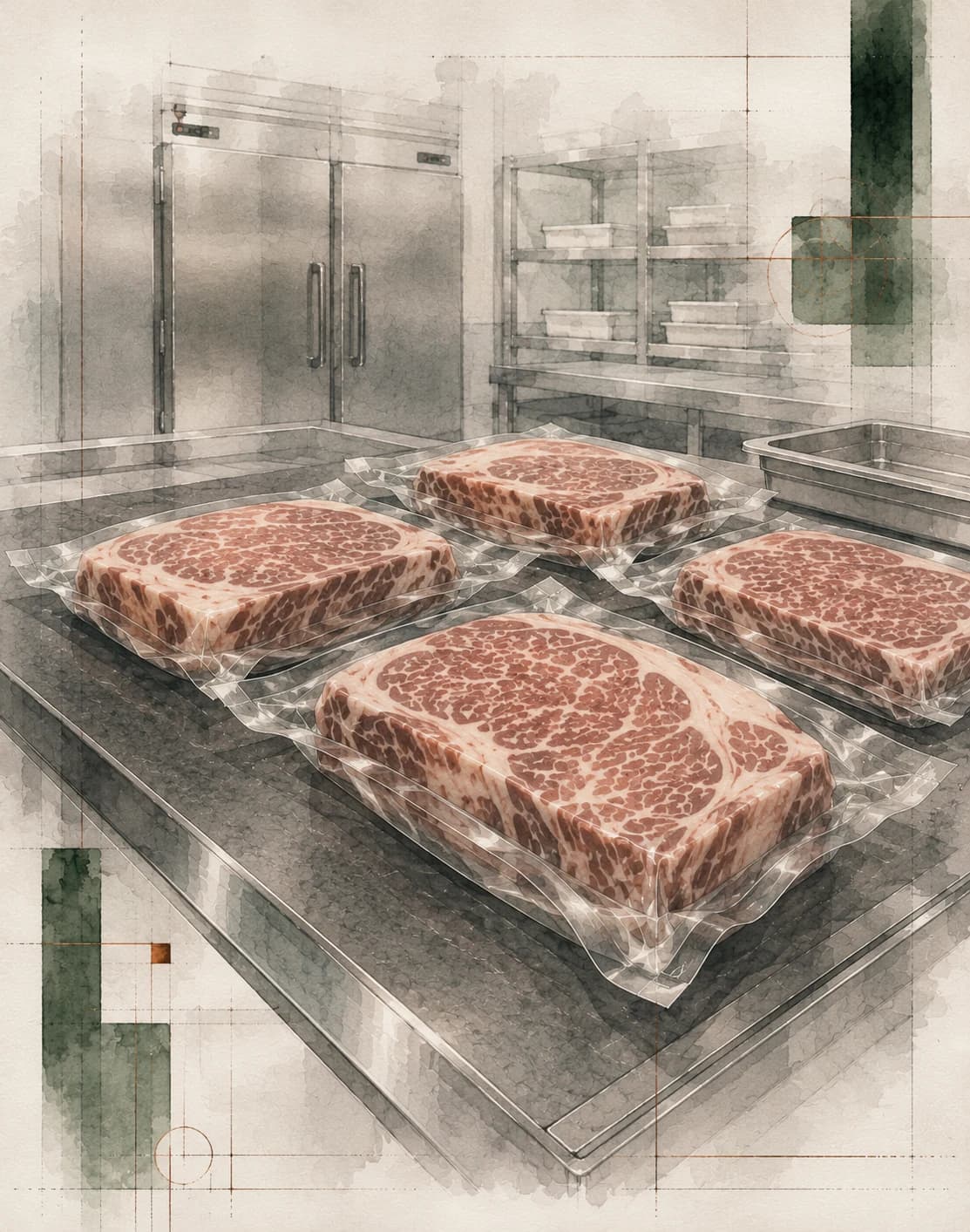
This article is for Singapore importers and hotel or restaurant groups that already buy Japanese wagyu by the cut and also operate halal-certified outlets or production lines. The question here is not whether to buy wagyu, nor which grade. It is narrower and more operational: once non-halal Japanese wagyu enters a shared cold store and a shared delivery run, how do you write down the separation so one mis-routed carton does not put the certified side of the business at risk?
That is a different problem from the ones covered next door. If you are still deciding between air-chilled and sea-frozen shipping per cut, or if your issue is marbling arriving below the specification you ordered, see the marbling spec drift audit. And if your market is halal-only and your task is proving an unbroken halal chain from plant to plate, that is the mirror image of this piece and is handled in halal custody continuity for Saudi buyers. Here, the product is non-halal by design and the deliverable is documented separation, not continuity.
One boundary before we start. This article does not make halal-certification rulings and does not claim that any Japanese wagyu supply is halal-certified. Whether your premises may hold non-halal product under a shared-premises arrangement, and under what physical conditions, is a determination for your certifier — in Singapore, the Islamic Religious Council of Singapore (MUIS) scheme under which your outlets are certified. Confirm the scheme conditions that apply to your specific operation with your certifier before you design anything below. Likewise, confirm current import permit and licensing conditions for beef from Japan with the Singapore Food Agency (SFA) at the time you order; terminology and conditions change, and we do not restate them here.
The control point is inside Singapore, not at origin
Buyers often treat the origin paperwork as the control point. It is not, for this problem. The export certificate, the plant listing and the grading sheet all describe a product that is non-halal and was never represented otherwise. Nothing at origin changes based on how many of your outlets are certified.
The risk sits in four handovers after arrival, all of them inside Singapore and all of them yours to specify:
- Cold-store bay assignment — which chamber, rack or bay the cartons land in, and whether that location is shared with product destined for certified outlets.
- Pallet and carton marking — whether a picker at 2 a.m. can tell, without opening anything and without reading Japanese, that this carton may not go on a particular run.
- Delivery run — which vehicle and which drop sequence carries the carton, and whether that vehicle also serves certified outlets on the same journey.
- Outlet receiving dock — who signs, what they are instructed to refuse, and what happens physically to a carton that arrives where it should not have.
Each of these is a decision someone makes anyway. The difference between a group that runs a mixed line calmly and one that does not is whether those four decisions were written down per cut before the first shipment, or improvised at the dock at delivery time. Improvised decisions are the expensive ones: the usual outcomes are refusing wagyu entirely across the group, or quietly paying for a dedicated delivery run and dedicated storage that was never in the landed-cost model.
The mixed-line wagyu segregation ledger
The artefact is a single table, one row per cut you actually buy. Not per shipment, not per supplier — per cut, because routing differs by cut. A ribeye roll that goes whole to one non-halal grill restaurant is an easy row. Trim that goes to a central kitchen serving several outlets is the row that causes incidents.
Columns, left to right:
- Cut — in the same wording as your purchase order, so the ledger and the PO can be read side by side. Typical rows: ribeye roll, striploin, tenderloin, chuck roll, short plate, short rib, trim and offcuts.
- Destination outlet type — non-halal outlet, central kitchen, or (as an explicit entry) never routed to certified outlets. Writing the prohibition as a value in the table, rather than leaving the cell blank, is what makes the row auditable.
- Carton marking convention — the exact text or color block that must be visible on the carton face when it reaches the dock. Specify it in a language and format your warehouse staff read, and specify where on the carton it must sit.
- Cold-store bay — named location, chilled and frozen separately if you hold both. If your cold store is a third-party operator, this column is the one you negotiate before you sign, not after.
- Pallet rule — may this cut share a pallet with other non-halal product? May it ever share a pallet with product bound for a certified outlet? A one-word answer per row, consistently applied, beats a paragraph of policy nobody reads.
- Delivery run slot — the named run, and whether that run touches a certified outlet at any drop.
- Receiving-dock signature owner — a role, not a person, so the row survives staff turnover. The role that signs is the role that is accountable for the next column.
- Stop condition — what the receiver does if this cut arrives on the wrong run or at the wrong dock. Specify the physical action (do not unload, do not move it into the chiller, call whom), not a sentiment. This is the only column that matters at the moment something goes wrong, and it is the one most often left empty.
Fill the ledger for the cuts you buy today, then stop. A ledger covering cuts you might buy next year will be stale before it is used.
How to test the ledger before the first shipment
You can validate the whole structure without any wagyu in the building. Walk it, in this order, with the ledger printed:
- Stand at the cold-store bay named in the row and check that the location physically exists, is labeled, and that the operator's own system shows the same location name. Mismatched names between your ledger and the operator's warehouse management system are the most common failure we see.
- Take a blank carton, apply the marking convention from the row, and put it on the rack. Ask a picker on the night shift what they would do with it. If they hesitate, the marking is wrong — not the picker.
- Read the delivery run sheet for that slot and list every drop. If a certified outlet appears anywhere in the sequence, the row is not yet finished.
- Ask the role named in the signature column to recite the stop condition from memory. If they cannot, it is too long.
This walk takes an afternoon. Redo it whenever you add an outlet, change cold-store operators, or add a cut to the ledger.
The supplier-side fields that make the marking survive
A marking convention that your warehouse invents on arrival is a re-labeling job on every carton, at chilled-dock speed, by whoever is on duty. It degrades fast. The cheaper path is to have the identifying information printed at origin, on the carton label and repeated on the packing list, so the convention arrives intact.
Before you lock a first order, agree these with your Japanese supplier:
- Carton label text — the exact cut name string, and whether any buyer-specified line (an outlet code, a run code) can be printed. Ask explicitly; printing buyer-specified text is often possible but may carry a minimum order quantity per label version.
- Per-cut pack size and pieces per carton — because your pallet rule and bay allocation depend on how many cartons a given cut actually becomes.
- Case weight range per cut — catch-weight variation determines whether a run slot can absorb the volume.
- Chilled or frozen per destination — if some outlets take chilled and others frozen, the split has to be decided before packing, not at the bay.
- Packing-list field order — so your receiving sheet and the supplier's document can be checked line by line without translation at the dock.
In our own handling experience these are the five fields that most often go unasked and then surface as a problem at the first delivery; this is an observation from order setup, not a measured figure.
What this does not cover
Three things stay outside this ledger on purpose. It does not determine whether your premises arrangement satisfies your certifier — ask them. It does not restate SFA permit conditions, which you should confirm directly at the time of import. And it does not price the segregation: whether a cold-store operator will commit a dedicated bay, and on what terms, is a commercial conversation with that operator, and it is worth having before you build the ledger around a bay you cannot get.
Next step
If you are setting up a mixed-line operation, the useful first conversation with us is not about price. It is about carton marking text, per-cut pack configuration, case weights and the chilled or frozen split by outlet — the supplier-side half of the ledger above. Once those are fixed, the quote means something, because it is a quote for cartons your warehouse can route without a decision at the dock.
Contact us to agree carton marking and pack configuration for your mixed-line setup.