
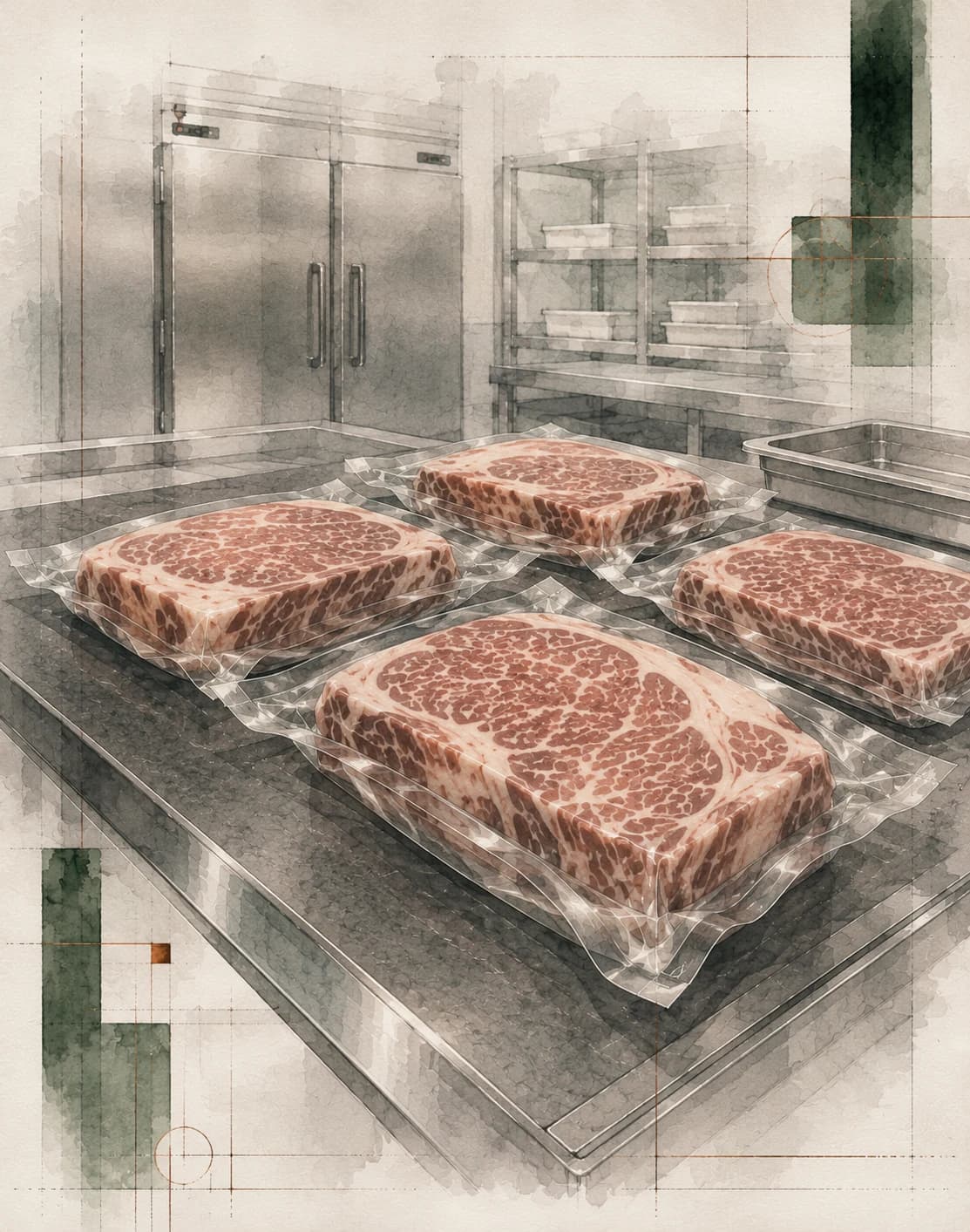
Most Singapore buyers of Japanese wagyu know their quoted per-kilo landed cost to the cent. Far fewer know what the same kilo costs after the part of the cut that never reaches the headline plate is taken out of it. This article works only on that remainder: trim, end pieces, fat cap and the narrow tail of a striploin, ribeye or chuck roll. It converts the remainder into a recovered value per kilo, and shows the three fields you can write into the next purchase order so the remainder arrives usable rather than as scrap.
That is a different job from the neighboring articles on this site. If you are choosing between inbound logistics modes, read air-chilled versus sea-frozen wagyu per cut. If you suspect the grade you received is not the grade you specified, read the marbling spec drift audit. If your question is how many covers a carving station serves, that is the buffet carving station per-cover math. None of those touch what happens to the cut after the primary portion has been taken. This one starts there.
The cost you are already paying without recording it
A whole imported cut does not portion at one hundred percent. Something is always removed: the thin end of a striploin that will not yield a uniform steak, the seam fat and silverskin on a ribeye, the fat cap trimmed down to the thickness your chef wants on the plate, the ragged first and last slices. In most kitchens that material is recorded, if at all, as kitchen shrinkage, and the entire cost of the cut is carried by the portions that do reach the menu.
The accounting consequence is simple. If a cut lands at a given price per kilo and only part of it becomes the advertised item, the real cost of each advertised portion is higher than the invoice suggests, by exactly the proportion that did not make it. That gap is not a rounding error on wagyu. It is a meaningful share of a high-value purchase, and it is the one line in your food cost that you can move without changing grade, changing supplier, or raising a menu price.
There are two ways to respond. Absorb it as loss and price the headline item to cover the whole cut. Or give each remainder stream a named destination before the order is placed, sell it, and subtract what it earns from the cost of the headline portion. The second path is what the worksheet below is for.
Why the answer depends on how the order was written
Remainder is not a fixed property of a cut. It is produced by how the cut was butchered and specified upstream. A striploin ordered with the fat cap left at full thickness arrives with more recoverable fat and more trimming work in your kitchen. The same striploin ordered trimmed to a set cap thickness arrives with less work and less recoverable material, and the trimmed fat stays in Japan. Neither is wrong. But only one of them matches what your kitchen can actually use, and that depends on whether you have a rendered fat or a mince line at all.
The same is true of end pieces. A cut portioned and packed so the thin tail arrives as one identifiable piece of a stated minimum length can go straight to a sando or a donburi line. The same tail arriving as three uneven fragments goes into the same bin as silverskin. The physical material is identical; the usable value is not.
This is why the worksheet has an order-side block at the end. Filling the recovery columns honestly requires knowing what form the remainder will arrive in, and that is decided at order time, not at the bench.
The Second Menu Recovery Sheet
Build one row per imported cut. Use the cuts you actually buy; the list below is a starting point. Every number here is entered by you from your own delivery records and your own menu, not supplied by us.
Columns
- Cut — ribeye, striploin, chuck roll, short plate, tongue, and whatever else is on your standing order.
- Delivered kilos per month — from your receiving records, not from the order sheet. Use the weighed figure.
- Headline portion kilos — the weight that leaves the bench as the advertised item, measured over a representative period. Weigh it; do not estimate it.
- Trim and end-piece kilos — everything edible that is not the headline portion and is not pure fat.
- Fat-cap kilos — separated, because it has a different destination and a different realizable value from lean trim.
- Waste kilos — bone, gristle, silverskin, anything that genuinely leaves as refuse. This column keeps the sheet honest; it should reconcile with column 2.
- Named second menu destination — one named item per remainder stream. Not "staff meal," not "specials." A dish with a price, a station and a par level. Examples used by kitchens we supply include a gyudon or donburi line, a wagyu sando, a mince application such as a burger patty or ragu, and rendered fat used for cooking or as a sold component.
- Realized value per kilo of remainder — take the menu price of the second item, subtract the non-wagyu cost of producing it, divide by the kilos of remainder it consumes. Enter your current Singapore menu prices here and refresh them at least once a year.
- Recovered value — column 8 multiplied by the kilos in columns 4 and 5 that actually sell through. Apply your real sell-through rate, not your par level.
- Effective landed cost per kilo of headline portion — the arithmetic below.
The arithmetic in the last column
For each row:
Effective cost per kilo of headline portion = (delivered kilos × landed cost per kilo − recovered value) ÷ headline portion kilos
Run it twice. First with recovered value set to zero, which is what you are paying today if remainder goes out as loss. Then with your realistic recovered value. The difference between the two figures, multiplied by your monthly headline portion kilos, is the annualized size of the decision. In our experience supplying hotel and restaurant groups, this is the number that gets a trim specification onto a purchase order, because it is expressed in the same units as the food cost target the F&B director is already carrying. This is an observation from how buyers use the sheet, not a measured benchmark.
Rules that keep the sheet truthful
- Weigh, do not assume. Yield varies by cut, by supplier butchery and by who is on the bench. One month of weighed data beats any published percentage.
- Only count what sells. Remainder that becomes a dish nobody orders is loss with extra labor attached. If the second item does not sell through, the recovered value is zero and the row should say so.
- Count the labor. Mincing, rendering and portioning remainder take bench time. Subtract it in column 8 or the sheet will flatter you.
- Separate grade claims from recovery. What you may state on a menu about the origin and grade of a second-line item is a labeling question, not a yield question. Confirm your wording against current Singapore food labeling and advertising requirements with the relevant local authority before you print it. Do not let a recovery plan drive a claim you cannot support.
- Note chilled versus frozen. Usable fat cap and end-piece condition differ between arrival formats. If you buy both, give them separate rows rather than blending them.
The order-side block: three fields for the next PO
The recovery columns are only as good as the form the remainder arrives in. These three fields are what you send back to the supplier side, per cut, so the sheet is based on real terms.
- Trim level. State whether the cut arrives untrimmed, partially trimmed or fully trimmed, and state who keeps the trim. If you want the lean trim, say so and say in what packaging. If you do not have a mince line, do not pay to ship trim across an ocean.
- End-piece minimum length. Give a minimum dimension for the tail piece and ask that it be packed identifiably rather than mixed into the portioned stack. This is the single field that most often turns a scrap stream into a sando or donburi stream.
- Fat-cap thickness. State the thickness you want on arrival. If you render fat and can use it, ask for the cap left on and packed separately where the cut allows. If you trim it off on arrival and discard it, you are paying chilled or frozen freight on material you will throw away.
Not every supplier will write all three as binding fields, and the achievable specification differs by cut and by how the primal is broken down at origin. That is a question to ask on a quotation rather than to guess at in a spreadsheet.
What to do with the completed sheet
Fill the sheet for one month using weighed figures and your current menu prices. If the gap between the zero-recovery and realistic-recovery versions of column 10 is small, keep buying as you do and stop spending management attention on it. If the gap is material at your volume, the next step is not a new supplier. It is a rewritten order.
Send us your cut list with the delivered kilos and the three order-side fields as you would like them written, and ask for trim level, end-piece minimum length and fat-cap thickness to be addressed explicitly on the quotation. Then the recovered-value column in your sheet rests on real order terms instead of assumptions about how the cut will arrive.
Request a wholesale quotation with trim, end-piece and fat-cap terms specified per cut.