
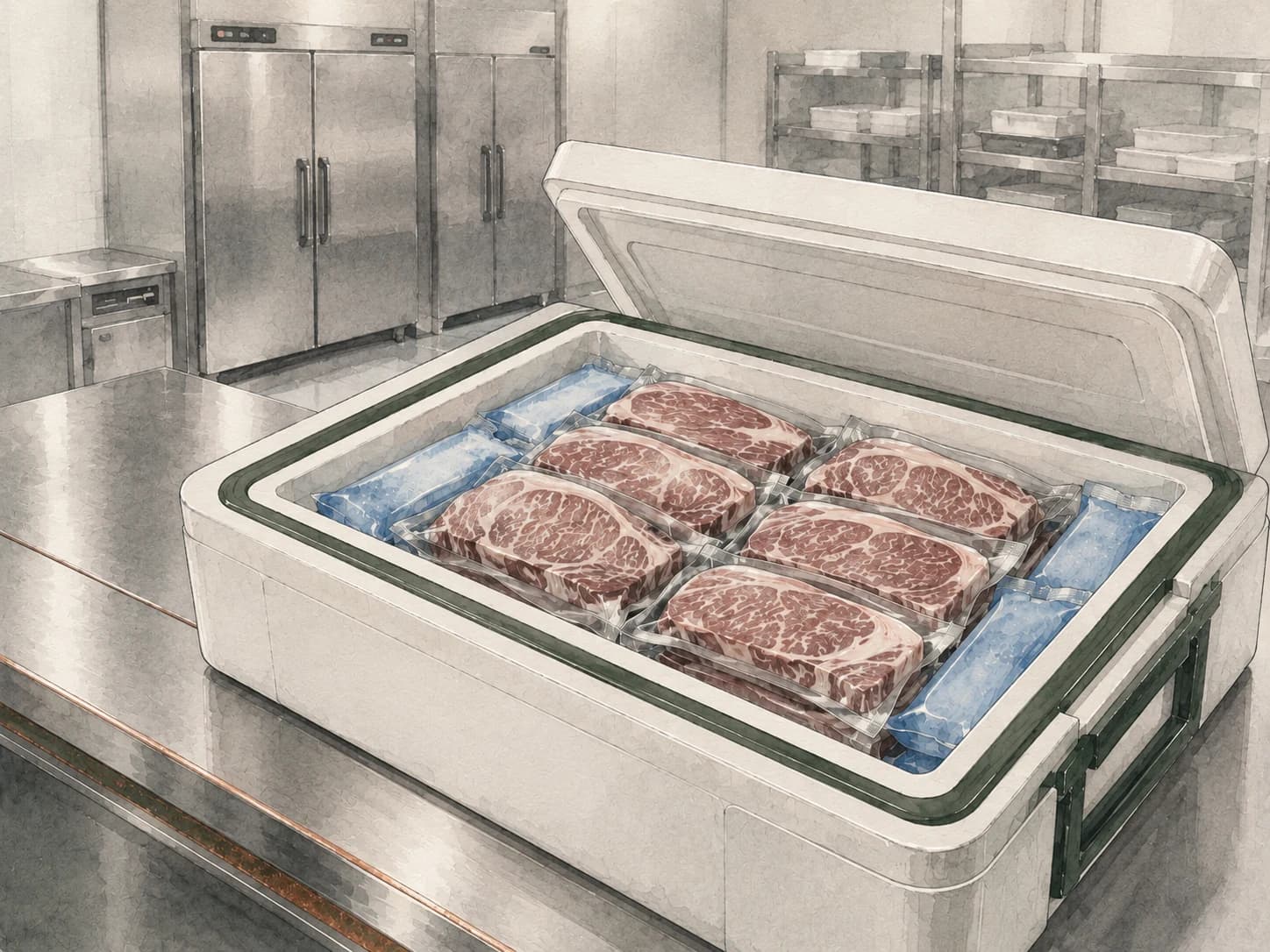
A 20 kg frozen case of Japanese Wagyu rarely plates 20 kg. Between case opening and the pass, weight leaves as thaw drip, purge held in the bag, surface and edge trim, and saw or portioning offcut. Finance sees the invoice weight; the kitchen sees the portion count; nobody in the argument has a number that connects the two. This article is about that number, per cut, under Thai kitchen conditions.
This article covers what happens after the frozen case is opened in Bangkok or Phuket: how much of the paid kilo disappears during thaw and trim, and which purchase-order lines to change in response. Adjacent topics are already covered elsewhere. If your question is how many covers a carving station can serve from a given joint, read the buffet carving station per-cover math, which starts from product that is already usable. If you are still deciding between air-chilled and sea-frozen shipping and want landed cost per cut, read air-chilled versus sea-frozen per cut. If the question is cost of entry by grade and duty line, read the tariff tier versus grade cost map. This piece sits between them: the kitchen-side yield ledger that turns into a spec conversation with your supplier.
The claim: the loss is a purchasing decision that shows up in the kitchen
When a Thai buyer and a Japanese supplier argue about yield, the argument usually gets framed as grade or quality. In our handling experience it is almost never grade. Two variables dominate, and both are controllable by the buyer:
- Thaw batch size relative to weekly cover count. Thaw more than the week can sell and the surplus either re-freezes, sits past its best condition, or gets trimmed harder before service. The loss is recorded in the kitchen but created at the moment someone decided to pull three cases instead of one.
- The cut and trim state you specified on the PO. A block with a thick fat cap and a long, uneven tail carries weight you paid for and will never plate. Whether that trimming happens in Japan before vacuum packing or in your kitchen at Thai labor and chiller cost is a line on the order form, not a fact of nature.
Everything below is a method for proving which of the two is costing you, per cut, with your own product.
Why Thai conditions make this worse than the textbook case
Most thawing guidance assumes a kitchen with spare refrigeration and a steady daily draw. Several conditions common in Thai hotel and restaurant operations push against that, and they are worth naming because they change the batch sizing math rather than the physics of thawing:
- Chiller space is the binding constraint. In many mid-size Bangkok hotel kitchens the Wagyu thaw batch competes for shelf space with everything else on the banquet sheet. The batch size you want is often not the batch size that fits. Measure your own usable shelf meters before you design a thaw cycle around a theoretical number.
- Ambient humidity and door traffic. A chiller that is opened constantly during service holds a less stable temperature than its set point suggests. If you are going to log thaw results, log where in the chiller the case sat and how busy that chiller was, or your cycles will not be comparable.
- Multi-day thaw cycles for large blocks. A heavy frozen block does not come to an even working temperature in one overnight pull. Partial thaw forces either a longer hold or a warmer, faster finish; both show up as drip or as harder trimming.
- Frozen is the default, not a fallback. Because air-chilled lead times and permit timing make chilled risky for many Thai buyers, frozen is the normal format, which means thaw loss is a permanent line item rather than an exception. It deserves a permanent measurement.
On the regulatory side: import permit, health certificate, and tariff treatment for frozen Japanese beef entering Thailand change from time to time, and preferential treatment under the Japan–Thailand and ASEAN–Japan agreements depends on the tariff line and on correct certificate of origin handling. Confirm the current requirements and rates with the Thai Department of Livestock Development and Thai Customs, or with your customs broker, before you commit to a shipping format. We do not restate those figures here because they are the part of this problem that expires.
Where the weight actually goes
Four losses, in the order they occur. Name them separately or you will never settle the supplier argument, because each one has a different owner.
1. Purge and thaw drip
Liquid released during thaw, collected in the vacuum bag. This is the number most often disputed, because the invoice net weight is normally established at packing, before any thaw, and purge is not deducted anywhere downstream. Confirm with your own supplier at what point their declared net weight is taken — that single clarification resolves a surprising share of yield disputes.
2. Surface and edge trim
Discolored or dried surface, freezer-affected edges, excess fat cap beyond what your menu wants, and the ragged tail of a block. Partly a function of pack integrity and thaw control, partly a function of what trim state you ordered.
3. Portion-cut offcut
The ends and odd pieces that cannot hit your target gram weight. A 20 mm difference in target steak thickness changes how many clean portions come off a striploin, and the remainder is offcut whether or not you find a second use for it.
4. Hold and re-work loss
Product thawed beyond what the week sells, and therefore re-trimmed, downgraded to a lower-margin application, or wasted. This is the loss that thaw batch sizing exists to eliminate, and it is the one most likely to be invisible in the kitchen's own records.
The Thaw Batch and Drip Loss Ledger
One page per cut — ribeye, striploin, chuck roll, short plate kept separate, because they behave differently and because the PO fix differs per item. Run it on three consecutive cycles of the same cut before drawing any conclusion. One cycle is an anecdote.
Columns, left to right:
- Case gross weight as received, before opening.
- Declared net weight from the invoice and carton label.
- Thaw start date, time, and chiller location, plus set-point temperature and whether it is a service chiller or a back-of-house one.
- Post-thaw weight in bag at the point you open it, at your standard thaw duration.
- Purge collected: weigh the drained liquid, or weigh the drained piece and subtract.
- Surface and edge trim weight, weighed separately from portioning offcut.
- Portion-cut offcut weight.
- Sellable portion count at your target gram weight, with that target written down.
- Sellable weight = portion count × target gram weight.
- True cost per plated portion = landed cost of the case ÷ sellable portion count.
Column 10 is the only figure to take to a finance conversation. Yield percentage is useful internally; cost per plated portion is what makes the argument land, because it compares directly against menu price.
Two discipline points. First, run the same target gram weight across all three cycles; changing portion size mid-measurement invalidates the comparison. Second, date every row and note who did the trimming. Trim loss varies with the butcher, and if two chefs produce very different trim weights on the same cut, that is a training finding, not a supplier finding.
Sizing the thaw batch
Once you have a measured sellable yield for a cut, batch sizing stops being a guess:
Thaw batch (kg) = forecast covers for the thaw window × portion gram weight ÷ 1,000 ÷ measured sellable yield
Then cap it by chiller shelf capacity. If the formula asks for more than fits, the answer is more frequent, smaller pulls — which usually means asking the supplier for a smaller vacuum pack size rather than trying to defeat the shelf.
Worked example, using illustrative numbers so the arithmetic is visible — substitute your own measurements: 120 forecast covers over the thaw window, a 200 g target portion, and a measured sellable yield of 0.78. That gives 120 × 200 ÷ 1,000 ÷ 0.78 ≈ 30.8 kg to thaw. If your chiller holds roughly one 20 kg case of this item alongside everything else, the honest conclusion is two pulls in the window, not one oversized one — and the pack size on your next PO should reflect that.
Note what the formula does: it makes the yield number operational. A yield figure sitting in a report changes nothing; a yield figure dividing into your cover forecast changes the order quantity.
Reading the ledger: which lever to pull
After three cycles, compare where the weight went:
- Purge dominates. Look at thaw duration and temperature stability first, and at pack integrity second. Ask the supplier when declared net weight is taken and what vacuum pack sizes are available for that cut. Smaller packs thaw more evenly and let you pull closer to demand.
- Surface and edge trim dominates. This is a spec problem. Specify fat cap thickness, specify whether you want the block trimmed and squared before packing, and specify tolerance on piece weight. You are currently paying Wagyu prices for material your menu was never going to use.
- Portion offcut dominates. Consider ordering steak-ready portions at your target gram weight for that item instead of blocks, and compare the per-portion price against the offcut you are absorbing. For some cuts and some menus the block is still right; for others it is clearly not, and the ledger says which.
- Hold and re-work loss dominates. Nothing in the spec will fix this. Reduce the batch, increase pull frequency, and, if the vacuum pack is larger than a sensible batch, change the pack size.
Set a threshold per cut rather than one number for everything. A short plate and a striploin have no business being judged by the same yield figure. Your threshold is whatever makes the cost per plated portion acceptable against that item's menu price — define it yourself, from column 10, rather than importing someone else's benchmark.
What to change on the next purchase order
When the ledger points at the spec, these are the lines worth rewriting per cut:
- Trim state — fat cap thickness in millimeters, silver skin removed or not, tail retained or removed.
- Format — block, portion-ready steaks at a stated gram weight, or a mix by item.
- Vacuum pack size — matched to a sensible thaw batch for your covers and chiller, not to the supplier's default carton logic.
- Piece weight tolerance — the acceptable range per piece, so that portioning math is predictable.
- Net weight basis — at what point net weight is declared, stated explicitly so both sides are measuring the same thing.
These changes trade against unit price. A trimmed, portion-ready, smaller-pack item costs more per kilo and may plate cheaper per portion. That comparison is only possible once you have the ledger, which is the whole point of running it before the conversation rather than after.
Talk to us with the numbers in hand
Most buyers who complete three cycles find that one or two cuts need a different pack and trim format — not a different grade. That is a specification conversation, and it is the one we are set up to have.
Send your completed per-cut loss figures and your target plated gram weight, and we will work through revised cut format, trim state, and vacuum pack size for the next shipment, including a trial case of the re-specified cut if that helps you verify the change. Contact us with your ledger figures.