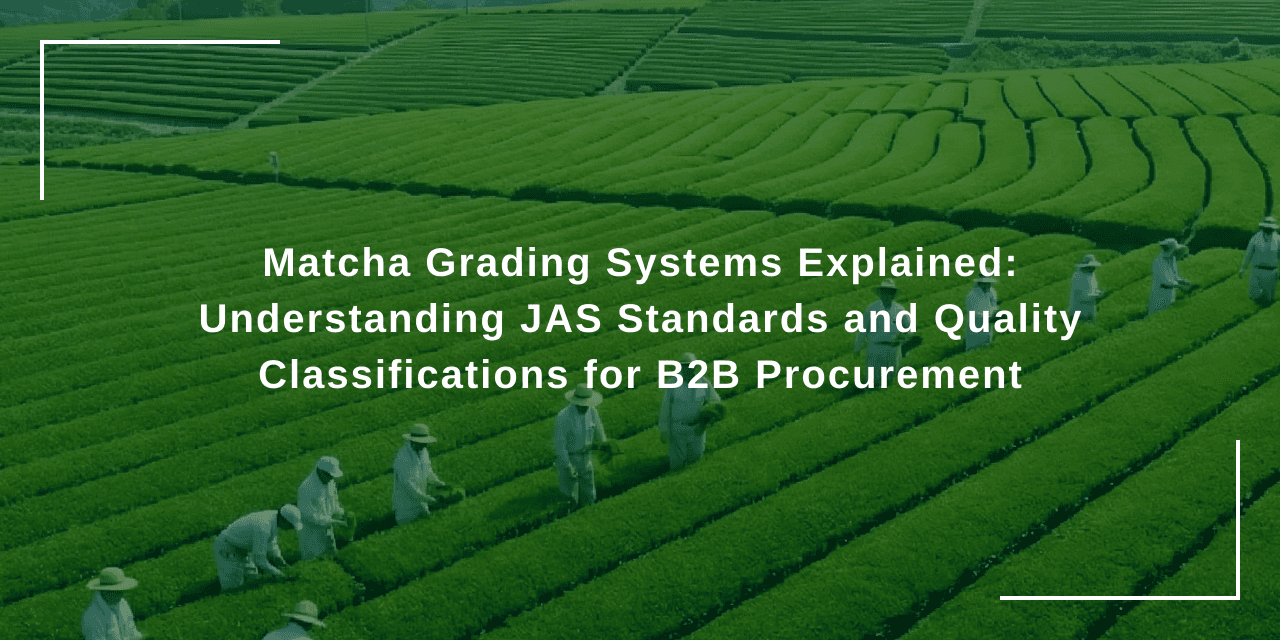
Navigating the matcha market as a B2B buyer requires understanding the complex grading systems that determine quality, pricing, and application suitability. As procurement complexity grows, B2B buyers need reliable frameworks to evaluate suppliers and make informed purchasing decisions.
This comprehensive guide breaks down Japan's official grading standards, regional classification systems, and practical verification methods to help you source the right matcha grades for your specific business applications.
Understanding Japan's Official JAS Grading Standards for Matcha
The Japanese Agricultural Standards (JAS) system provides the official framework for matcha quality classification in Japan. Established by the Ministry of Agriculture, Forestry and Fisheries, JAS standards focus on measurable quality parameters that directly impact taste, color, and functionality in commercial applications.
Core JAS Quality Parameters
JAS evaluation centers on four primary criteria that B2B buyers should understand when evaluating suppliers:
- Color intensity and uniformity: Measured using standardized color charts, with higher grades requiring vivid green coloration without brown or yellow undertones
- Particle size distribution: Premium grades must achieve 95% passage through specific mesh sizes, typically 200-400 mesh for ceremonial applications
- Moisture content: Strictly controlled below 5% to prevent degradation and ensure shelf stability
- Foreign matter content: Maximum allowable limits for stems, leaf fragments, and other materials
The JAS system classifies matcha into distinct grades, each with specific applications and pricing implications. Understanding these classifications helps procurement teams match products to their intended use cases while optimizing costs.
JAS Grade Classifications and Commercial Applications
JAS Grade | Color Score | Particle Size | Primary Applications | Indicative cost tier |
|---|---|---|---|---|
Extra Superior | 9.0-10.0 | 400+ mesh | Premium tea service, luxury retail | Premium |
Superior | 7.0-8.9 | 300-400 mesh | High-end beverages, confectionery | Upper-mid |
Good | 5.0-6.9 | 200-300 mesh | Commercial beverages, baking | Mid |
Standard | 3.0-4.9 | 100-200 mesh | Industrial applications, flavoring | Entry |
These price ranges reflect current wholesale markets and can vary based on harvest conditions, regional origins, and supply chain factors. B2B buyers should note that JAS certification requires documentation from accredited testing facilities, providing traceability that many international clients require.
Regional Grading Systems: Uji, Nishio, and Other Premium Tea Regions
Beyond JAS standards, Japan's premium matcha regions maintain their own classification systems that often command higher prices due to terroir, traditional cultivation methods, and historical reputation. Understanding these regional variations helps buyers identify authentic premium products and justify price premiums to end customers.
Uji Regional Standards
The Uji region, recognized as the birthplace of Japanese tea culture, maintains the most stringent regional grading system. Uji matcha must meet specific geographic and processing requirements:
- Geographic authenticity: Tea must be grown within designated Uji region boundaries in Kyoto Prefecture
- Shading requirements: Minimum 20-day shading period before harvest, with premium grades requiring 25-30 days
- Processing methods: Stone grinding mandatory for top grades, with specific granite stone requirements
- Cultivar specifications: Premium grades limited to traditional varieties like Samidori, Okumidori, and Asahi
Uji's internal grading system includes designations like "Koicha" (thick tea) and "Usucha" (thin tea), referring to traditional preparation methods but indicating quality levels. Koicha-grade Uji matcha typically costs 40-60% more than equivalent JAS grades but provides superior color stability and flavor complexity for premium applications.
Nishio Regional Classifications
Aichi Prefecture's Nishio region produces approximately 50% of Japan's matcha and has developed grading systems optimized for commercial applications. Nishio standards emphasize:
- Production volume capability: Suppliers must demonstrate capacity for consistent large-scale orders
- Standardized processing: Automated processing systems ensure batch consistency crucial for B2B applications
- Quality consistency metrics: Statistical process control measures that reduce variation between production runs
- Seasonal availability: Extended harvest windows and storage capabilities for year-round supply
For B2B buyers requiring consistent supply chains, Nishio suppliers often provide better reliability than smaller traditional producers, though sometimes at the expense of the most premium quality tiers.
Emerging Regional Standards
Other Japanese regions are developing their own classification systems as matcha production expands:
"Kagoshima Prefecture has increased matcha production by 180% since 2018, developing new grading standards that emphasize organic certification and sustainable farming practices," according to the Japan Tea Association's 2023 annual report.
These emerging regions often provide cost advantages for B2B buyers willing to work with newer suppliers, particularly for applications where extreme premium quality isn't essential.
How Grading Affects Pricing and Application Suitability
Understanding the relationship between matcha grades and their optimal applications enables procurement teams to balance quality requirements with budget constraints. Different business applications have varying sensitivity to the quality parameters that drive grading classifications.
Application-Specific Quality Requirements
Different commercial applications require specific quality characteristics that don't always align with the highest grades:
Hot Beverage Applications: High-temperature preparation reduces color vibrancy benefits of premium grades. Good to Superior grades typically provide optimal cost-performance ratios, with particle size being more important than color intensity.
Cold Beverage Applications: Color retention becomes critical for visual appeal. Superior grades or above recommended for applications where appearance drives consumer perception.
Baking and Confectionery: Heat processing diminishes premium grade benefits. Standard to Good grades often sufficient, with focus on flavor stability rather than color or particle fineness.
Ice Cream and Frozen Applications: Freezing affects both color and flavor development. Superior grades provide better performance due to higher chlorophyll content and flavor compound concentration.
Price-Performance Analysis for B2B Applications
Cost analysis reveals that premium grades don't always deliver proportional value increases across all applications:
- Beverage applications: Moving from Good to Superior grade typically increases ingredient costs by 60-80% while improving perceived quality by 20-30%
- Baked goods: Premium grades above Good classification show minimal performance improvements due to heat degradation
- Retail tea service: Extra Superior grades justify premium pricing through enhanced ceremony experience and customer satisfaction
- Industrial flavoring: Standard grades provide adequate flavor profiles at optimal cost points for mass market applications
Seasonal Pricing Variations
Matcha pricing follows predictable seasonal patterns that sophisticated buyers can leverage for procurement timing:
- May-July: New harvest period brings 15-25% price reductions as fresh inventory enters the market
- August-October: Stable pricing period optimal for contract negotiations and forward purchasing
- November-February: Price increases of 10-20% as inventory levels decline before new harvest
- March-April: Peak pricing period with limited availability of previous year's stock
B2B buyers with storage capabilities can achieve significant cost savings through strategic timing of larger purchases during optimal periods.
Verifying Grade Claims: Documentation and Testing Methods
With increasing matcha demand and complex supply chains, grade verification becomes essential for protecting business interests and maintaining product consistency. Professional buyers need systematic approaches to validate supplier claims and ensure ongoing quality compliance.
Essential Documentation Requirements
Legitimate matcha suppliers should provide comprehensive documentation supporting their grade claims:
- JAS certification documents: Current certificates from accredited testing facilities with specific grade classifications
- Origin certificates: Documentation proving geographic source, particularly important for regional grade claims
- Processing records: Detailed records of shading periods, harvest dates, and grinding methods
- Laboratory analysis reports: Third-party testing results for moisture, particle size, color measurements, and contaminant screening
- Traceability documentation: Chain of custody records from farm through final packaging
Suppliers unable or unwilling to provide this documentation should be approached with caution, as grade misrepresentation is unfortunately common in international matcha trade.
Independent Testing Methods
For high-volume purchases or critical applications, independent verification provides additional security:
Visual Assessment Protocols: Standardized color comparison using Munsell color charts or colorimeter measurements can quickly identify grade inconsistencies. Authentic high-grade matcha should display vibrant green coloration without yellow or brown undertones.
Particle Size Analysis: Laboratory sieve analysis confirms mesh size claims. Premium grades claiming 400+ mesh should show 95% or greater passage through appropriate screens.
Chemical Analysis: Advanced testing can measure chlorophyll content, amino acid profiles, and caffeine levels that correlate with traditional grading parameters.
Sensory Evaluation: Trained tasters can identify grade-appropriate flavor profiles, though this requires specialized expertise and standardized protocols.
Red Flags in Grade Verification
Experienced buyers watch for warning signs that suggest grade misrepresentation:
- Pricing inconsistencies: Premiums grades offered significantly below market rates often indicate quality issues
- Documentation gaps: Missing or outdated certificates, reluctance to provide testing reports
- Visual inconsistencies: Color variations between batches, presence of foreign matter, or uneven particle sizes
- Supply chain opacity: Suppliers unable to provide clear origin information or processing details
Matching Matcha Grades to Your Business Applications
Successful matcha procurement requires aligning grade selection with specific business requirements, customer expectations, and operational constraints. This section provides practical frameworks for making these matching decisions across different commercial contexts.
Systematic Grade Selection Process
Professional buyers should follow structured decision-making processes that consider multiple factors:
Step 1: Application Analysis
Document specific quality requirements for your intended use. Consider preparation methods, temperature exposure, storage duration, and final product presentation requirements.
Step 2: Customer Expectation Assessment
Evaluate your target market's quality sensitivity and price tolerance. Premium positioning requires higher grades, while value-oriented offerings can utilize lower classifications effectively.
Step 3: Operational Requirement Review
Assess your processing capabilities, storage conditions, and supply chain requirements. Some grades require specialized handling or have shorter shelf lives.
Step 4: Financial Optimization
Calculate total cost implications including ingredients, handling, waste, and customer satisfaction impacts across different grade options.
Industry-Specific Recommendations
Cafe and Tea Shop Operations: Superior to Extra Superior grades essential for traditional tea service. Good to Superior grades appropriate for matcha lattes and blended beverages. Consider offering multiple grades to support different price points and applications.
Food Manufacturing: Good grades typically optimal for most applications due to processing effects on premium characteristics. Focus on suppliers with consistent batch quality rather than maximum grade levels.
Bakery Applications: Standard to Good grades provide adequate performance for most baked goods. Reserve Superior grades for products where matcha is the primary flavor component and appearance remains visible.
Beverage Manufacturing: Grade requirements vary significantly by product type. Cold beverages benefit from higher grades for color retention, while flavored products may perform adequately with lower classifications.
Building Long-Term Supplier Relationships
Successful matcha procurement extends beyond individual transactions to building reliable supply partnerships:
- Supplier capability assessment: Evaluate producers' ability to maintain consistent grades across seasonal variations and production scaling
- Quality agreement development: Establish clear specifications, testing protocols, and performance standards with key suppliers
- Supply chain diversification: Develop relationships with suppliers across different regions and grade capabilities to ensure continuity
- Performance monitoring: Implement ongoing quality tracking and supplier scorecards to maintain standards
Future-Proofing Your Matcha Procurement Strategy
The matcha market continues evolving with new grading systems, production regions, and quality standards emerging regularly. Successful buyers stay ahead of these trends:
"Organic certification is becoming increasingly important in matcha grading, with 65% of premium buyers now requiring organic credentials alongside traditional quality classifications," notes the International Tea Committee's 2024 market analysis.
Consider incorporating sustainability criteria, organic certifications, and fair trade requirements into your grade selection framework to meet evolving customer expectations and regulatory requirements.
Understanding matcha grading systems provides the foundation for successful B2B procurement, but implementation requires ongoing attention to market changes, supplier performance, and application requirements. By following systematic approaches to grade selection and verification, procurement professionals can optimize both quality and cost outcomes while building reliable supply chains.
First Agri specializes in direct-from-Japan matcha sourcing with complete grade verification and documentation. Our relationships with certified producers across all major Japanese tea regions enable us to match exact grade requirements to your specific applications while ensuring authentic quality and competitive pricing. Request samples of different grades to evaluate options for your business applications, or contact our procurement specialists to discuss your specific requirements and develop customized sourcing solutions.