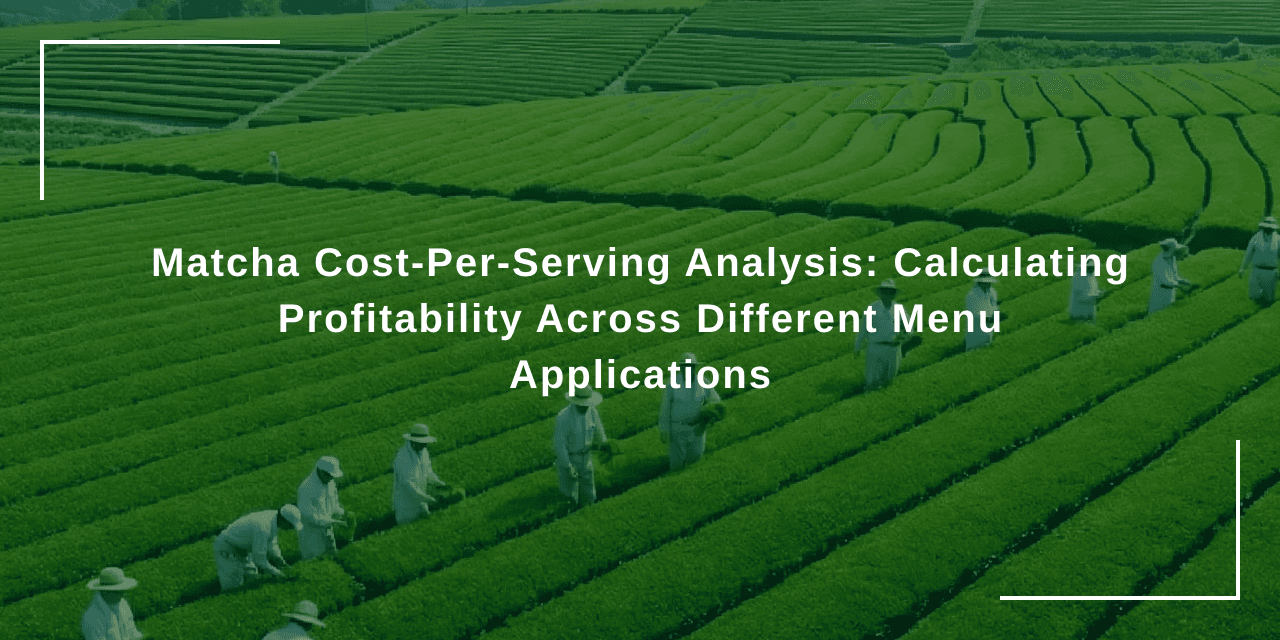
For food service operators and manufacturers, matcha represents both an opportunity and a challenge. While consumer demand for matcha products continues to surge, many businesses struggle to optimize their matcha-based offerings for maximum profitability. The key lies in understanding the true cost per serving across different applications and implementing strategic portion control measures that balance quality with profit margins.
This comprehensive analysis will equip B2B buyers with the tools and knowledge needed to calculate accurate matcha costs, establish profitable pricing strategies, and maximize ROI across their product lines.
Cost Calculation Methods: Breaking Down Matcha Usage by Application Type
Understanding matcha cost per serving requires a granular approach that accounts for the varying usage rates across different menu applications. Unlike other ingredients that maintain consistent ratios, matcha consumption varies dramatically depending on the product type, preparation method, and desired flavor intensity.
Beverage Applications
Matcha beverages represent the highest volume opportunity for most food service operators, but they also require careful cost management due to direct customer visibility of quality differences.
Traditional Matcha Tea: A single serving of ceremonial matcha typically uses 2-4 grams of powder, mixed with 60-80ml of hot water. For café applications, this translates to approximately $1.20-$2.40 per serving when using ceremonial grade matcha priced at $30 per 50g.
Matcha Lattes: The most popular commercial application uses 1.5-3 grams of matcha powder per 12-16oz serving. The lower powder requirement, combined with milk volume, creates a more cost-effective option while maintaining flavor profile. Cost per serving ranges from $0.90-$1.80 for the matcha component alone.
Iced Matcha Drinks: Cold applications often require 15-20% more powder to achieve equivalent taste intensity due to temperature effects on flavor perception. Factor in 2-3.5 grams per serving, increasing costs to $1.20-$2.10 per drink.
Food Applications
Matcha integration into food products offers opportunities for premium pricing while typically requiring smaller quantities per serving, leading to improved margin potential. The food costs below assume culinary grade matcha at half the per-gram price of the ceremonial matcha priced above.
Baked Goods: Matcha cookies, cakes, and pastries typically incorporate 6-18 grams of matcha powder per dozen items, depending on desired intensity. This translates to approximately $0.15-$0.45 per individual serving, making it one of the most cost-effective applications for premium positioning.
Ice Cream and Desserts: Premium dessert applications use 8-12 grams per liter of base mixture. With typical serving sizes of 100-120ml, the matcha cost per portion ranges from $0.24-$0.43, allowing for significant markup potential in dessert-focused establishments.
Confectionery Products: Chocolates and specialty confections require precise matcha integration, typically 3-8% by weight of the final product. While this creates higher per-unit costs ($0.30-$1.20 per piece), the premium positioning supports corresponding price points.
Portion Control Standards: Recommended Serving Sizes for Maximum Profit
Effective portion control represents the cornerstone of matcha profitability management. Unlike subjective seasoning, matcha requires precise measurement to maintain consistency while controlling costs.
Standardization Equipment and Techniques
Implementing proper portioning systems reduces waste by up to 23% compared to estimative methods, according to industry cost analysis data. Digital scales accurate to 0.1 grams should be standard equipment for any operation serving more than 50 matcha items daily.
Volume-Based Portioning: Many operators prefer measuring spoons or scoops for speed, but this method introduces 15-25% variance in actual powder quantities. A "level teaspoon" of matcha ranges from 1.8 to 2.4 grams depending on powder fineness and packing.
Weight-Based Accuracy: Professional operations should establish weight-based standards. Pre-portioning during prep periods allows for precise cost control while maintaining service speed. Consider preparing measured portions in small containers during low-traffic periods.
Quality-Tier Optimization
Strategic matching of matcha grades to applications significantly impacts profitability without compromising customer satisfaction.
One of the most common and costly mistakes is using ceremonial grade matcha in applications where culinary grade would be equally effective. On matcha desserts, this single decision can add ten percentage points to the food cost ratio.
Ceremonial Grade Applications: Reserve premium grades for traditional tea service and high-visibility beverages where customers can distinguish quality differences. Limit to applications using minimal additional ingredients that might mask subtle flavor notes.
Culinary Grade Optimization: Food applications, heavily sweetened beverages, and blended drinks perform equally well with culinary grades that cost 50-70% less than ceremonial options. This substitution alone can improve food cost ratios from 28% to 18% on matcha desserts.
Pricing Strategy Framework: Setting Menu Prices Based on True Matcha Costs
Developing profitable matcha pricing requires understanding both direct ingredient costs and the value perception factors that support premium positioning.
Cost-Plus Pricing Foundation
Traditional food cost percentages (25-35%) may not apply effectively to matcha products due to their premium positioning and unique preparation requirements. In the table below, suggested menu prices keep the upper end of each matcha cost range within the recommended food cost percentage, and gross margin is the menu price minus that matcha cost, so servings at the lower end of the cost range earn more.
Application Type | Matcha Cost Per Serving | Recommended Food Cost % | Suggested Menu Price Range | Gross Margin |
|---|---|---|---|---|
Traditional Matcha Tea (2-4g) | $1.20-$2.40 | 20% | $12.00 | $9.60 |
Matcha Latte (16oz) | $1.20-$1.80 | 25-33% | $5.50-$7.20 | $3.70-$5.40 |
Matcha Dessert | $0.25-$0.45 | 15-20% | $2.25-$3.00 | $1.80-$2.55 |
Matcha Pastry | $0.15-$0.35 | 18-22% | $1.60-$1.95 | $1.25-$1.60 |
Value-Based Pricing Considerations
Matcha's vivid color, distinctive flavor, and cultural significance support premium positioning beyond traditional cost-plus models. Market research indicates consumers accept 20-35% price premiums for authentic, high-quality matcha products compared to standard beverage alternatives.
Positioning Factors:
- Rich umami and a flavor profile distinct from other tea drinks
- Appeal as a coffee alternative for customers seeking variety
- Instagram-worthy presentation and color
- Cultural authenticity and ceremonial significance
- Limited availability and seasonal variations
Dynamic Pricing Strategies
Consider implementing tiered pricing structures that allow customers to self-select their preferred quality level while maximizing revenue per transaction.
Three-Tier System: Offer "Traditional," "Premium," and "Ceremonial" versions of core menu items. This approach increases average transaction values by 18-25% while giving cost-conscious customers accessible entry points.
Size-Based Optimization: Matcha beverages show stronger profitability in smaller serving sizes due to the concentrated flavor profile. Consider emphasizing 8-12oz servings rather than competing with commodity coffee sizes.
ROI Optimization: Balancing Quality Grades with Profit Margins
Maximizing return on investment requires strategic inventory management and application-specific quality matching that optimizes both cost and customer satisfaction.
Inventory Management Strategies
Matcha's sensitivity to light, air, and temperature creates unique storage costs that must be factored into profitability calculations. Proper storage extends usability periods from 6-8 months to 12-18 months, significantly impacting true cost per serving.
Bulk Purchasing Optimization: Volume discounts on matcha typically range from 15-30% for quantities above 5kg, but operators must balance savings against storage requirements and turnover rates. Calculate break-even points based on monthly usage:
- High-volume operations (>2kg monthly): Bulk purchasing provides 18-25% cost savings
- Medium-volume operations (0.5-2kg monthly): Quarterly ordering optimizes freshness vs. cost
- Low-volume operations (<0.5kg monthly): Smaller, more frequent orders keep stock fresh, since bulk discounts rarely offset the loss from product that goes stale before it is used
Quality-Application Matrix
Systematic matching of matcha grades to specific applications eliminates over-specification while maintaining quality standards.
High-Impact Applications: Traditional tea service, premium lattes, and signature beverages justify ceremonial grade usage due to direct customer quality perception. These applications typically support 60-75% gross margins.
Medium-Impact Applications: Standard lattes, smoothies, and visible desserts perform well with premium culinary grades, maintaining customer satisfaction while improving margins by 15-20%.
Cost-Optimized Applications: Baked goods, ice cream bases, and heavily sweetened applications achieve identical results with standard culinary grades, maximizing profitability without quality compromise.
Waste Reduction Protocols
Matcha waste represents a significant hidden cost due to the ingredient's premium pricing. Implementing systematic waste reduction can improve effective margins by 8-12%.
Preparation Timing: Matcha beverages show optimal quality within 10-15 minutes of preparation. Implementing made-to-order policies eliminates remake costs while supporting premium positioning.
Cross-Utilization: Develop secondary applications for near-expiration inventory. Matcha approaching freshness limits remains suitable for baked applications, allowing operators to maintain rotation without loss.
Performance Monitoring Metrics
Establish key performance indicators that track true profitability beyond simple margin calculations:
- Cost Per Serving Accuracy: Track variance between theoretical and actual usage
- Quality Waste Percentage: Monitor remake rates and inventory loss
- Customer Price Acceptance: Analyze sales volume response to pricing adjustments
- Seasonal Demand Fluctuations: Identify optimization opportunities during peak and low periods
Successful matcha program management requires ongoing analysis and adjustment. Operators who implement systematic cost tracking and portion control typically achieve 25-40% higher profitability on matcha items compared to those using estimative approaches.
The investment in proper systems and training pays dividends through improved consistency, reduced waste, and optimized pricing strategies that position matcha as a profitable menu category rather than a costly specialty item.
Ready to optimize your matcha program with authentic, direct-from-Japan sourcing that ensures consistent quality and competitive pricing? First Agri's team can help you match matcha grades to your applications and work out cost per serving and portion standards for each one. Request samples and pricing information today to discover how our direct relationships with Japanese producers can improve your matcha profitability while maintaining the authentic quality your customers expect.