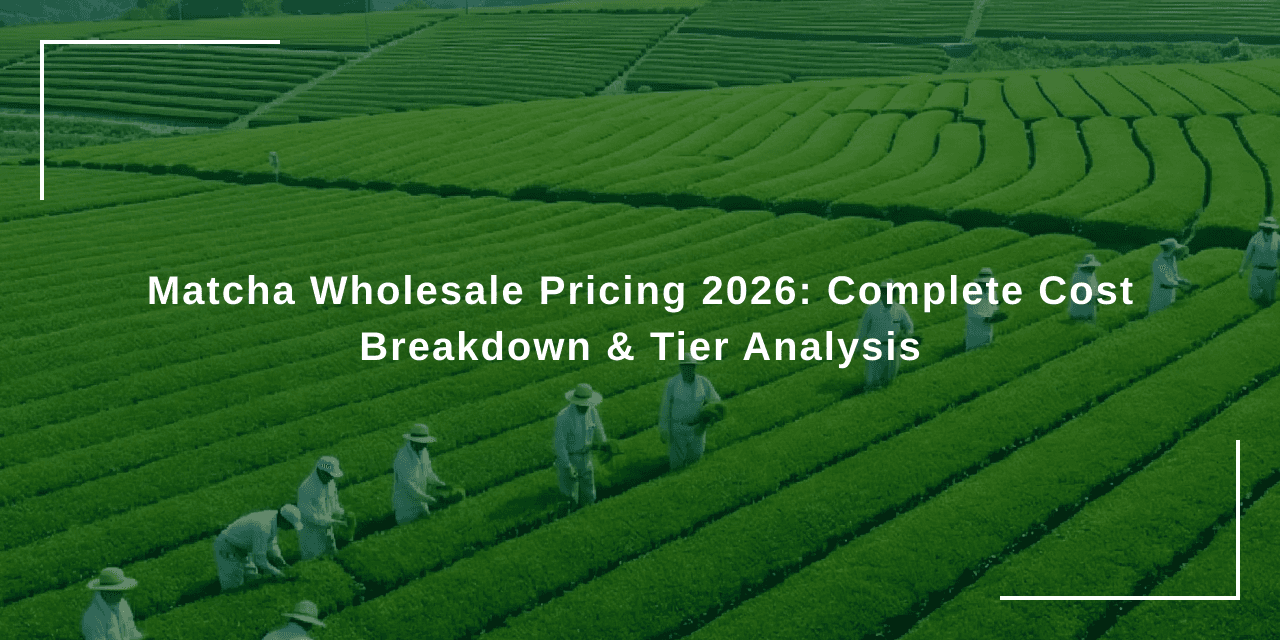
Matcha wholesale pricing in 2026 has not come back down—the 2026 first-flush auctions pushed raw-material prices higher again, and every B2B buyer budgeting for the next fiscal year needs to understand the new cost base. The 2024–2025 "matcha shock" permanently reset the price floor: Kyoto matcha-grade tea trading at 2.6 times the prior year's price in 2025, Japanese heritage makers holding customers on strict allocation, and production leadership shifting decisively from Shizuoka to Kagoshima. The raw material and energy cost increases that drove the spike have integrated into the cost structure; prices will not return to 2023 norms.
This guide provides the 2026 Q1–Q2 wholesale pricing snapshot by grade and MOQ, the cost-structure breakdown behind those numbers, the factors actively moving prices, and a 2026 negotiation playbook for food importers, beverage manufacturers, private-label brands, and café chain purchasing teams. It is an operational reference document—built for buyers who need actionable data, not a recap of historical trends.
2026 pricing snapshot
- Wholesale planning should use current supplier quotes rather than broad market forecasts.
- Kyoto matcha-grade tea traded at 2.6 times the prior year's price in 2025, and the May 2026 first tencha auctions in Kyoto and Kagoshima cleared higher again.
- Kagoshima surpassed Shizuoka as Japan's #1 first-flush producer in 2025 (8,440 vs. 8,120 tons).
- Uji-premium pricing now runs 30–60% above the market average; Kagoshima runs 20–30% below.
- Direct-import from Japan saves 25–40% versus distributor stock at equivalent grade.
- Ceremonial-grade below USD 120/kg and latte-grade below USD 65/kg on orders up to 10 kg, and culinary-grade below USD 35/kg at any volume, are 2026 red-flag thresholds for counterfeit or adulterated product.
Table of contents
- 2026 Q1–Q2 wholesale price snapshot
- Regional price differentiation
- The 2024–2025 shock and the new normal
- 2026 cost structure breakdown
- Factors actively moving prices
- 2026 price trend forecast
- Negotiation strategy for 2026
- Fake-matcha red flags and price thresholds
- Where competitor pricing guides fall short
- Recommended buyer actions
- FAQ
1. 2026 Q1–Q2 wholesale price snapshot
The 2026 Q1–Q2 matcha wholesale market was priced in clearly defined grade-and-MOQ tiers, but it has not settled: the May 2026 first tencha auctions cleared above 2025 levels, so treat these ranges as a baseline for 2026-harvest quotes rather than a ceiling. The table below reflects direct-import pricing from qualified Japanese exporters (FOB Japan). Distributor-intermediated pricing runs 25–40% higher at each cell.
Grade × MOQ price matrix (USD / kg, direct import, 2026 Q1–Q2)
Grade | 1 kg | 5 kg | 10 kg | 25 kg+ | Notes |
|---|---|---|---|---|---|
Heritage / Competition | $450 – $650+ | $400 – $550 | $350 – $500 | By contract | Uji-origin, hand-picked, stone-milled |
Standard Ceremonial | $180 – $320 | $150 – $280 | $120 – $240 | $100 – $200 | Uji or Kagoshima, stone-milled |
Premium Latte / Barista | $85 – $140 | $75 – $120 | $65 – $100 | $55 – $85 | Late first-flush / early second-flush blend |
Culinary (High-end) | $55 – $80 | $45 – $70 | $40 – $60 | $35 – $50 | Second-flush dominant, bakery and pastry |
Industrial / Ingredient | $30 – $50 | $25 – $40 | $20 – $30 | $15 – $25 | Autumn harvest, RTD and supplement |
Key observations from the 2026 Q1–Q2 market:
- The premium-latte tier ($55–140/kg) is where the largest share of café and bakery B2B volume transacts. This is the tier most buyers should model for annual budgeting.
- Ceremonial-tier pricing has bifurcated: Uji-origin ceremonial product commands the high end of the range ($180–320/kg at 1 kg MOQ), while Kagoshima-origin ceremonial at equivalent quality clears at 30–40% less.
- Industrial-tier pricing has firmed materially from pre-shortage levels, with legitimate product at 25 kg+ volumes running $15–25/kg.
2. Regional price differentiation
Within Japan, price formation in 2026 reflects a two-pole structure: brand-heritage premium origins on one end, large-scale mechanized production on the other, with mid-tier origins balancing both.
Region | Price position vs. market avg | Characteristics and 2026 context |
|---|---|---|
Uji (Kyoto) | +30% to +60% | Heritage brand premium. 2025 climate damage still restricting supply. Uji is now a premium storytelling SKU rather than a volume supply origin. |
Nishio (Aichi) | Market average | Long-standing B2B supply discipline. Stable quality and reliable pricing. High share of shade cultivation. |
Shizuoka | –10% | Mountainous plot retirement continues; flat-zone mechanization advancing. Active transition from sencha to tencha production. |
Kagoshima | –20% to –30% | Japan's largest export-oriented production base. Large-scale mechanization delivers high-quality product at low cost. The B2B volume standard of 2026. |
Critical 2026 insight: Uji has become the specialty origin for brand storytelling, while the practical quality-to-cost solution for café chains and food manufacturers sits firmly in Kagoshima. Buyers whose sourcing architecture still treats Uji as the default origin are paying a 30–60% premium for brand pedigree that adds no functional value in latte, bakery, or manufactured product applications.
3. The 2024–2025 shock and the new normal
The 2024–2025 matcha shortage was the defining pricing event of the decade. Understanding its drivers is essential to modeling 2026 and beyond.
Root causes (a perfect storm)
- Weather-reduced first flush. Early-spring weather cut Japan's 2025 first flush: crude tea output in the main producing prefectures fell 10%, which MAFF attributes to low minimum temperatures from early April to early May, mainly in Shizuoka. At the JA Zennoh Kyoto tea market, traded volume of hand-picked Uji tencha fell 21% in 2025, from 10,216 kg to 8,029 kg, and machine-picked first-flush tencha fell 8%. In 2024, hand-picked Uji tencha volume had risen, from 8,188 kg in 2023.
- Depletion of reserve stock. Japanese manufacturers traditionally blend frozen prior-year tencha into each harvest's production to stabilize quality. 2024's global demand surge (227–1,380% YoY reported by individual operators) exhausted these reserves.
- Farmer aging and plot abandonment. Traditional production regions like Shizuoka saw accelerating attrition, with average farmer age above 65 and labor-intensive shade cultivation increasingly unsustainable.
- New-entrant speculative buying. Major beverage manufacturers and overseas investment capital entered pre-harvest forward contracts ("green field" purchases), removing material volume from auction supply.
Kyoto Prefecture's 2025 first-flush tea traded at an average of 2.5 times the prior year's price, with matcha-grade tea at 2.6 times.
2026 recovery outlook and the new normal
Tencha output is growing in 2026, led by Kagoshima's expanded production capacity, but demand is still ahead of supply: Kyoto's 2026 first-flush machine-picked tencha averaged about 22% above 2025, and hand-picked Uji tencha about 11% above (JA Zennoh Kyoto tea market, data to July 31, 2026), while Kagoshima's May 2026 tencha auction cleared well above its 2025 level. The cost-side increases—labor, fertilizer, energy—have integrated permanently into the supply structure, and the 2023 price baseline will not return. Buyers modeling 2026 should anchor on current quotes for 2026-harvest lots and plan for further increases, not a mean-reversion to pre-shortage levels.
4. 2026 cost structure breakdown
Understanding where cost sits in the matcha value chain is the foundation of effective price negotiation. The 2026 cost stack for a typical latte-grade kilogram breaks down as follows.
Raw tea leaf (tencha): 70–80% of total cost
- Yield loss: The refinement process from unprocessed bulk tea to finished matcha removes approximately 20–30% of mass as stems, veins, and out-of-spec material. The buyer's per-kilogram matcha cost effectively embeds ~1.3 kg of upstream raw material cost.
- Cultivation cost: Shade netting infrastructure, organic fertilizer (2–3x more expensive than chemical alternatives), and frost-protection fan electricity all sit in this layer. Each has increased materially between 2022 and 2026.
Processing and quality control: 10–15%
- Grinding: Stone mills produce only 30–40 g per hour per unit. Stone-milled product carries 5x+ the grinding cost of jet-milled alternatives.
- Sterilization: Many US and EU buyers set microbial limits that call for steam sterilization; steam sterilization adds approximately JPY 500–1,000 per kilogram.
- Packaging: Oxygen-barrier aluminum pouches, nitrogen flushing, and oxygen absorbers are essential to preserving chlorophyll and aroma during transit and storage.
Logistics and distribution: 5–10%
- Freight: 2026 air freight clears at USD 5–12/kg Japan to major hubs; sea freight (reefer) at USD 1.50–2.50/kg. Premium and ceremonial tiers ship air by default to protect quality.
- Storage: Pre-milling tencha is held at –10°C to –20°C; Japanese electricity cost inflation has added to this component.
Certification and customs: 2–5%
- JAS, USDA, or EU organic certification maintenance and per-shipment Certificate of Inspection issuance.
- Destination duty (US: as of September 2026, unflavored green tea under HTS 0902.10.90 enters duty-free and is exempt from the Section 301 tariffs that replaced the expired Section 122 surcharge; EU generally 0%; GCC variable).
The concentration of cost in the raw-material layer (70–80%) explains why matcha wholesale pricing is so sensitive to tencha auction dynamics and climate events. It also explains why price floors are rigid: processing and logistics cost reductions alone cannot offset raw-material inflation.
5. Factors actively moving prices
Beyond the Q1–Q2 snapshot, several structural factors will continue to influence matcha wholesale pricing through 2026 and beyond.
JPY/USD exchange dynamics
Sustained JPY weakness from 2024 through 2026 creates a two-sided dynamic. Foreign buyers enjoy favorable currency conversion on yen-denominated contracts, partially offsetting underlying yen-price increases. Japanese producers face higher imported input costs (fertilizer, fuel), which feeds back into yen-denominated wholesale prices.
Sophisticated 2026 buyers use forward currency hedging or yen-denominated payment terms to lock in the current currency advantage before it reverses, managing 10–15% exchange variance as a material line item in annual procurement modeling.
Organic certification premium (+20% to +40%)
Certified-organic matcha consistently trades at a 20–40% premium to conventional equivalents. The delta reflects the ~30% yield reduction from prohibiting synthetic fertilizers and the labor cost of manual weed management. 2026's continued consumer shift from "health-conscious" to "clean-label" positioning is widening the organic premium; buyers targeting D2C and premium retail should budget for it.
Harvest timing (first vs. second flush)
First-flush tencha (April–May harvest) carries dramatically higher amino acid content, produces vivid umami, and commands auction-tier pricing. Second-flush material (June harvest) has elevated catechin content, stronger astringency, and yellower hue.
6. 2026 price trend forecast
Public announcements from Japanese tea companies and the 2026 first-flush auction results point to the following trends.
Market signals
- Cost pass-through at retail. Ito En raised the suggested retail price of its Oi Ocha green tea 600 ml bottle to JPY 220 (excluding tax) from March 2026, citing tight tea raw-material supply and rising logistics and labor costs. The wholesale side is following a similar pattern.
- Supply growth without price relief. Kagoshima's production expansion and the broader industry transition toward tencha cultivation are adding volume, yet the 2026 first-flush tencha auctions still cleared above 2025 levels. Suppliers are competing on allocation security rather than price reduction.
- Climate resilience investment. Producers are investing in frost-resistant cultivars (Okumidori predominates), smart-agriculture sensor deployment, and protected cultivation. These capital expenditures will embed into long-term wholesale pricing.
Major producer announcements (2026)
- Marukyu Koyamaen: Continued limited Uji-origin matcha supply under strict allocation, with pricing indexed to annual auction clearances.
- Ippodo: Announced in February 2026 that it would discontinue its large bags of hojicha and genmaicha from March 1 and restrict bancha sales, because growers switching to tencha for matcha had cut bancha supply.
7. Negotiation strategy for 2026
In a market where raw-material pricing remains elevated and is still rising, buyers secure competitive pricing through volume commitment, contract structure, and grade engineering—not through price haggling.
Volume discount thresholds
- 1–5 kg: Sample / start-up. Highest per-kilogram.
- 10–50 kg: Mid-tier café and retail. 5–10% discount.
- 100 kg+: Distributor-equivalent volume. 15–25% discount.
- 500 kg+ (pallet): Manufacturing tier. Largest discounts available.
Annual contracts vs. spot purchasing
Spot purchasing is the highest-risk procurement strategy in the 2026 market. Buyers who defer commitment until supply tightens face both premium pricing and stock-out risk. The recommended approach is annual allocation contracts signed in the July–August post-harvest window, locking both price and volume for the following 12 months.
Grade engineering
Not every application requires the highest grade:
- Latte applications: Late-first-flush/second-flush blends ($60–90/kg) deliver better mouthfeel against milk than ceremonial-tier product at 2–3x the price.
- Bakery and dessert: Premium culinary tier ($40–60/kg) retains color under heat and reduces COGS by 30%+ versus misapplied ceremonial grade.
- RTD manufacturing: Industrial tier ($20–30/kg) is the only rational choice; ceremonial flavor nuance is lost in mass-produced bottled product anyway.
8. Fake-matcha red flags and price thresholds
The 2024–2025 shortage attracted opportunistic entry: counterfeit Uji-origin labels, sencha powder sold as tencha-derived matcha, and aged stock relabeled as current harvest. Buyers must apply strict price-floor discipline to avoid these.
Danger-zone pricing
Ceremonial-grade below USD 30/kg at any MOQ. Genuine Japanese stone-milled ceremonial tencha cannot be produced profitably below this level. Offers at this price are either:
- Chinese-origin product relabeled as Japanese. Significantly lower production cost; materially different flavor and chemistry profile.
- Powdered green tea from sencha leaves. Sencha, not tencha, ground into powder. Lacks shade-cultivation L-theanine profile; produces harsh bitterness and yellow color.
- Aged inventory clearance. Product 2+ years past milling with fully oxidized chlorophyll and degraded aroma compounds.
2026 healthy price range (FOB Japan, direct import)
- Ceremonial: USD 120/kg and above on orders up to 10 kg
- Premium latte: USD 65/kg and above on orders up to 10 kg
- Culinary: USD 35/kg and above
Offers below these thresholds, or below the 25 kg+ column of the Section 1 matrix on contract volumes, should trigger mandatory documentation requests: Certificate of Origin, current lot microbial and heavy metals testing, harvest-year declaration, and milling date. Legitimate suppliers provide all of this without friction; illegitimate ones do not.
9. Where competitor pricing guides fall short
SERP analysis of the top ten English-language "matcha pricing" guides reveals three consistent blind spots in the public information available to B2B buyers:
- Structural shortage understanding. Most articles attribute 2024–2025 price increases to "rising demand" in general terms. The actual driver was the synergy between tencha reserve depletion and Kyoto-region climate damage—a combination that requires specific industry knowledge to unpack.
- Kagoshima quality repositioning. Most guides still frame sourcing as "Uji vs. non-Uji," missing the 2025 production reality that Kagoshima has become the global B2B standard for high-quality, cost-efficient matcha. Buyers acting on outdated frameworks materially overpay.
- Direct-import cost advantage. Most price guides anchor on traditional distributor pricing (USD 200+/kg for ceremonial), omitting that direct Japanese exporters now deliver equivalent grade at USD 120–150/kg. Buyers unaware of this channel option lose 25–40% on every transaction.
10. Recommended buyer actions
1. Audit current pricing against 2026 Q1 benchmarks
Compare your current supplier's per-kilogram pricing against the matrix in Section 1. A 25%+ delta against direct-import equivalents for lots of the same harvest year indicates you are paying distributor markup on old inventory.
2. Evaluate direct-sourcing alternatives
Simulate annual savings from switching to a direct Japanese exporter (e.g., First Agri). For buyers above 100 kg/month, the landed-cost advantage typically exceeds USD 20,000/year and can approach USD 50,000/year at 500+ kg/month volumes.
3. Portfolio grades rather than buying the highest tier
Match grade to application using the framework in Section 7. A 30–40% COGS reduction is achievable in most B2B operations simply by grade-engineering the existing product mix.
FAQ
Will matcha wholesale prices return to 2023 levels?
No. The cost-side drivers (labor, fertilizer, energy) have integrated into the supply structure permanently, and the May 2026 first tencha auctions cleared above 2025 levels. Treat current 2026 pricing as the floor and plan for further increases rather than mean reversion.
Why is Kagoshima matcha cheaper than Uji?
Kagoshima's flat terrain enables large-scale mechanized cultivation, which reduces per-kilogram labor and infrastructure cost by 20–30% relative to Uji's hand-picked hillside operations. Quality at the latte and culinary tiers is equivalent or better; the Uji premium reflects brand heritage, not functional quality differential.
What is the lowest legitimate price for ceremonial-grade matcha in 2026?
USD 120/kg direct-import (FOB Japan) on orders up to 10 kg; 25 kg+ contract volumes can clear lower, as the Section 1 matrix shows. Offers below the floor for your order size are almost certainly counterfeit, adulterated, or aged inventory.
How does the US Section 122 duty affect landed cost in 2026?
It does not. Green tea, including unflavored matcha under HTS 0902.10.90, was excluded from the 10% Section 122 surcharge imposed after the February 2026 Supreme Court ruling that invalidated IEEPA-based tariffs, and that surcharge expired on July 24, 2026. Plain matcha is also exempt from the Section 301 tariffs that replaced the surcharge and carries a free MFN rate, so it adds no ad valorem duty to US landed-cost modeling.
How do currency movements affect matcha pricing?
Sustained JPY weakness provides favorable conversion for foreign buyers on yen-denominated contracts (10–15% typical advantage through 2026), partially offsetting the underlying yen-price increases in the wholesale market.
Get current 2026 pricing direct from Japan.
First Agri provides the full 2026 Q1–Q2 price list with grade × MOQ pairing, cold-chain air freight to major hubs, and lot-level COA documentation. Our team builds procurement plans that lock in current pricing ahead of the next allocation cycle.