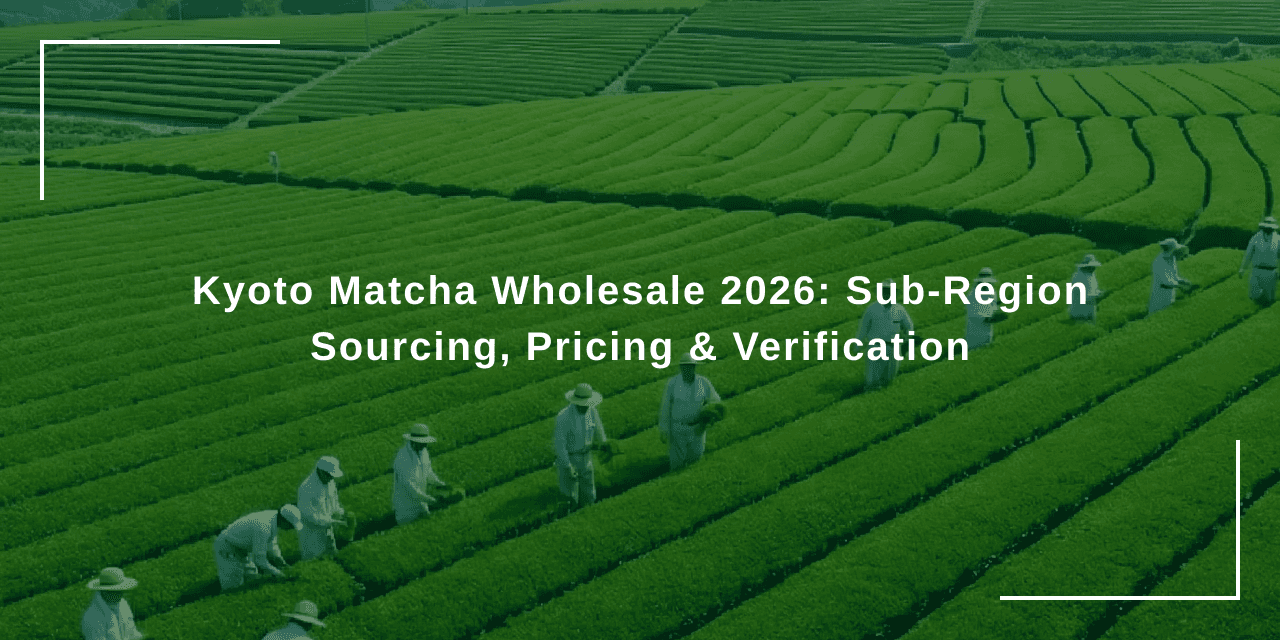
Kyoto matcha wholesale is the most nuanced origin sourcing decision in the 2026 B2B market. The "Kyoto" label spans dramatically different production regions — Uji's traditional hillside hand-picked tencha, Wazuka's more accessible mid-tier production, Kizugawa's mixed operations, and Kyotango's northern coastal tencha — each with different price structures, yield profiles, and allocation accessibility. Most international buyers collapse all of these into "Uji" or "Kyoto," and consequently pay either a premium for product that isn't actually from the premium region or accept commodity pricing for product that deserves a premium. Understanding the Kyoto prefecture production geography is how sophisticated 2026 buyers secure better pricing, more reliable allocation, and verifiable origin stories.
This guide is the 2026 Kyoto wholesale playbook for premium retail brands, luxury foodservice operators, boutique café chains, and private-label buyers who want authentic Kyoto-origin matcha at accurate market prices. It covers the four production sub-regions within Kyoto Prefecture and what each delivers, the verification steps that distinguish genuine Kyoto-origin product from marketing claims, the 2026 wholesale pricing matrix broken out by sub-region, the allocation timing that secures supply while Kyoto tencha prices keep climbing, and the complementary Nishio and Kagoshima sourcing that should accompany any Kyoto-focused supply plan.
Key takeaways for Kyoto matcha wholesale in 2026
- Kyoto Prefecture includes four meaningful matcha production sub-regions: Uji, Wazuka, Kizugawa, and Kyotango. Each has different pricing and availability.
- "Kyoto matcha" without sub-region declaration is insufficient for premium-tier procurement.
- Uji commands 30–80% premium over Wazuka and Kizugawa for equivalent-grade product in 2026.
- Kyoto's 2025 first flush cut traded volume of hand-picked Uji tencha by 21% and machine-picked tencha by 8%; the 2026 first flush brought volume back (up about 19% and 20%), but average prices rose again.
- Allocation contracts signed July–August post-harvest are the only reliable 2026 Kyoto supply mechanism for new or scaled accounts.
- A Kyoto-only supply plan is fragile; pair with Nishio or Kagoshima allocation for supply resilience.
Table of contents
- The four Kyoto matcha production sub-regions
- Verifying Kyoto origin at sub-region level
- 2026 Kyoto wholesale pricing matrix
- Allocation timing and contract mechanics
- Supplier archetypes that deliver Kyoto matcha
- Pairing Kyoto with complementary origins
- Your 2026 Kyoto sourcing action plan
- FAQ
1. The four Kyoto matcha production sub-regions
Kyoto Prefecture produced only about 5% of the 2026 first-flush crude tea (all tea types, provisional MAFF data) from Japan's main producing prefectures — a fraction of Shizuoka's 44% or Kagoshima's 40%. Tencha, the matcha raw material, is the one tea type Kyoto growers are expanding: first-flush tencha volume at Kyoto's JA Zennoh tea market rose about 20% in 2026 while other tea types fell about 20%. Within Kyoto, four distinct production zones account for most commercial output, each with its own character.
Uji District
- Geography: Uji city and surrounding river basin in southern Kyoto Prefecture. The historical heart of Japanese tea production since the 13th century.
- Production share: Approximately 25–30% of Kyoto tencha volume, concentrated on highest-quality grades.
- Cultivation: Predominantly hillside with traditional honzu (straw-mat) shading; hand-picked for top tiers.
- Character: Highest theanine content, most complex aroma, deepest umami. The benchmark for premium Japanese ceremonial matcha.
- Heritage makers headquartered here: Marukyu Koyamaen, Horiishichimeien, Yamamasa Koyamaen.
- 2026 pricing position: Highest; 25–80% above other Kyoto sub-regions for equivalent grade.
Wazuka (Wazuka-cho / Soraku-gun)
- Geography: Mountainous town south of Uji in Soraku County.
- Production share: Approximately half of Kyoto tencha volume.
- Cultivation: Mixed hillside and valley; synthetic shade netting dominates (more cost-efficient than Uji's traditional honzu).
- Character: Strong ceremonial and premium latte-tier quality; subtle character differences from Uji that matter at ceremonial level, less at latte level.
- Commercial positioning: Often marketed as "Kyoto matcha" without Uji-specific claim. Strong value tier for buyers wanting Kyoto origin narrative without Uji pricing.
- 2026 pricing position: 25–35% below Uji for equivalent grade.
Kizugawa
- Geography: Kizugawa city and surrounding districts in southern Kyoto.
- Production share: Approximately 7% of Kyoto tencha volume.
- Cultivation: Flat and rolling terrain; mechanized harvesting for mid and standard tiers.
- Character: Mid-premium quality; stronger in latte and culinary grades than in ceremonial tier.
- Commercial positioning: Often blended with other Kyoto sub-regions for "Kyoto Prefecture" product. Standalone Kizugawa marketing is less common.
- 2026 pricing position: 35–45% below Uji for equivalent grade.
Kyotango
- Geography: Northern Kyoto Prefecture coastal area.
- Production share: Approximately 1% of Kyoto tencha volume.
- Cultivation: Cooler climate, later harvests, smaller-scale production.
- Character: Distinct terroir driven by maritime influence; lower theanine than Uji, specific aroma profile.
- Commercial positioning: Niche; occasionally appears in artisan single-origin packaging.
- 2026 pricing position: Variable; often premium for artisan positioning despite baseline production economics.
"Kyoto Prefecture" blends
Most mid-market wholesale "Kyoto matcha" is a blend drawn from multiple sub-regions, sometimes with small percentages of Uji-origin tencha added for narrative value. The blend itself is legal and common; what matters is disclosure and pricing. Product marketed as "Uji" but sourced from Wazuka or Kizugawa with a small Uji percentage is mislabeled; product marketed as "Kyoto Prefecture blend" with appropriate disclosure is legitimate mid-market supply.
2. Verifying Kyoto origin at sub-region level
For any Kyoto wholesale purchase above USD 10,000/year, verify origin at sub-region level. The documentation checklist:
Required documentation
- Prefecture and sub-region statement. "Kyoto Prefecture, Uji District" / "Kyoto Prefecture, Wazuka-cho" / "Kyoto Prefecture, Kizugawa City" etc. Generic "Kyoto" or "Kyoto-grown" is insufficient for premium-tier procurement.
- Farmer or farm cooperative identification. Production-level traceability to the cooperative or grower. Heritage makers produce from their own farms and name them explicitly; trading exporters identify the cooperative or grower network.
- Cultivar declaration. Samidori, Asahi, Okumidori, Yabukita, Gokou, etc. Sub-region typical cultivars: Uji favors Samidori and Asahi; Wazuka uses wider Yabukita mix; Kizugawa leans toward Okumidori.
- Harvest date and year. Current-year 2026 or prior-year 2025. Older harvest dates indicate inventory-clearance product.
- Processing location. Tencha harvesting and primary processing typically happens in the sub-region. Stone-milling can happen elsewhere but should be documented.
- Blend disclosure (if applicable). If the product is a Kyoto Prefecture blend, the percentage composition by sub-region. A mid-market "Kyoto blend" with 10% Uji and 90% Wazuka should disclose this.
Third-party verification for high-value contracts
Contracts above USD 50K annual warrant third-party verification. Available services in 2026:
- Isotope ratio analysis: Specialist food-authenticity labs in Japan and Europe can distinguish Japanese-origin tea from Chinese or Vietnamese-origin with high confidence through isotope signatures.
- DNA marker analysis: Cultivar-level verification possible via DNA testing; useful when cultivar claims are central to pricing.
- Field audit: Physical visit to claimed production area, verification of farm identity and scale. Heritage makers welcome documented visits from significant wholesale customers.
Red flags in Kyoto-origin claims
- Uji claim at Wazuka or Kizugawa pricing. If the product is marketed as Uji-origin but priced at market-average Kyoto tier, it's almost certainly Wazuka or Kizugawa with an Uji blend-in.
- "Kyoto" origin without sub-region: Commercial-tier legitimate, but not appropriate for premium-tier branding.
- No cultivar declaration: Indicates generic bulk sourcing rather than spec-controlled production.
- Blending percentage undisclosed: "Contains Uji-origin tencha" without percentage means it could be 2% Uji and 98% other. Demand the percentage.
- Harvest-year ambiguity: If the supplier can't document harvest year, the lot is either very old or undocumented supply.
3. 2026 Kyoto wholesale pricing matrix
Kyoto matcha pricing stratifies clearly by sub-region in 2026, with Uji commanding the premium position and other sub-regions offering meaningful value at lower tiers. The matrix below reflects direct-Japan wholesale pricing (FOB Japan) from qualified trading exporters with verifiable sub-region sourcing.
Kyoto ceremonial grade pricing by sub-region (2026, USD/kg)
Sub-region | 1 kg | 10 kg | 25 kg+ | Notes |
|---|---|---|---|---|
Uji | $280–420 | $220–340 | $200–310 | Stone-milled, high theanine, premium cultivars |
Wazuka | $180–290 | $150–240 | $140–220 | Stone-milled, strong ceremonial character |
Kizugawa | $150–240 | $130–200 | $120–180 | Mid-premium ceremonial; volume availability strong |
Kyotango | $200–320 | $170–270 | $155–240 | Niche; artisan positioning often commands premium |
Kyoto Prefecture blend | $120–210 | $100–175 | $90–160 | Multi-region blend; verify composition |
Kyoto premium latte grade pricing by sub-region (2026, USD/kg)
Sub-region | 10 kg | 25 kg+ | Notes |
|---|---|---|---|
Uji | $115–175 | $100–160 | Latte-grade Uji; premium-tier café programs |
Wazuka | $85–130 | $75–115 | Strong latte-tier quality at more accessible pricing |
Kizugawa | $75–115 | $65–100 | Volume latte-tier Kyoto product |
Kyoto Prefecture blend | $65–100 | $55–90 | Entry-tier Kyoto-labeled latte matcha |
Price comparison: Kyoto sub-regions vs other Japanese prefectures (ceremonial, 10 kg MOQ)
Origin | Ceremonial 10 kg (USD/kg) | Relative to Uji baseline |
|---|---|---|
Uji (Kyoto) | $220–340 | 100% baseline |
Wazuka (Kyoto) | $150–240 | 65–75% |
Kizugawa (Kyoto) | $130–200 | 55–65% |
Nishio (Aichi) | $160–240 | 65–75% |
Kagoshima | $140–220 | 60–70% |
Shizuoka | $120–200 | 50–65% |
What the pricing tells you
- Uji-origin premium is genuine but discrete — primarily for ceremonial and single-origin branding, less for volume latte work.
- Wazuka and Kizugawa offer the best Kyoto-origin value proposition — Kyoto narrative at 25–45% pricing discount vs Uji.
- Kagoshima ceremonial at equivalent quality tier is cheaper than Uji and Wazuka — the right volume-driver choice for buyers prioritizing cost over Kyoto narrative.
- Nishio ceremonial is roughly priced at Wazuka-equivalent level with stronger supply consistency — an excellent non-Kyoto alternative.
4. Allocation timing and contract mechanics
The 2024–2025 shortage reshaped how Kyoto wholesale supply is allocated. In 2026, buyers who treat allocation as an afterthought face stock-outs and premium pricing; buyers who understand the harvest and allocation calendar secure predictable supply at reasonable rates.
Kyoto harvest and allocation calendar
Period | What happens | Buyer action |
|---|---|---|
March–April | Shading period begins; early estimates of yield emerge | Monitor harvest news; prepare renewal requests |
May (first flush) | Hand-picked premium tencha harvest | Tencha auction watching; spot purchases if needed |
June–July | Kyoto Prefecture tencha auctions; clearing prices set | Monitor auction results; finalize budget for following year |
July–August | Heritage makers and trading exporters finalize 12-month allocations | Negotiate and sign annual allocation contract |
September–October | Production shipments for early-allocation customers | Receive early deliveries; plan quarterly cadence |
November–February | Ongoing production and shipments against allocations | Standard operations |
Allocation contract structures (2026)
Three common forms:
- Fixed-volume annual allocation: Buyer commits to 12 months of specified volume, supplier commits to fixed per-kg pricing. Most common for 50–500 kg annual buyers.
- Allocation with volume flexibility: Buyer commits to a minimum (e.g., 80% of annual forecast) with option to increase up to a maximum (e.g., 120%). Pricing tiers adjust by final volume. Common for growing accounts.
- Multi-year allocation with renewal: 2–3 year commitment with pricing reset windows. Reserved for established customers with multi-year track record.
Allocation priority clauses (essential 2026)
In today's tight market, every Kyoto allocation contract should include an explicit supply-constraint clause:
- Supply constraint definition: What triggers the clause (e.g., prefecture-wide yield decline > 20%, declared climate event).
- Allocation formula: How constrained supply is divided among contracted customers (typically proportional to prior-year purchase volume).
- Minimum allocation floor: Guaranteed minimum percentage of contracted volume (75–85% is industry standard).
- Alternative grade substitution: If contracted grade is unavailable, supplier's right/obligation to offer next-tier substitute at discounted pricing.
- Notification timeline: Supplier obligation to notify buyer within 48 hours of declaring a supply-constraint event.
5. Supplier archetypes that deliver Kyoto matcha
Not all Japanese matcha suppliers have Kyoto supply chains, and among those that do, service models differ substantially. The right supplier archetype depends on your volume, positioning, and relationship capacity.
Heritage Uji houses
- Examples: Ippodo, Marukyu Koyamaen, Horiishichimeien, Yamamasa Koyamaen, Kanbayashi Shunsho-do.
- Kyoto supply: Predominantly Uji-origin from own farms and contracted growers; Ippodo, headquartered in central Kyoto city, also sources from Wazuka and broader Kyoto.
- Wholesale access in 2026: Very limited for new accounts. 3–6 month onboarding including potential in-person visits.
- Pricing: Highest in the Japanese market.
- Best for: Luxury retail, flagship hospitality, brands where the heritage-maker association itself carries meaningful brand value.
Kyoto-based trading exporters
- Examples: Kyoto Obubu Tea Farms (smaller scale), various Uji-based exporters, First Agri (Shizuoka-based, with Uji + broader Kyoto allocation).
- Kyoto supply: Direct relationships with sub-region producers; transparent on sub-region sourcing and cultivar composition.
- Wholesale access: More accessible than heritage makers. 4–10 week onboarding. Entry MOQ 10–25 kg typical.
- Pricing: 5–15% below heritage maker equivalents for same-sub-region product.
- Best for: Mid-market premium brands, boutique café chains, D2C brands, private labels wanting Kyoto sub-region transparency.
National Japanese exporters with Kyoto portfolio
- Examples: Ito En, Aiya.
- Kyoto supply: Typically blended into multi-region product rather than offered as 100% Kyoto standalone.
- Wholesale access: Volume-driven; minimum commitments typically 500 kg+.
- Pricing: Blend-based, often not Kyoto-percentage transparent.
- Best for: Large beverage manufacturers, RTD producers, industrial food applications.
US/EU distributor brands claiming Kyoto
- Kyoto supply: Varies widely. Some legitimately source Kyoto; others use "Kyoto" loosely. Verification required.
- Wholesale access: Lower MOQ than direct Japan; higher per-kg cost.
- Pricing: 25–40% above equivalent direct Japan.
- Best for: Small-volume buyers, emergency replenishment.
6. Pairing Kyoto with complementary origins
A Kyoto-only matcha supply plan is fragile in the 2026 market. The 2025 first flush, when yields fell across Japan's main producing prefectures just as tencha demand surged, showed how exposed single-origin buyers are: hand-picked Uji tencha volume fell 21% while its average auction price more than doubled. The 2026 best practice is a Kyoto + complement portfolio.
The Kyoto + complement model
Role | Primary origin | Complement origin | Rationale |
|---|---|---|---|
Flagship ceremonial / single-origin | Uji (Kyoto) | — | Premium heritage narrative demands Kyoto specifically |
Mid-premium ceremonial | Wazuka (Kyoto) or Kizugawa (Kyoto) | Nishio (Aichi) as backup | Kyoto narrative at value pricing; Nishio backup for supply continuity |
Volume latte / café program | Kagoshima | Wazuka (Kyoto) optional | Kagoshima for primary volume; small Kyoto allocation for menu variety |
Industrial / ingredient applications | Kagoshima or Shizuoka | — | Kyoto economics don't work for industrial tier |
Private-label retail | Depends on brand positioning | Always have a backup origin contracted | Brand narrative drives origin choice; supply risk drives complement |
Sourcing consolidation vs distribution
Buyers have two models for managing Kyoto + complement:
- Consolidated (single supplier): One trading exporter supplies both Kyoto and complementary origins. Simpler documentation, unified allocation contract, single relationship. Recommended for most mid-market buyers. Examples: First Agri, larger trading exporters.
- Distributed (separate suppliers): One heritage maker for Kyoto flagship product, a separate exporter for volume origins. More complex but sometimes necessary if a brand's positioning demands the heritage-maker relationship explicitly.
Sample Kyoto + complement portfolio (mid-size premium café chain)
- Single-origin flagship SKU (5% of volume): Uji ceremonial from trading exporter, USD 250/kg. Annual: 2 kg.
- Menu hero latte (15% of volume): Wazuka latte grade, USD 100/kg. Annual: 6 kg.
- Core volume latte (75% of volume): Kagoshima latte grade, USD 70/kg. Annual: 30 kg.
- Seasonal / culinary (5% of volume): Kagoshima culinary, USD 40/kg. Annual: 2 kg.
Total annual matcha spend: approximately USD 3,300. Single-supplier consolidation captures the full portfolio under one allocation contract with documentation consistency.
7. Your 2026 Kyoto sourcing action plan
Step 1: Define your Kyoto narrative role
Is Kyoto matcha essential to your brand, or is it one of several origin options? Answer determines scale of investment.
- Essential (brand identity): invest in Uji or Wazuka premium tier; accept premium pricing
- Important (one SKU): small Wazuka or Kizugawa allocation; compensate with Kagoshima for volume
- Optional (menu variety): minimum Kyoto-labeled blend; primary focus on Kagoshima
Step 2: Scale the allocation
Calculate monthly Kyoto-origin consumption by role. Most buyers find Kyoto allocation is 1–5 kg/month — meaningfully less than total matcha consumption. Size the Kyoto contract to match the role, not the total matcha program.
Step 3: Qualify 2 suppliers
- Shortlist 1 Uji-capable supplier (heritage maker or trading exporter) and 1 Kyoto-blend-capable supplier.
- Request samples with full sub-region origin documentation.
- Verify documentation against Section 2 checklist.
- Conduct blind tasting against reference Uji product.
Step 4: Negotiate during July–August allocation window
Kyoto supply is committed to allocation contracts in the post-harvest window. September–October negotiation windows face tighter terms. Plan contract discussions for July.
Step 5: Contract the complement
Simultaneously or sequentially, contract a Kagoshima or Nishio volume supply for non-Kyoto matcha needs. Single-supplier consolidation preferred.
Source Kyoto wholesale with First Agri. Direct Uji and Wazuka allocation plus Kagoshima volume under a single supplier relationship. 7–14 day air freight. Ask us which prefecture-sub-region origin and cultivar documents are available for each lot, and how allocation priority works in supply-constraint scenarios.
Request a Kyoto + complement sourcing plan →
FAQ
What is the difference between "Uji matcha" and "Kyoto matcha"?
Uji matcha is produced in Uji city and surrounding districts in southern Kyoto Prefecture. "Kyoto matcha" can include Uji but also Wazuka, Kizugawa, Kyotango, and blends. Uji commands a 25–80% pricing premium over other Kyoto sub-regions for equivalent grade. Always verify sub-region, not just prefecture.
Is Wazuka matcha worse quality than Uji matcha?
For ceremonial tier, Uji typically has slightly higher theanine content and more complex aroma. For latte-tier applications, Wazuka delivers equivalent cup quality at 25–35% lower cost. Wazuka is not "worse" — it's differently priced for different use cases.
What is the minimum order for Kyoto wholesale matcha in 2026?
5–10 kg for Wazuka/Kizugawa from qualifying trading exporters; 10–25 kg for Uji from most direct exporters; 25 kg+ for most heritage makers. Kyoto Prefecture blends often available from 5 kg.
How do I verify a Kyoto matcha sub-region claim?
Require prefecture and sub-region statement, cultivar declaration, harvest date, farmer or cooperative identification, processing location, and blend composition disclosure if applicable. For contracts above USD 50K annual, commission third-party verification (isotope analysis, DNA markers, or field audit).
Did 2026 Kyoto production recover from the 2024–2025 shortage?
In volume, largely; in price, no. At Kyoto's JA Zennoh tea market, the 2026 first flush lifted hand-picked Uji tencha about 19% to 9,517kg, still below 2024, and machine-picked first-flush tencha about 20%, above its 2024 level. Average prices rose again — about 11% for hand-picked and about 22% for machine-picked tencha — as growers shifted fields into tencha and other tea types fell about 20%. Kyoto's tea industry association reported no sign of prices easing as of August 2026.
Should my café use Kyoto matcha for every SKU?
Almost certainly not. Kyoto matcha justifies its premium in ceremonial service and single-origin positioning. For volume latte work (250 ml + milk + sweetener), Kagoshima or Wazuka delivers equivalent cup character at lower cost. Use Kyoto strategically, not universally.
Related reading
- Uji Matcha Wholesale 2026: Sourcing, Pricing & Verification Amid the Kyoto Shortage
- Uji Matcha: Why Kyoto's Tea Region Produces the World's Finest Matcha
- Matcha Wholesale 2026: The Complete B2B Buyer's Guide to Sourcing from Japan
- Matcha Wholesale Pricing 2026: Complete Cost Breakdown & Tier Analysis
- Matcha Supplier Auditing: Essential Factory Inspection Checklist
- Japanese Tea Regions Explained: A Buyer's Guide to Origin and Quality
Build your Kyoto matcha wholesale program with First Agri.
Kyoto sourcing from Uji, Wazuka, and Kizugawa paired with Kagoshima volume under a single allocation contract. 7–14 day air freight, 25–40% below distributor pricing. Ask us which prefecture-sub-region origin and cultivar documents are available for each lot.