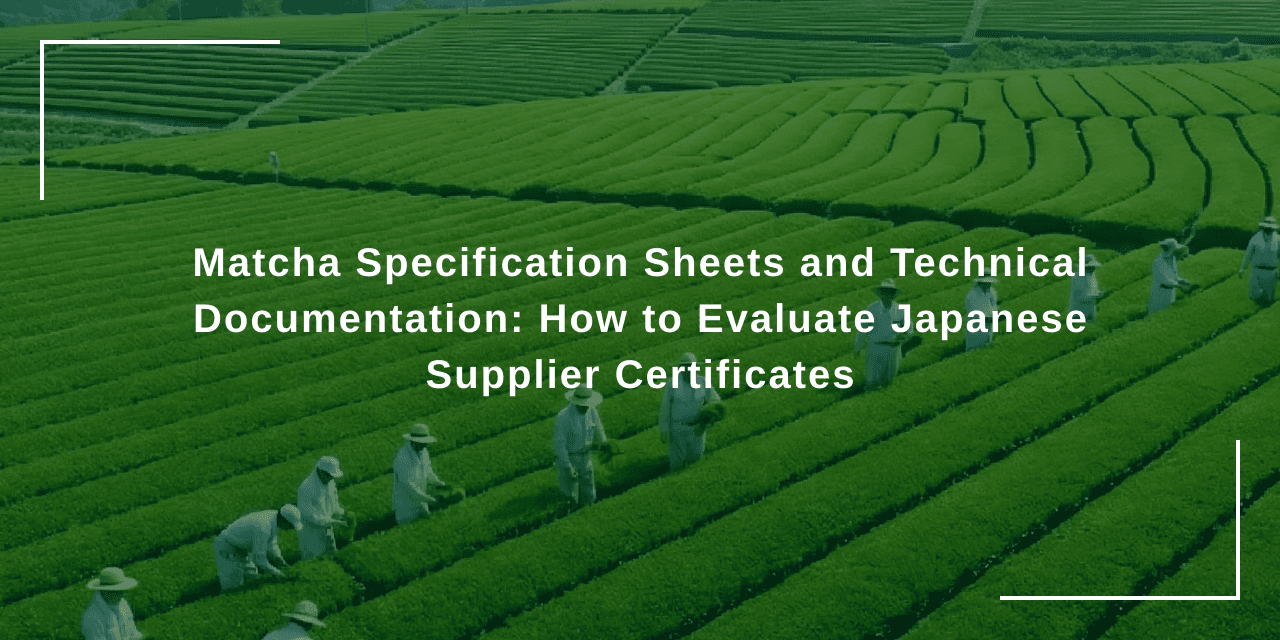
For B2B buyers sourcing matcha from Japanese suppliers, navigating the complex landscape of quality certifications and technical documentation can make the difference between securing premium product and encountering costly quality issues downstream. Understanding how to properly evaluate supplier certificates and specification sheets has become a critical business skill for food manufacturers, beverage companies, and hospitality businesses.
This comprehensive guide will equip you with the knowledge to confidently assess Japanese matcha documentation, identify potential red flags, and establish robust supplier evaluation processes that protect your business interests while ensuring consistent product quality.
Understanding Japanese Quality Certificates: JAS, JFS, and Regional Standards
Japanese matcha suppliers typically provide multiple types of certifications, each serving different purposes in the quality assurance ecosystem. The most fundamental is the Japan Agricultural Standards (JAS) certification, which establishes baseline requirements for organic production, processing methods, and labeling standards.
JAS organic certification requires strict adherence to soil management practices, with a mandatory three-year transition period before fields can be certified organic. For matcha specifically, this means tea plants must be grown without synthetic pesticides, chemical fertilizers, or GMOs. When reviewing JAS certificates, verify the certification number, expiration date, and ensure the specific product matches your order specifications.
The JFS standards of the Japan Food Safety Management Association (JFSM) represent a more recent development, designed to align with international HACCP principles while incorporating uniquely Japanese food safety practices. JFS-A covers general hygiene management with flexible HACCP operation, while JFS-B fully implements Codex HACCP. JFS-C represents the highest tier and is the only one recognized by the Global Food Safety Initiative (GFSI), putting it on the same footing as international standards like BRCGS or SQF.
Regional designations add another layer of authenticity and quality assurance. The Uji-cha regional collective trademark covers tea grown in Kyoto, Nara, Shiga, and Mie Prefectures and finished in Kyoto Prefecture, while the Nishio Matcha regional collective trademark covers matcha grown and processed in the Nishio area of Aichi Prefecture. These regional stamps carry significant weight in the Japanese market and often correlate with premium pricing and superior quality characteristics.
Verifying Certificate Authenticity
Authentication of Japanese certificates requires understanding specific formatting conventions and verification processes. Legitimate JAS certificates include a unique registration number following the format "有機JAS認定番号" followed by a series of numbers and letters. The issuing body's official seal should be clearly visible, and certificate dates must show current validity status.
Cross-reference certification numbers with official lists when possible. Japan's Ministry of Agriculture, Forestry and Fisheries (MAFF) publishes a list of organic JAS certified operators, and certifying bodies such as the Japan Organic and Natural Foods Association (JONA) publish lists of the operators they certify, while regional authorities provide verification services for geographic designations.
Reading Lab Reports: Heavy Metals, Pesticides, and Microbiological Testing Results
Laboratory analysis reports form the technical backbone of matcha quality documentation. Understanding how to interpret these reports protects your business from regulatory compliance issues and ensures product safety for end consumers.
Heavy Metals Testing
Matcha's concentrated nature means heavy metals testing requires particular attention. Japanese suppliers typically test for four primary metals: lead, cadmium, mercury, and arsenic. The EU contaminants regulation, Regulation (EU) 2023/915, sets no specific maximum levels for lead or cadmium in dried tea leaves, so buyers typically define their own limits in purchase specifications, while US FDA guidelines focus on daily exposure limits rather than absolute concentrations.
When reviewing heavy metals reports, verify testing methodology. ICP-MS (Inductively Coupled Plasma Mass Spectrometry) represents the gold standard for accuracy, while older atomic absorption methods may lack sufficient sensitivity for premium products. Results should be reported in mg/kg (parts per million) with clear detection limits stated.
Pesticide Residue Analysis
Japanese matcha testing typically covers 200-400 different pesticide compounds, reflecting both domestic agricultural practices and international export requirements. The testing scope should include organochlorines, organophosphates, carbamates, and newer neonicotinoid compounds.
Critical evaluation points include:
- Method Detection Limits (MDL): Should be well below regulatory maximums
- Sample size and representation: Minimum 100g sample size for reliable results
- Testing date correlation: Reports should be generated within 6 months of harvest
- Quantification vs. detection: Distinguish between "detected but not quantified" and "not detected"
For organic matcha, any pesticide detection above 0.01 mg/kg should trigger investigation, as true organic products should show no synthetic pesticide residues.
Microbiological Testing Standards
Microbiological safety testing for matcha focuses on pathogenic bacteria, yeast, mold, and total plate counts. Japanese standards typically require testing for E. coli, Salmonella, Staphylococcus aureus, and general aerobic bacteria counts.
Acceptable limits vary by intended use, but general guidelines include:
- Total plate count: <10,000 CFU/g, with many Japanese specifications set at 3,000 CFU/g or lower
- Yeast and mold: <100 CFU/g
- E. coli: Negative/absent
- Salmonella: Negative in 25g sample
Pay attention to sample collection methodology descriptions. Proper sampling should follow ISO standards with sterile collection techniques and controlled storage conditions during transport to testing facilities.
Specification Sheet Analysis: Color Values, Particle Size, and Moisture Content
Technical specification sheets provide quantitative data essential for production planning and quality control. Understanding how to interpret these measurements ensures consistent performance in your specific applications.
Color Value Assessment
Color measurement in matcha typically follows the Lab color space system, which provides more precise data than subjective visual assessment. The L* value indicates lightness (0-100 scale), while a* measures green-red spectrum positioning and b* covers blue-yellow spectrum.
Premium ceremonial grade matcha typically shows:
Grade Level | L* Value | a* Value | b* Value | Typical Applications |
|---|---|---|---|---|
Ceremonial | 45-55 | -6 to -8 | 15-25 | Traditional tea ceremony, premium beverages |
Premium | 40-50 | -4 to -7 | 20-30 | Specialty lattes, high-end confections |
Culinary | 35-45 | -2 to -5 | 25-35 | Baking, ice cream, general food production |
Industrial | 30-40 | 0 to -3 | 30-40 | Mass production, cost-sensitive applications |
Color measurements should be taken using standardized conditions with D65 illumination and 10° observer angle. Variations in measurement equipment can produce different results, so establish baseline measurements with your specific applications.
Particle Size Distribution
Particle size directly impacts solubility, mouthfeel, and visual appearance in finished products. Traditional stone-ground matcha achieves finer particle sizes compared to modern mechanical grinding methods.
Quality matcha should show:
- Average particle size: 5-20 micrometers
- D90 value: 90% of particles smaller than 30 micrometers
- Distribution curve: Narrow distribution indicating consistent grinding
Laser diffraction analysis provides the most accurate particle size data. Be wary of reports using only sieve analysis, which cannot accurately measure the fine particles that characterize premium matcha.
Moisture Content and Water Activity
Moisture content directly affects shelf life and susceptibility to quality degradation. Japanese matcha typically maintains moisture content between 3-5% for optimal stability. Higher moisture levels increase risks of mold growth and accelerate color degradation.
Water activity (Aw) measurements provide additional insight into microbial stability. Look for an Aw below 0.6, which is below the growth limit of virtually all spoilage microorganisms: most spoilage bacteria need an Aw of about 0.90 to grow, and even the most tolerant molds and yeasts stop at about 0.61.
Red Flags in Documentation: Incomplete Testing and Translation Issues
Identifying problematic documentation requires understanding common deficiencies and intentional omissions that indicate supplier reliability issues or quality concerns.
Incomplete Testing Protocols
Several warning signs indicate insufficient testing rigor:
- Limited pesticide panels: Testing fewer than 100 compounds may miss relevant contaminants
- Outdated test results: Reports older than 12 months may not reflect current production
- Missing methodology details: Legitimate reports include specific testing methods and equipment used
- Rounded detection limits: Precise analytical work produces specific detection thresholds, not round numbers
Also check whether radioactivity testing is available. Following the 2011 Fukushima incident, responsible Japanese suppliers implemented comprehensive radioactivity screening for cesium-134 and cesium-137. The US FDA deactivated its Fukushima-related import alert in 2021 and the EU lifted its Fukushima-related import restrictions on Japanese food in 2023, so these results are no longer an import requirement in those markets, but a supplier that screens should be able to share recent data on request.
Translation and Documentation Issues
Poor translation quality often masks more serious underlying problems. Professional suppliers invest in accurate technical translation because international business depends on clear communication. Red flags include:
"Certificate translations with technical errors, inconsistent terminology, or missing regulatory reference numbers suggest limited export experience or cost-cutting measures that may extend to quality control processes."
Verify that Japanese characters and English translations match on critical data points like product names, testing dates, and certification numbers. Discrepancies may indicate document manipulation or careless handling of quality records.
Suspicious Quality Claims
Be skeptical of documentation making extraordinary quality claims without supporting data. Terms like "ultra-premium" or "highest grade" should be backed by specific metrics. Similarly, claims about traditional production methods should include verifiable details about stone-grinding duration, shade-growing periods, and harvest timing.
Authentic suppliers readily provide detailed production information because traditional methods represent significant cost investments that justify premium pricing.
Creating Your Documentation Requirements Checklist for Supplier Evaluation
Systematic supplier evaluation requires standardized documentation requirements tailored to your specific business needs and risk tolerance. This checklist framework can be adapted across different product categories and supply chain relationships.
Essential Documentation Categories
Regulatory and Compliance Documents:
- Current organic certification (JAS or equivalent international standard)
- Food safety management certification (JFS, HACCP, or international equivalent)
- Business license and export permits
- Third-party audit reports from recognized certification bodies
Quality Testing Reports:
- Heavy metals analysis (lead, cadmium, mercury, arsenic)
- Pesticide residue testing (minimum 200-compound panel)
- Microbiological safety testing
- Radioactivity screening (cesium-134, cesium-137)
- Nutritional analysis and allergen declarations
Technical Specifications:
- Color measurement data (Lab values with measurement conditions)
- Particle size distribution analysis
- Moisture content and water activity measurements
- pH and solubility characteristics
- Sensory evaluation reports
Supplier Qualification Scoring System
Implement a weighted scoring system to objectively evaluate supplier documentation quality:
- Documentation completeness (30%): All required documents provided within validity periods
- Testing comprehensiveness (25%): Scope and frequency of quality testing
- Certification credibility (20%): Recognition and audit rigor of certifying bodies
- Traceability depth (15%): Ability to trace products to specific farms and harvest dates
- Communication quality (10%): Professional presentation and translation accuracy
Establish minimum threshold scores for new supplier approval and ongoing relationship continuation. This systematic approach reduces subjective decision-making and creates consistent evaluation standards across your procurement team.
Ongoing Monitoring Requirements
Supplier evaluation extends beyond initial qualification. Establish requirements for ongoing documentation updates:
- Annual certification renewals with updated certificates
- Seasonal testing reports reflecting current harvest quality
- Immediate notification of any quality incidents or certification changes
- Regular facility audit reports from third-party assessors
Create document management systems that track expiration dates and automatically request updated documentation before current versions expire. This proactive approach prevents supply chain disruptions due to lapsed certifications.
Ready to source premium matcha with complete confidence in your supplier documentation? First Agri specializes in direct-from-Japan matcha sourcing with comprehensive technical documentation and transparent quality certifications. Our experienced team understands the complexities of Japanese supplier evaluation and provides complete specification sheets, laboratory reports, and certification verification for every product shipment. Request samples and documentation packages to experience the difference that thorough supplier vetting makes for your business success.
Related certified supplier checklist: A specification sheet is only one part of supplier diligence. Use the Certified Matcha Supplier Japan checklist to evaluate certificates, COAs, and operating fit.