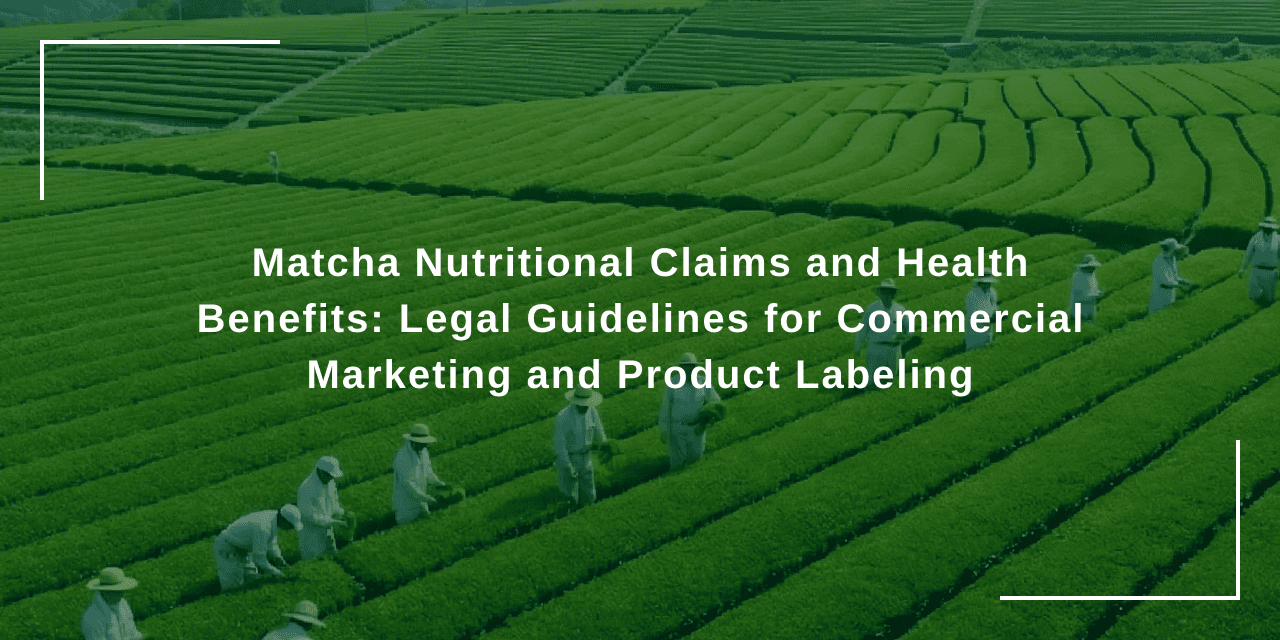
Matcha has exploded in popularity across commercial food and beverage applications, from specialty lattes to premium desserts. However, marketing matcha products requires careful navigation of complex regulatory frameworks governing health claims and nutritional labeling. For B2B buyers developing matcha-infused products, understanding these legal requirements isn't just about compliance—it's about protecting your business from costly violations while maximizing your product's legitimate marketing potential.
The regulatory landscape for matcha health claims varies significantly across jurisdictions, with strict documentation requirements and specific formatting standards that can make or break your product launch. This comprehensive guide provides the essential knowledge you need to market matcha products legally and effectively in today's regulated marketplace.
Understanding Regulatory Frameworks: FDA, EU, and International Health Claim Standards
The foundation of compliant matcha marketing begins with understanding the distinct regulatory approaches across major markets. Each jurisdiction has developed specific frameworks for evaluating and approving health claims, with varying degrees of stringency and different evidentiary standards.
FDA Regulations in the United States
The FDA categorizes health-related statements into three distinct types: structure/function claims, nutrient content claims, and health claims. For matcha products, this distinction is crucial because each category has different substantiation requirements and approval processes.
Structure/function claims describe how a nutrient affects normal body functions without making disease-related statements. For matcha, you might legally claim that "antioxidants support cellular health" but cannot claim that matcha "prevents cancer." The FDA requires reasonable substantiation for these claims but doesn't require pre-market approval.
Nutrient content claims must meet specific quantitative thresholds. To label matcha as a "good source of antioxidants," the product must contain at least 10% of the Daily Value for the specified antioxidant compounds. This becomes complex with matcha because many of its beneficial compounds don't have established Daily Values.
European Union Regulations
The European Food Safety Authority (EFSA) maintains a more restrictive approach through Regulation EC 1924/2006. The EU operates on a positive list system, meaning only pre-approved health claims can be used in marketing materials. This creates challenges for matcha marketers because many traditional health benefits associated with green tea haven't received EFSA approval.
Currently, the only approved health claim for tea products in the EU relates to weight management and metabolic function, specifically that "tea catechins help maintain normal blood LDL-cholesterol concentrations." This narrow approval significantly limits marketing language for European markets.
International Considerations
Markets like Canada, Australia, and Japan each maintain their own regulatory frameworks. Health Canada requires Natural Product Numbers (NPNs) for products making health claims, while Australia's Therapeutic Goods Administration uses a risk-based classification system. Japanese regulations, particularly relevant for matcha, focus on functional food categories but require substantial clinical evidence for health claims.
Permitted vs Prohibited Claims: What You Can Legally Say About Matcha's Health Benefits
Understanding the boundary between compliant marketing language and prohibited health claims is essential for commercial success. The key lies in focusing on factual nutritional information rather than therapeutic benefits.
Generally Permitted Claims
Most jurisdictions allow factual statements about matcha's nutritional composition when properly substantiated. You can typically state that matcha "contains antioxidants," "provides caffeine," or "is a source of L-theanine" if your product testing confirms these compounds are present in meaningful quantities.
Sensory and experience-based claims often face fewer restrictions. Statements like "provides sustained energy" or "supports focus and concentration" may be permissible as structure/function claims, though they still require reasonable substantiation through consumer studies or scientific literature.
"The difference between compliant and non-compliant claims often comes down to specificity. General wellness statements typically face less scrutiny than specific health outcomes."
Prohibited Territory
Disease-related claims represent the most dangerous territory for matcha marketers. Statements suggesting that matcha can "boost immunity," "detoxify the liver," "prevent diabetes," or "fight inflammation" typically cross into therapeutic territory requiring drug-level substantiation.
Comparative claims also present risks. Saying matcha has "more antioxidants than blueberries" requires rigorous testing protocols and standardized measurement methods. Many businesses run into trouble when making these comparisons without proper analytical support.
The Gray Area: Qualified Health Claims
The FDA allows qualified health claims when scientific evidence supports a relationship between a food component and health outcome, but the evidence doesn't meet the standard for an authorized health claim. These claims are not free-form: a company petitions FDA, and if FDA finds credible evidence it issues a Letter of Enforcement Discretion setting out the specific claim wording and qualifying language the label must use. For green tea, the only such claim concerns breast and prostate cancer risk (letters of February 24, 2011 and April 17, 2012). FDA denied a qualified health claim for green tea and reduced risk of cardiovascular disease on May 9, 2006, finding no credible evidence, so no cardiovascular qualified health claim is available for green tea or matcha. The wording "This statement has not been evaluated by the Food and Drug Administration" belongs to the dietary-supplement disclaimer, not to qualified health claims.
Documentation Requirements: Scientific Evidence and Substantiation for Nutritional Claims
Regulatory compliance requires robust documentation supporting every health-related claim. The type and quality of evidence needed varies by claim type and jurisdiction, but certain principles apply universally.
Analytical Testing Requirements
Any nutritional claim must be supported by analytical testing of your specific matcha product. Generic literature about matcha isn't sufficient—regulators require product-specific data. This means testing for catechins, caffeine, L-theanine, and other compounds you plan to highlight in marketing materials.
Testing protocols should follow recognized analytical methods such as those published by AOAC International. For matcha, high-performance liquid chromatography (HPLC) is typically required for catechin analysis, while spectrophotometric methods may be acceptable for total antioxidant capacity measurements.
Compound | Typical Testing Method | Regulatory Consideration | Substantiation Level |
|---|---|---|---|
EGCG (Epigallocatechin gallate) | HPLC-UV | Individual catechin claims | High |
Total Catechins | HPLC-UV | General antioxidant claims | Medium |
Caffeine | HPLC-UV or UPLC-MS | Stimulant content labeling | Required |
L-theanine | HPLC-FLD | Amino acid content claims | Medium |
ORAC (Oxygen Radical Absorbance Capacity) | Fluorometric | Antioxidant capacity | Low |
Literature Review and Meta-Analysis
Strong substantiation files include comprehensive literature reviews demonstrating scientific consensus around claimed benefits. For matcha, this might include peer-reviewed studies on green tea catechins, clinical trials on L-theanine and cognitive function, or epidemiological studies on tea consumption and health outcomes.
The quality of scientific evidence matters significantly. Randomized controlled trials carry more weight than observational studies, while human studies are preferred over animal or in-vitro research. For structure/function claims, even a single well-designed study may provide adequate substantiation, though multiple studies strengthen your position.
Manufacturing and Quality Documentation
Regulators increasingly scrutinize manufacturing processes and quality control systems. Good Manufacturing Practice (GMP) certification, Hazard Analysis Critical Control Points (HACCP) documentation, and third-party quality certifications all strengthen your substantiation file.
For matcha specifically, documentation should address authenticity concerns, pesticide residue testing, heavy metals analysis, and microbiological safety. These factors don't directly support health claims but demonstrate the overall integrity of your product and manufacturing process.
Labeling Compliance: Formatting Requirements and Mandatory Disclaimers
Even permitted health claims must be presented according to specific formatting requirements. Regulatory agencies are increasingly focused on how claims appear to consumers, not just the technical accuracy of the statements.
FDA Labeling Requirements
The disclaimer "This statement has not been evaluated by the Food and Drug Administration. This product is not intended to diagnose, treat, cure, or prevent any disease." is required only on dietary supplements that make structure/function claims (21 CFR 101.93), and supplement makers must also notify FDA within 30 days of first marketing a supplement that bears the claim. Matcha powder, matcha lattes and ready-to-drink matcha beverages are conventional foods, so FDA requires neither the disclaimer nor the notification for their structure/function claims. Those claims must still be truthful and not misleading, and should describe effects that come from the food's nutritive value. The disclaimer comes into play only if you sell matcha as a dietary supplement, for example in capsules, where it must appear prominently and be easily readable.
The FDA also requires that health claims be presented in a balanced way. If you highlight beneficial compounds, you cannot ignore potential negative aspects. For matcha, this might mean acknowledging caffeine content alongside antioxidant claims, particularly for products targeting caffeine-sensitive consumers.
EU Labeling Standards
European regulations require that approved health claims appear exactly as authorized, without modification or embellishment. The claim must be accompanied by information about the quantity of the food or food constituent that provides the claimed benefit, along with any conditions of use or warnings.
For the approved tea catechin claim, products must specify that the effect is obtained with a daily intake of 150-300mg of catechins from green tea, and this information must appear near the health claim on packaging.
Digital Marketing Considerations
Online marketing presents unique compliance challenges because space constraints on social media and digital advertisements can make it difficult to include required disclaimers. The FTC requires that disclaimers be "clear and prominent," meaning they can't be buried in terms of service or require multiple clicks to access.
For matcha products marketed online, ensure that any health-related claims made in advertisements, social media posts, or e-commerce listings include appropriate qualifications and disclaimers visible without scrolling or clicking to additional pages.
Case Studies: Common Violations and How to Avoid Regulatory Penalties
Learning from others' compliance failures provides valuable insights into enforcement priorities and common pitfalls in matcha marketing.
Case Study 1: Overstated Antioxidant Claims
A premium matcha beverage company faced FDA warning letters for claiming their product contained "the highest concentration of antioxidants available in any natural food." The violation occurred because the company lacked comparative testing data and used superlative language without substantiation.
Lesson learned: Comparative claims require head-to-head testing using standardized methods. Superlative language ("highest," "best," "most powerful") faces heightened scrutiny and should be avoided unless supported by extensive comparative data.
Case Study 2: Implied Disease Claims
An organic matcha powder distributor received regulatory action for marketing materials stating that their product "fights free radicals that cause aging and disease." While technically a structure/function claim, regulators determined that referencing "disease" crossed into therapeutic territory.
Lesson learned: Context matters as much as specific language. Even permitted claims can become problematic when presented alongside disease-related imagery or testimonials suggesting therapeutic benefits.
Case Study 3: Inadequate Substantiation
A matcha supplement manufacturer faced enforcement action despite making only structure/function claims. The issue arose during facility inspection when regulators found that the company's substantiation file consisted entirely of general green tea research without product-specific testing or analysis.
Lesson learned: Substantiation must be product-specific and readily available for regulatory review. Generic industry research isn't sufficient to support claims about your specific matcha product.
Prevention Strategies
Successful companies implement systematic compliance programs including regular legal review of marketing materials, comprehensive substantiation files maintained by qualified scientific staff, and clear internal guidelines distinguishing permitted from prohibited claim types.
Staff training is crucial because violations often occur when sales teams or marketing personnel create materials without understanding regulatory constraints. Regular compliance training helps ensure that everyone from product developers to social media managers understands the boundaries of permissible marketing language.
Working with Legal Counsel: When to Seek Professional Review for Marketing Materials
While internal compliance programs are essential, certain situations require professional legal review to minimize risk and ensure regulatory compliance.
Mandatory Legal Review Situations
Any health claim beyond basic nutritional information should receive legal review before implementation. This includes structure/function claims, comparative statements, and any marketing language suggesting health benefits. The cost of legal review is minimal compared to potential enforcement actions, product recalls, or class-action litigation.
International expansion always warrants legal consultation because regulatory frameworks vary significantly across jurisdictions. A claim that's perfectly compliant in the United States might violate European regulations, potentially leading to product seizures or market access restrictions.
Selecting Appropriate Legal Counsel
Food and supplement regulation is a specialized legal field requiring specific expertise. Look for attorneys with FDA experience, food law specialization, and familiarity with your target markets. Many larger firms maintain dedicated food and drug practice groups with the specialized knowledge needed for complex compliance issues.
Consider establishing ongoing relationships rather than project-based consultations. Regular legal counsel can provide guidance on evolving regulations, review marketing materials proactively, and help develop internal compliance programs that prevent violations before they occur.
Cost-Benefit Analysis
Legal review costs typically range from a few hundred dollars for simple claim review to several thousand for comprehensive compliance audits. Compare this to potential enforcement actions, which can include warning letters, product recalls, facility shutdowns, and criminal prosecution in severe cases.
The reputational damage from regulatory violations often exceeds direct financial costs. A single FDA warning letter can damage relationships with retailers, distributors, and consumers, making legal consultation a worthwhile investment in business protection.
Implementing Your Compliance Strategy
Successful matcha marketing compliance requires a systematic approach combining scientific substantiation, legal review, and ongoing monitoring of regulatory developments. Start by conducting comprehensive analytical testing of your specific matcha products, focusing on compounds you plan to highlight in marketing materials.
Develop clear internal guidelines distinguishing permitted structure/function claims from prohibited disease claims. Train your marketing and sales teams on these distinctions, and implement review processes ensuring that all customer-facing materials comply with applicable regulations.
Consider engaging legal counsel for initial compliance audit and ongoing review of marketing materials. While this represents an upfront investment, it provides crucial protection against enforcement actions and supports sustainable business growth in regulated markets.
The matcha market's continued growth depends partly on responsible marketing that maintains consumer trust and regulatory compliance. By following these guidelines, you can maximize your product's marketing potential while avoiding costly violations that could damage your business and the industry's reputation.
Ready to develop compliant, high-quality matcha products for your business? First Agri sources premium ceremonial and culinary-grade matcha directly from traditional Japanese tea gardens, ensuring consistent quality and authenticity for your commercial applications. Our comprehensive quality documentation and analytical testing support your compliance efforts from product development through market launch. Request samples and technical specifications today to discover how our direct-from-Japan sourcing can elevate your matcha products while supporting your regulatory compliance goals.