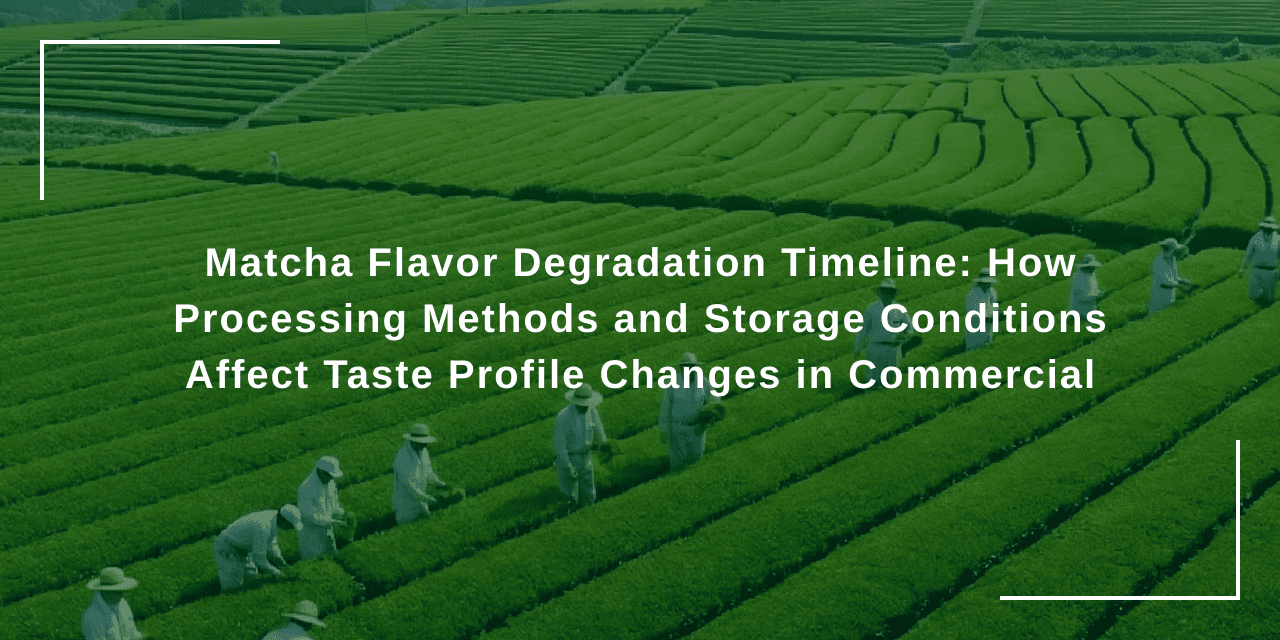
For commercial buyers investing in matcha as an ingredient, understanding flavor degradation patterns isn't just about quality—it's about protecting profit margins and maintaining consistent customer experiences. Unlike traditional tea leaves that can maintain acceptable quality for years, matcha's vibrant flavor profile begins changing within days of production, making storage and handling decisions critical business considerations.
The stone-ground powder that delivers matcha's distinctive umami-rich taste contains volatile compounds that react predictably to environmental stressors. By understanding these degradation patterns, food manufacturers, beverage companies, and cafe operators can optimize their purchasing, storage, and inventory rotation strategies to maintain product quality while minimizing waste.
Understanding Matcha's Primary Flavor Compounds and Their Vulnerability to Degradation
Matcha's complex flavor profile results from specific compounds concentrated through the shade-growing process and stone grinding. L-theanine, responsible for the smooth, savory umami taste, comprises 3-4% of high-grade matcha's composition—significantly higher than regular green tea. Chlorophyll contributes to both the vibrant green color and grassy undertones, while catechins (particularly EGCG) provide the subtle astringency that balances sweetness in beverage applications.
These compounds degrade at different rates under commercial storage conditions. Chlorophyll breaks down rapidly when exposed to light and heat, leading to the familiar brown discoloration that signals flavor deterioration. L-theanine remains relatively stable but can be overwhelmed by the bitter compounds that emerge as catechins oxidize. The volatile oils responsible for matcha's fresh aroma dissipate quickly once the powder is exposed to air.
Most critically for commercial applications, flavor degradation follows a predictable cascade pattern. The bright, grassy top notes disappear first (within 24-48 hours of air exposure), followed by the development of stale, hay-like off-flavors as chlorophyll degrades. Finally, increased bitterness emerges as oxidized catechins begin to dominate the taste profile.
Temperature Sensitivity of Key Compounds
Research indicates that every 10°C increase in storage temperature roughly doubles the rate of chlorophyll degradation. At room temperature (20-22°C), noticeable color changes occur within 2-3 weeks. At refrigerated temperatures (4°C), the same degree of degradation takes 6-8 weeks. This temperature sensitivity directly translates to flavor changes, making cold storage essential for maintaining product consistency in commercial applications.
How Processing Methods (Stone-Ground vs Machine-Milled) Affect Long-Term Flavor Stability
The grinding method significantly impacts how quickly matcha degrades after production. Traditional stone grinding operates at low speeds (30-40 RPM) and generates minimal heat, preserving the cellular structure of the tea leaves. This results in larger particle sizes (10-20 microns) with less surface area exposed to oxidation.
Machine-milled matcha, while more cost-effective to produce, creates smaller particles (5-10 microns) through high-speed grinding that generates friction heat. This increased surface area accelerates oxidation and creates more points of vulnerability for flavor compound degradation.
In commercial taste tests, stone-ground matcha maintained acceptable flavor profiles for 90-120 days under proper storage conditions, while machine-milled varieties showed significant deterioration after 60-75 days. However, machine-milled matcha's finer particle size provides better suspension in liquid applications, creating a trade-off between stability and functional performance.
"For beverage applications where matcha is consumed within 30-45 days, machine-milled varieties can offer cost advantages without noticeable quality compromise. For longer-term storage or applications where subtle flavor differences matter—like premium desserts or ceremonial preparations—stone-ground matcha justifies the higher initial investment." - Quality Control Manager, Leading Japanese Tea Processor
Particle Size and Surface Area Impact
The relationship between particle size and degradation rate follows predictable scientific principles. Smaller particles provide approximately 40-50% more surface area for oxidation reactions. This translates to measurably faster flavor deterioration in machine-milled products, particularly in the first 30 days after grinding when volatile compounds are most vulnerable to loss.
Environmental Factors That Accelerate Flavor Loss: Temperature, Light, Humidity, and Oxygen Exposure
Commercial matcha storage requires controlling four primary environmental variables, each contributing differently to flavor degradation patterns.
Temperature Control
Optimal storage temperature range: -1°C to 4°C. Each degree above optimal storage temperature accelerates chemical reactions that break down flavor compounds. At typical warehouse temperatures (15-20°C), chlorophyll degradation occurs 3-4 times faster than under refrigerated conditions. Freezer storage (below -10°C) can extend shelf life significantly but requires careful thawing procedures to prevent condensation damage.
Light Exposure
UV and visible light catalyze chlorophyll breakdown through photodegradation. Direct sunlight can cause noticeable color and flavor changes within 6-8 hours. Even fluorescent warehouse lighting contributes to gradual degradation over weeks of exposure. Opaque packaging or light-blocking storage containers are essential for maintaining quality during distribution and storage phases.
Humidity Management
Ideal relative humidity: 45-55%. Higher humidity levels promote enzymatic reactions that accelerate flavor compound breakdown while encouraging microbial growth. Lower humidity can cause static electricity issues during handling and processing. Humidity fluctuations are particularly damaging, as they create condensation cycles that introduce moisture directly into the powder.
Oxygen Exposure
Perhaps the most critical factor for commercial operations, oxygen exposure begins the moment packaging is opened. Flavor degradation accelerates exponentially once containers are opened, making portion control and resealing protocols crucial. Vacuum packaging or nitrogen flushing can extend shelf life by 200-300% compared to standard packaging methods.
Flavor Degradation Timeline: What to Expect at 30, 60, 90, and 180 Days Under Different Storage Conditions
Understanding specific degradation timelines helps commercial buyers plan inventory rotation and quality control testing schedules. These timelines assume proper initial quality and vary based on grade and processing methods.
Storage Condition | 30 Days | 60 Days | 90 Days | 180 Days |
|---|---|---|---|---|
Optimal (4°C, dark, sealed) | No noticeable changes | Slight aroma reduction | 10-15% flavor intensity loss | 25-30% degradation, still usable |
Refrigerated (4°C, opened weekly) | Slight staleness in aroma | Noticeable flavor flattening | 20-25% quality loss | Poor quality, bitter notes |
Room temperature (20°C, sealed) | Color begins fading | Hay-like off-flavors develop | Significant quality loss | Unsuitable for premium applications |
Poor storage (warm, light, air exposure) | Brown discoloration, bitter taste | Severe degradation | Unusable quality | Complete flavor breakdown |
Critical Quality Thresholds
Commercial applications have different tolerance levels for quality degradation. Premium beverage applications require maintaining 90%+ of original flavor intensity, limiting useful life to 60-90 days even under optimal storage. Baked goods and ice cream applications can tolerate 70-80% flavor retention, extending usable life to 120-150 days. Mass market applications with stronger flavor masking may accept 60-70% retention, allowing 180+ day storage under proper conditions.
Testing Methods for Monitoring Flavor Changes in Commercial Operations
Implementing systematic quality control testing protects product consistency and helps optimize purchasing cycles. Commercial operations should establish both sensory evaluation protocols and objective measurement systems.
Sensory Evaluation Protocols
Weekly taste testing using standardized preparation methods (2g matcha in 100ml 80°C water) provides early warning of flavor changes. Train multiple team members to recognize specific off-flavors: staleness (loss of fresh grassy notes), hay-like aromas (chlorophyll degradation), and increased bitterness (catechin oxidation). Document findings with consistent terminology and rating scales.
Visual Quality Assessment
Color changes often precede flavor degradation by 7-14 days, making visual inspection a valuable early indicator. Fresh matcha should maintain vibrant jade green color. Yellow tinting indicates early deterioration, while brown discoloration signals significant degradation. Digital color measurement tools can provide objective data for tracking changes over time.
Objective Testing Methods
For larger operations, chlorophyll content measurement using simple spectrophotometric methods provides quantitative data on degradation rates. Moisture content testing ensures storage conditions remain appropriate. pH testing can detect chemical changes that affect flavor balance before they become organoleptically apparent.
Formulation Adjustments: Compensating for Flavor Degradation in Product Development
Smart product developers account for predictable flavor degradation when formulating commercial products. This approach maintains consistent customer experience while optimizing ingredient costs and inventory management.
Overformulation Strategies
Increasing matcha content by 10-20% above the target flavor intensity compensates for degradation during typical storage periods. This approach works well for products with 30-60 day shelf lives, ensuring end-consumers receive the intended flavor experience even when using matcha that's 4-6 weeks post-grinding.
Complementary Flavor Systems
Natural flavor compounds can supplement matcha's volatile components that dissipate quickly. Natural green tea extracts provide grassy top notes, while umami enhancers like certain amino acid combinations can restore the savory depth that fades with L-theanine degradation. These additions should complement rather than mask the matcha character.
Stabilization Techniques
Encapsulation technologies protect matcha from environmental stressors in shelf-stable products. Spray-drying with protective carriers, lipid encapsulation, or inclusion in fat-based systems can significantly extend functional shelf life. These methods add processing costs but may be justified for premium products or longer distribution chains.
Cost-Benefit Analysis: Premium Storage vs Faster Inventory Turnover for Flavor Preservation
Commercial operations must balance storage costs against quality maintenance and waste reduction. The optimal approach depends on usage volumes, application requirements, and customer quality expectations.
Premium Storage Investment
Dedicated refrigerated storage adds approximately $0.50-1.00 per kilogram per month in operating costs but can extend usable life by 200-300%. For operations using 50+ kilograms monthly, dedicated cold storage typically pays for itself through reduced waste and improved product consistency.
Vacuum packaging and nitrogen flushing equipment requires initial investment of $5,000-15,000 but reduces degradation rates by 60-80% compared to standard packaging. Break-even typically occurs within 12-18 months for operations processing 100+ kilograms annually.
Rapid Turnover Strategy
Purchasing smaller quantities more frequently (15-30 day supplies) maintains optimal quality without storage infrastructure investment. This approach requires reliable supply chains and may result in 10-15% higher unit costs due to reduced volume discounts. However, elimination of waste from degraded product often offsets the price premium.
Hybrid Approaches
Many successful operations combine strategies: maintaining 60-75% inventory in optimal storage conditions for consistent quality, while keeping 25-40% in rapid-turnover purchasing cycles for premium applications requiring peak flavor characteristics.
"We switched to weekly deliveries of small batches for our signature matcha lattes while keeping bulk inventory for baked goods. The slight increase in purchasing costs was more than offset by eliminated waste and consistent customer satisfaction scores." - Operations Manager, Regional Coffee Chain
Implementing Quality Control Systems
Successful matcha flavor preservation requires systematic approaches rather than ad-hoc storage decisions. Establish clear protocols for receiving, testing, storage, and inventory rotation. Document storage conditions and quality assessment results to identify trends and optimize procedures.
Train staff on proper handling techniques: minimizing air exposure during portioning, maintaining cold chain integrity, and recognizing early signs of quality deterioration. Create standard operating procedures for different applications, acknowledging that premium beverages and mass-market baked goods have different quality tolerance levels.
Supplier Relationship Management
Work with suppliers who understand commercial storage challenges and can provide guidance on optimal handling procedures for their specific products. Request processing dates, storage recommendations, and expected shelf life data. Establish quality standards and testing protocols that align with your specific application requirements.
Ready to optimize your matcha supply chain for maximum flavor stability and cost efficiency? First Agri sources premium matcha directly from certified Japanese producers, ensuring the freshest possible product reaches your facility. Our quality control team can provide detailed storage recommendations and degradation timeline data specific to our products.
Request samples and detailed technical specifications to evaluate how our stone-ground matcha performs in your specific applications. Contact our B2B team to discuss volume pricing, custom packaging options, and supply chain solutions that maintain peak flavor quality throughout your inventory cycle.