Key Takeaways
- Uji's 800-year tea heritage, combined with its unique terroir — river fog from the Uji River, sharp temperature swings, and mineral-rich alluvial soil — creates conditions that no other region can replicate
- Traditional Uji production methods (natural reed-and-straw shading, brick tencha ovens, slow stone-milling at 30–40g per hour) prioritize flavor complexity over volume, which is why Uji matcha commands a 1.5–3x price premium over other origins
- The 2025 supply crisis saw hand-picked Uji tencha auction prices more than double (+135% year-over-year) as traded volume fell 21% and export demand soared; the 2026 harvest brought back some volume but prices rose again, so early procurement and direct supplier relationships remain critical
- Verifying authentic Uji matcha requires checking origin documentation, harvest timing (first flush only for top grades), milling method documentation, and physical indicators like vibrant green color and creamy aroma
Eight Centuries of Tea Excellence
The story of Uji matcha begins in the early Kamakura period. In 1191, the Zen monk Eisai brought tea seeds and preparation methods back from Song Dynasty China, popularizing tea culture in Japan. His contemporary, the monk Myoe Shonin, planted these seeds at Kozan-ji temple in Kyoto's Toganoo district — establishing one of Japan's first tea gardens.
As cultivation expanded to areas with more favorable growing conditions, the Uji region emerged as the premier production site. During the Muromachi period, the distinction became formal: in the popular tea-tasting competitions known as "tocha," tea from Uji and Toganoo was classified as "honcha" (authentic tea), while tea from all other regions was labeled "hicha" (non-authentic). Under the patronage of the Ashikaga shoguns, Uji's seven renowned tea gardens were cultivated and protected, cementing the region's reputation.
The most consequential innovation came in the 15th–16th centuries with the development of "oishita saibai" — the practice of shading tea bushes before harvest using reed screens and straw mats. This technique suppressed bitterness while dramatically increasing umami and chlorophyll content, creating the foundation for modern premium matcha. By the Edo period, the Tokugawa shogunate organized elaborate processions called "ocha-tsubo dochu" to transport Uji's finest tea to Edo, a practice that continued for over two centuries.
What Makes Uji Matcha Different: Terroir and Climate
The flavor profile of Uji matcha is shaped by specific geographic and climatic conditions in the Yamashiro Basin of southern Kyoto Prefecture — factors that other tea regions cannot reproduce.
The Uji River Effect
The most distinctive feature of Uji's geography is the river fog that rises from the Uji River. This fog provides natural humidity control and acts as a diffusion filter for sunlight — reducing UV stress on tea leaves. Less UV stress means the amino acid L-theanine (responsible for umami) is preserved in the leaves rather than converting to catechins (responsible for bitterness). The annual mean temperature is about 16°C, with abundant rainfall during the spring-to-summer growing season.
Soil Composition
Uji's soil contains ancient river deposits and weathered granite, providing rich mineral content. The hillside tea gardens offer excellent drainage, allowing roots to grow deep while preventing waterlogging. This soil composition contributes to Uji matcha's characteristic creamy texture and clean sweetness.
Regional Comparison
Region | Key Climate/Geography | Soil Type | Flavor Profile | Primary Use |
|---|---|---|---|---|
Uji (Kyoto) | River fog, extreme temperature swings | Fertile alluvial deposits | Deep umami, creamy, elegant sweetness | Ceremonial, highest-grade products |
Nishio (Aichi) | Coastal humidity, mild temperatures | Sandy soil from Yahagi River | Smooth, low bitterness, vivid color | Cooking, confectionery, daily use |
Kagoshima | Subtropical climate, strong sunlight | Volcanic ash (shirasu) | Bold, slightly wild, hint of bitterness | Beverage ingredients, organic, industrial |
Shizuoka | Mt. Fuji fog, varied elevations | Volcanic and gravelly soil | Refreshing, sharp, fresh-grass aroma | Sencha-dominant; matcha for multiple uses |
While southern regions like Kagoshima benefit from warm climates that allow multiple harvests per year and higher output volumes, the complex and refined umami that defines top-tier matcha requires Kyoto's harsh winters followed by humid springs — a combination unique to the Uji basin.
The Uji Production Process
Traditional Shading (Oishita Saibai)
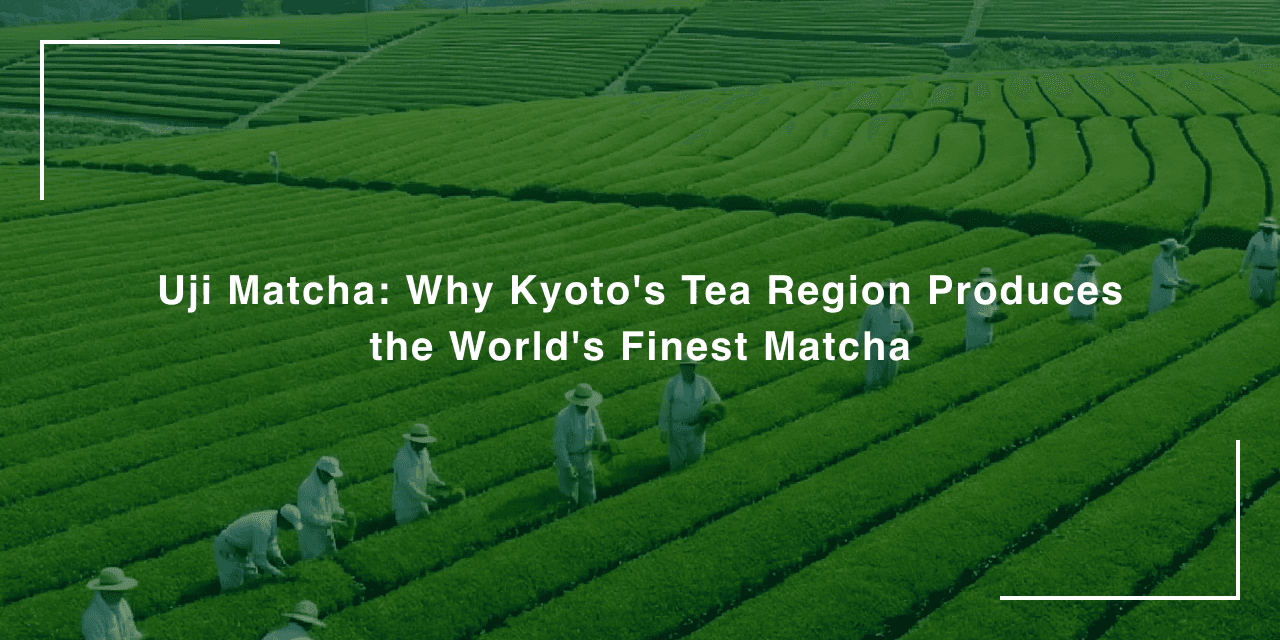
The shading process begins 20–30 days before harvest and is the single most important factor in determining matcha quality. For Uji's highest grades, natural materials — reed screens (yoshizu) and rice straw (wara) — are still used rather than synthetic netting. This traditional "honzu" method blocks over 90% of sunlight, triggering a physiological stress response in the tea plant: chlorophyll production surges (creating deep green color), while the conversion of L-theanine to catechins is suppressed (preserving umami over bitterness).
Natural straw coverings also allow rainwater to permeate gradually and impart a subtle fragrance to the leaves — the distinctive "ooi-ka" (covering aroma) that characterizes authentic Uji matcha.
Tencha Oven Drying
After harvesting, leaves are immediately steamed to halt oxidation, then dried in traditional brick tencha ovens — some extending up to 10 meters in length. Unlike sencha, which is rolled during drying, tencha leaves are dried flat on conveyor belts using radiant heat from the brick walls. The dried leaves are then sorted to remove veins and stems, yielding pure leaf material ready for milling.
Stone Milling: Where Patience Defines Quality
The final step — and perhaps the most defining characteristic of premium Uji matcha — is stone milling using granite mills.
Specification | Stone Mill (Uji Traditional) | Ball Mill (Mass Production) |
|---|---|---|
Rotation speed | 30–38 rpm | High-speed rotation |
Temperature control | Maintained below 35°C | Requires active cooling |
Output per hour | 30–40g | 1–25kg |
Particle shape | Irregular, smooth edges (sheared) | Sharp edges (crushed) |
Average particle size | 5–11 μm | 15–50+ μm |
The critical advantage of stone milling is heat control. At just 30–40 grams per hour, there is minimal friction heat — preserving the volatile aromatics and vibrant color that are destroyed when temperatures rise. The unique groove pattern of the granite stones shears the leaves rather than crushing them, producing ultra-fine particles that create an exceptionally smooth mouthfeel when whisked.
Grades and Pricing for B2B Buyers
Uji matcha pricing is determined by harvest timing, picking method (hand vs. machine), and milling process. The 2025 supply crisis reset the pricing landscape, and prices moved higher again with the 2026 harvest.
Grade | Retail Price (per 30g) | Characteristics | B2B Notes |
|---|---|---|---|
Supreme Ceremonial | ¥5,000 – ¥15,000 | First harvest, hand-picked, single cultivar, stone-milled | Allocation-based; requires established relationships |
Premium | ¥3,000 – ¥5,000 | First harvest, machine-picked, stone-milled | Suitable for signature cafe lattes and premium retail |
Culinary | ¥1,000 – ¥2,500 | Second harvest or later, ball-milled | Available in larger quantities; lower color and aroma |
Compared to Kagoshima or Nishio matcha of equivalent grade, Uji commands a 1.5x to 3x price premium — reflecting both the production constraints and the brand value that "Uji" carries in international markets.
The 2025 Supply Crisis
The 2025 first flush was unprecedented. Unfavorable early-spring weather cut tea yields across Japan, and the traded volume of Kyoto's top tencha fell sharply — hand-picked Uji tencha dropped 21% (from 10,216kg to 8,029kg), while machine-picked first-flush tencha declined 8%. Average auction prices for hand-picked Uji tencha surged 135% from the 2024 average of ¥20,024/kg.
The 2026 first flush restored some volume but not lower prices. Traded volume of hand-picked Uji tencha rose about 19% to 9,517kg, still below 2024, and machine-picked first-flush tencha rose about 20%, yet average prices climbed further — about 11% for hand-picked and about 22% for machine-picked tencha. Demand explains the gap: Japan's green tea exports nearly doubled in value in 2025 to a record, led by matcha and other powdered tea for lattes and sweets, and rose another 83.5% year-over-year in the first half of 2026.
Behind this price spike lie structural factors beyond weather: the share of Japan's core tea farmworkers aged 65 or older rose from 51% in 2000 to 61% in 2020, while the number of tea-growing farms fell from about 54,000 to about 12,300 over the same period. The skilled labor required for hand-picking premium matcha leaves is increasingly scarce, physically constraining supply at the highest quality levels.
How to Verify Authentic Uji Matcha
The official definition of "Uji tea," established in 2004 by the Kyoto Prefectural Tea Industry Council, states: tea produced from leaves grown in Kyoto, Nara, Shiga, or Mie prefectures, finished and processed within Kyoto Prefecture by a Kyoto-based business using production methods originating in the Uji region, with priority given to Kyoto-grown leaves. Products specifically labeled "Kyoto Prefecture-grown" indicate leaves cultivated exclusively within Kyoto, commanding a higher premium.
B2B buyers should implement a four-step verification protocol:
1. Check Certifications
- JAS Organic: Japan's organic standard with mutual recognition agreements for USDA and EU markets. Note that Uji's top-grade matcha often intentionally forgoes organic certification because traditional production uses nitrogen-rich fertilizers to maximize umami
- FSSC 22000: International food safety management standard, relevant for large-scale processing facilities
2. Request Traceability Documentation
- Origin documentation: Confirming where the leaves were grown and that they were finished and processed within Kyoto Prefecture
- Harvest timing: First-harvest (ichibancha) from late April to May is the absolute requirement for top grades
- Milling method declaration: Written confirmation of stone-milling; ball-milled products should be disclosed
3. Require Laboratory Analysis
- Heavy metals testing (lead, arsenic, cadmium)
- Pesticide residue screening for your target market's standards
- Radiation testing, still requested by some buyers as a voluntary standard
4. Conduct Physical Inspection
- Color: Vibrant, luminous green. Any yellow or brown tones indicate age or insufficient shading
- Texture: Should feel as fine as cornstarch between your fingers. Grittiness means larger particle size and coarser processing
- Aroma: Look for the distinctive "ooi-ka" — a sweet, creamy scent reminiscent of nori seaweed. A plain grassy smell suggests poor freshness
Source authentic Uji matcha directly. First Agri maintains direct relationships with tea farms in Uji, Kyoto, offering full traceability from garden to shipment. We provide origin certificates, batch-level COAs, and stone-milling verification for every order. Request Uji matcha samples here.