
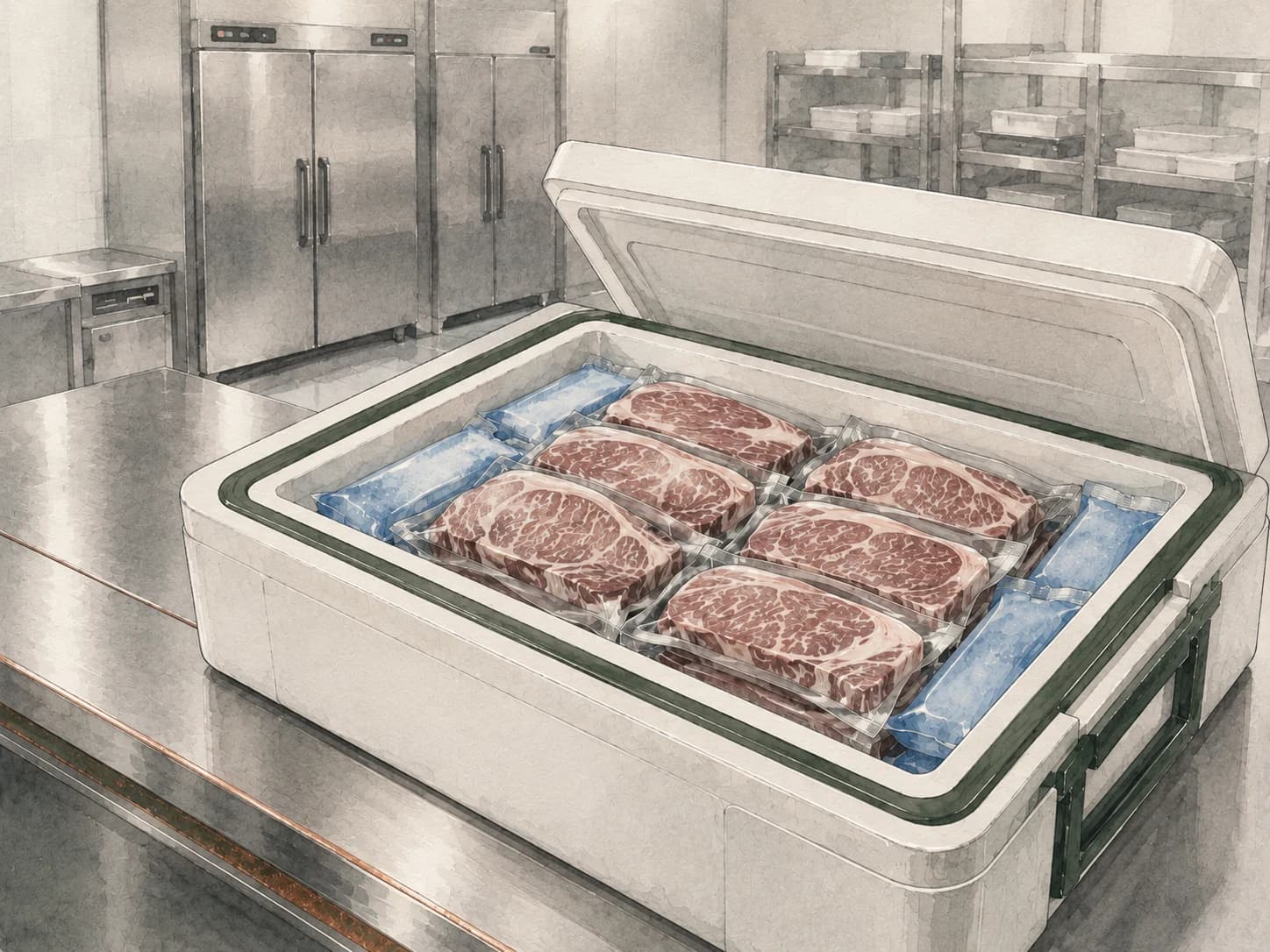
Chilled Wagyu bought by the cut into Dubai or Abu Dhabi rarely arrives with the window the vacuum pack implies. The nominal chilled window starts at packing in Japan; the window you can actually sell against starts when the carton clears the cargo terminal, passes Municipality inspection and halal document verification, and finishes in-house break-down. This article builds that subtraction line by line, per cut, and sets a threshold for moving a cut to frozen.
This article covers the day arithmetic only. If your question is how to spread chilled volume across a demand season, the Ramadan peak chilled allocation calendar handles that. If the problem is mismatched fields between PO, invoice, health certificate and halal certificate, see UAE PO document consistency. A comparable day-count exercise for a different lane, with different clearance steps, inspection authority and transit time, is in the Hong Kong chilled shelf-life day count; the UAE deductions below are not interchangeable with it.
Scroll sideways to see the whole diagram
Why the paper window and the walk-in window diverge
A chilled vacuum-packed primal carries a stated window from the packing date. Buyers then plan menus from that date as though the whole window were theirs. It is not. Every day spent between slaughter and the plated service deadline is a day deducted from the same budget, whether the carton is in a chiller in Japan, in an aircraft hold, on a cargo terminal floor, or waiting on a document check.
The practical consequence is a mismatch of expectation rather than of quality: the carton is fine, but the outlet rotation or banquet cycle promised against it was built on a longer window than exists. The fix is not a longer shelf life. It is ordering against residual days.
The UAE Chilled Day-Budget Sheet
Build one row per cut you order chilled. The columns are deductions from a single starting figure. Fill the supplier-side columns from your quotation, not from assumption, and fill the lane and in-house columns from your own records of past consignments.
| Column | What goes in it | Where the figure comes from |
|---|---|---|
| A. Nominal chilled window | Stated window for that cut and packing format, counted from packing date | Supplier specification, confirmed per consignment |
| B. Slaughter-to-dispatch lag | Days between slaughter date and wheels-up, including chilling, cutting, packing and consolidation | Confirmed at quote time per cut |
| C. Flight and transit | Sector time plus any transshipment hold | Routing on the airway bill |
| D. Cargo terminal dwell | Arrival to release from the cold chain terminal at DXB, DWC or AUH | Your own past consignment records |
| E. Inspection and document verification | Municipality inspection plus health and halal certificate verification | Your own past consignment records; confirm current procedure with the authority |
| F. Delivery and in-house handling | Transfer to your chiller, any in-house aging, break-down and portioning | Your kitchen or warehouse log |
| G. Residual service days | A minus (B + C + D + E + F) | Computed |
| H. Safety reserve | Days you hold back for one slipped clearance step | Your own policy |
Scroll sideways to see the whole table
Residual service days (G) minus the reserve (H) is the number you may plan menus against. Note that column B is counted from the slaughter date, not the packing date, because that lag differs by cut: a thick primal that is chilled and aged before packing consumes days that a quick-turn cut does not.
Three bands, and the threshold between them
Once G is computed per cut, each row falls into one of three bands. The exact day figures below are placeholders for your own thresholds, not published standards; set them from your rotation speed and your reserve policy.
Band 1: normal chilled rotation
Residual days comfortably exceed the time your outlets need to sell through the ordered quantity, with the reserve intact. Thick primals with slow surface deterioration and high per-carton volume usually land here. Order on your normal cycle.
Band 2: shortened chilled cycle
Residual days cover sell-through only if nothing slips. The response is not to abandon chilled, but to order smaller quantities more often, so that any single consignment is consumed well inside its residual window. This raises freight cost per kilogram and should be weighed against the menu value of chilled presentation for that cut.
Band 3: switch to frozen
Residual days are at or below your reserve, meaning one delayed clearance day puts the cut past its usable window before service. This is common for low-volume accent cuts, which sit in the chiller a long time per kilogram sold, and for high-surface-area cuts where exposed area is large relative to weight. These are the candidates to order frozen instead, accepting the thaw and drip-loss handling that frozen requires.
The banding is per cut, not per order. A single PO can legitimately contain Band 1 cuts chilled and Band 3 cuts frozen. Splitting a PO across temperature regimes has its own document and packing implications, which should be agreed per case rather than assumed.
Re-running the sheet
The sheet is not a one-time calculation. Re-run it whenever any of the following happens, and re-band the cuts before the next PO:
- A consignment is held one or more days longer than your recorded figure at the cargo terminal or in inspection.
- Routing changes — a different carrier, a transshipment point, or a shift between DXB, DWC and AUH.
- The slaughter-to-dispatch lag quoted for a cut changes, for example when packing format or consolidation schedule changes.
- Seasonal cargo load rises, including the run-up to Ramadan and the peak banquet season, when terminal and inspection turnaround generally lengthen.
- Your in-house handling time changes — a new portioning schedule, or a move from central break-down to outlet-level break-down.
Procedures and turnaround times at UAE authorities and cargo terminals change. Treat any figure you carry forward in columns D and E as a working record of your own consignments, and verify current requirements and procedure with the relevant authority before relying on them for a season's planning.
Common errors in the arithmetic
- Counting from arrival instead of slaughter. The window began in Japan. Starting the clock at the airport hides column B entirely.
- Treating document verification as free. Halal certificate verification and health certificate checks may run alongside physical inspection or may not; record what actually happened on your consignments rather than assuming parallel processing.
- Ignoring in-house days. Hotel groups with central break-down and multi-outlet distribution typically spend more days between release and plate than a single-site restaurant. Column F is yours to measure.
- No reserve. A sheet with zero reserve says every cut is fine until the first delayed day, after which several cuts are not.
- Banding the whole order. Applying one chilled/frozen decision across the cut list wastes chilled window on cuts that cannot use it.
What to send when you ask for a quote
Columns A and B are the supplier side of the sheet, and they are cut-specific: they depend on packing format, aging before packing, and dispatch consolidation. They are settled in a quoting conversation, not read off a chart.
Send your cut list, the chilled quantity you expect per cycle for each cut, your target service dates, and your current figures for columns D, E and F. What comes back can then be matched against your sheet: indicative slaughter-to-dispatch lag per cut, packing formats available, and where a chilled/frozen split across the same order may be workable. Specifications, lead times and any split arrangement are confirmed case by case.