
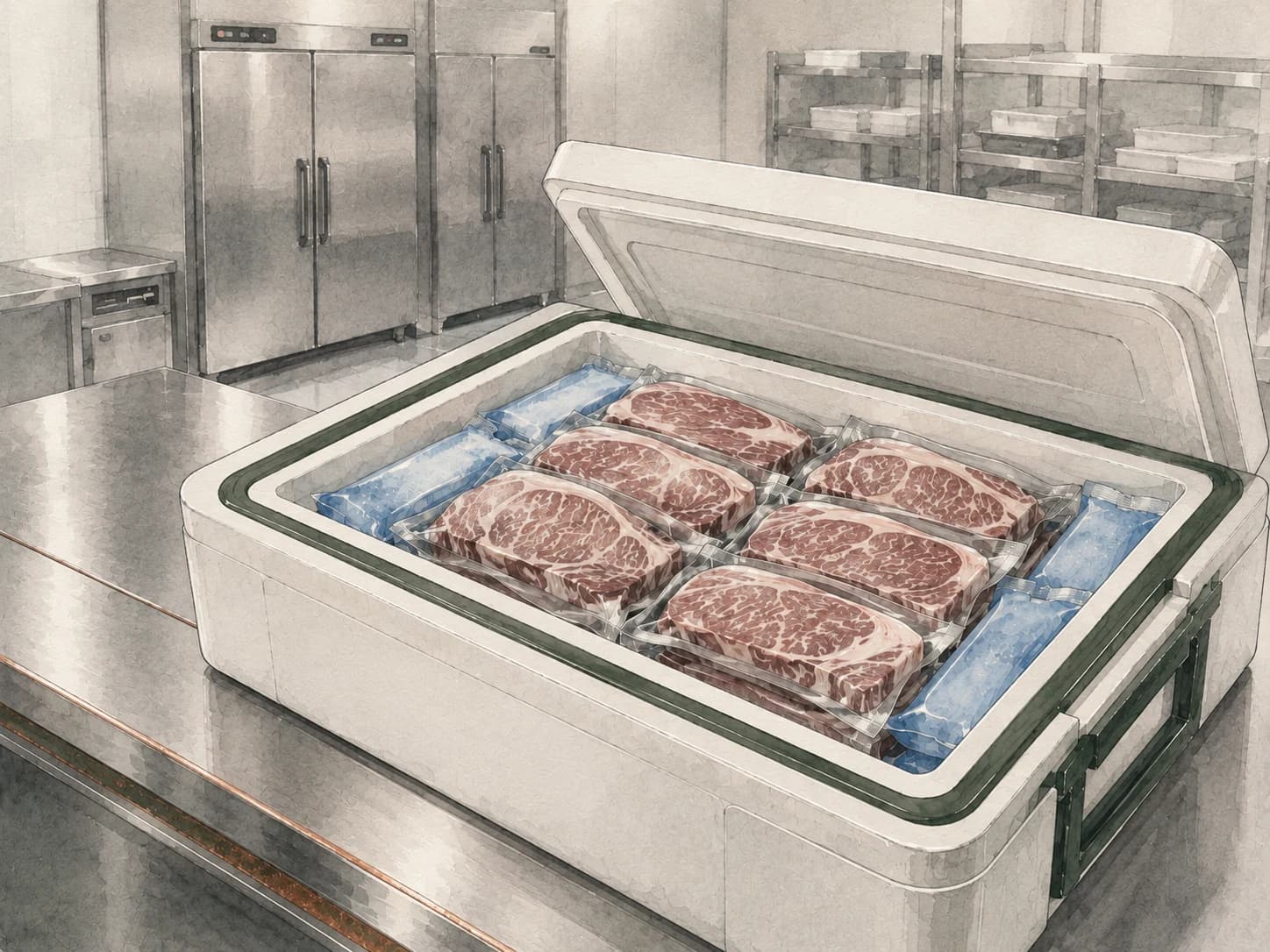
You have decided to buy Japanese Wagyu by the cut and you are now drafting the first purchase order for an Australian entity. The open question at this point is not quality — it is which fields must be identical across the DAFF import permit application, the Japanese government export health certificate and the carton markings, and how to write the grade so your menu or spec sheet claim does not become a relabelling job after arrival.
This article covers Australian import documentation for Japanese Wagyu cuts and the JMGA-versus-AUS-MEAT grade wording problem. Neighboring pieces cover other ground: the US quoted-kilo to sellable-pound ledger stops at yield economics and never touches permits; UAE PO document consistency works from a halal-anchored certificate set and a different authority chain, so its field list does not map onto DAFF conditions or AUS-MEAT terminology; and air-chilled versus sea-frozen per cut for Singapore compares logistics, not paperwork.
Conditions verified as of February 2025. Import conditions change: confirm the current BICON case for your commodity and origin before applying any of this to a live order.
The border risk is a document mismatch, not the meat
In our export experience, Australian consignments of Japanese Wagyu are rarely questioned on the product itself. What creates delay is disagreement between three documents that were each written by a different party: the permit application your customs broker lodges, the export health certificate issued under the Japanese government system, and the carton and inner-wrap markings applied at the Japanese establishment weeks before you saw them.
The carton is the hardest of the three to fix. A permit application can be amended and a certificate can, in some cases, be reissued at origin before shipment. Printed carton markings on 40 boxes already in a chilled container cannot be corrected without physically relabelling under supervision, at your cost, in Australia. That asymmetry is the whole reason to settle the wording at PO stage rather than at booking.
The authoritative sources for the Australian side are the Department of Agriculture, Fisheries and Forestry's import requirements by food type and the BICON database, which holds the case-specific conditions. Labelling requirements for the product once it is in the Australian market sit with Food Standards Australia New Zealand. The beef language you are used to as an Australian buyer is defined by AUS-MEAT. The Japanese export certificate templates and facility-approval requirements are published by MAFF, by destination country, on its certificate and facility application portal (Japanese). Field names on certificate templates are revised from time to time, so treat any list below as a checklist structure, not as a transcription of the current form.
The five fields to lock before the PO is issued
1. Exporting establishment number
Every carton, the health certificate and the permit application must carry the same establishment identifier for the Japanese facility that produced and packed the meat. Ask for it in writing before the PO, not after. If the order is split across two facilities — common when a chilled cut and frozen trim come from different plants — that is two establishment numbers and, in practice, two documentary sets. Decide at PO stage whether you want that complexity in a first shipment.
2. Exact cut name plus bone-in or boneless declaration
"Ribeye" is a menu word, not a document field. The PO should name the cut in the same words that will appear on the certificate and the carton, and it must state boneless or bone-in explicitly. Bone-in product can attract different conditions from boneless product of the same origin; whether it does for your case is a BICON question, and it is worth resolving before you commit to a bone-in SKU for a first order. If you are unsure, a first consignment of boneless ribeye, striploin and rump cap keeps the documentary set simple.
3. Grade written as JMGA specification, not as an AUS-MEAT claim
This is the field that catches Australian buyers specifically, because your home market already has its own Wagyu language. Write the grade on the PO and on the carton as the Japanese grading system states it — for example JMGA A5, BMS 10 — with the yield grade letter, the quality number and the BMS number kept together.
Do not put MB 9+ or any other AUS-MEAT marbling score on the carton, the certificate request or the customer-facing label. AUS-MEAT scores describe product assessed under the AUS-MEAT language; Japanese product graded by JMGA was never assessed that way. An AUS-MEAT-style claim on imported product that never went through that system is, in our experience, the single most common reason an Australian buyer ends up relabelling. If your sales team needs a comparison for the trade, put it in internal sell material where it is clearly framed as an approximate reference, for example: "Graded JMGA A5, BMS 10 under the Japanese Meat Grading Association system. For internal reference only; not an AUS-MEAT assessment."
4. Storage state and temperature
Chilled and frozen are different products for documentary purposes even when the cut name is identical. The PO must say which, and the temperature range stated on the PO must match what the certificate attests and what the carton declares. Mixing a chilled ribeye line and a frozen trim line on one PO is workable, but each line needs its own storage declaration, and you should confirm with your broker that both states are covered by the permit you hold.
5. Production and expiry dates in one format
Pick a single date format for the whole documentary set and state it on the PO. Japanese cartons and Australian systems can both be read unambiguously if the format is written out — DD MMM YYYY, for example, avoids the 03/04 problem entirely. For chilled cuts, agree at PO stage what production date and what shelf-life end date will be printed, because the remaining shelf life on arrival is what your distribution window is built on. The number of days you actually receive depends on the routing you book, not on the certificate.
The PO-to-permit field map
Build the map as a five-column sheet and fill it in with your supplier before the PO goes out. The columns are: (1) how the field is written on the proforma invoice, (2) the matching entry on the Japanese export health certificate, (3) the matching entry on the permit application, (4) what physically appears on the carton and inner wrap, and (5) the failure mode if the three disagree. Rows to include:
- Exporting establishment number and facility name
- Country of origin and production date
- Cut name, in document wording
- Bone-in or boneless declaration
- JMGA yield and quality grade
- BMS number
- Storage state (chilled or frozen) and temperature range
- Net weight per carton and carton count
- Lot or batch identifier
- Expiry or best-before date and date format
- Consignee name and address as it will appear on the permit
- Packaging description, including inner wrap
The value of the exercise is that column five forces the conversation. If nobody can say what happens when the carton says one cut name and the certificate says another, that row is not settled.
Open items to resolve with your broker, not with your supplier
Some questions on a first Australian order sit on the import side and cannot be answered from Japan. Whether current conditions require any attestation beyond the standard health certificate for chilled Japanese beef; whether bone-in cuts of this origin carry conditions that boneless does not; and how tariff treatment under the Japan-Australia Economic Partnership Agreement applies to your specific tariff lines, including whether a certificate of origin needs to be arranged at PO stage rather than at shipment. Put these to your customs broker with the BICON case reference in hand before the PO, because each of them can change what the supplier must issue.
What we can give you
The field map is only useful once it holds real values: an actual establishment number, the cut names as they will be written, and the grade values for the lots you intend to list. Those come from our export documentation set, not from a template.
Send us the cuts, the grade and the monthly volume you intend to list — for example 60 kg of chilled boneless ribeye and 40 kg of frozen trim per month — and we will return a wholesale quote together with the exact document wording we will use for each field. You can then pre-check that wording against your permit conditions before committing to a first air consignment or container.