
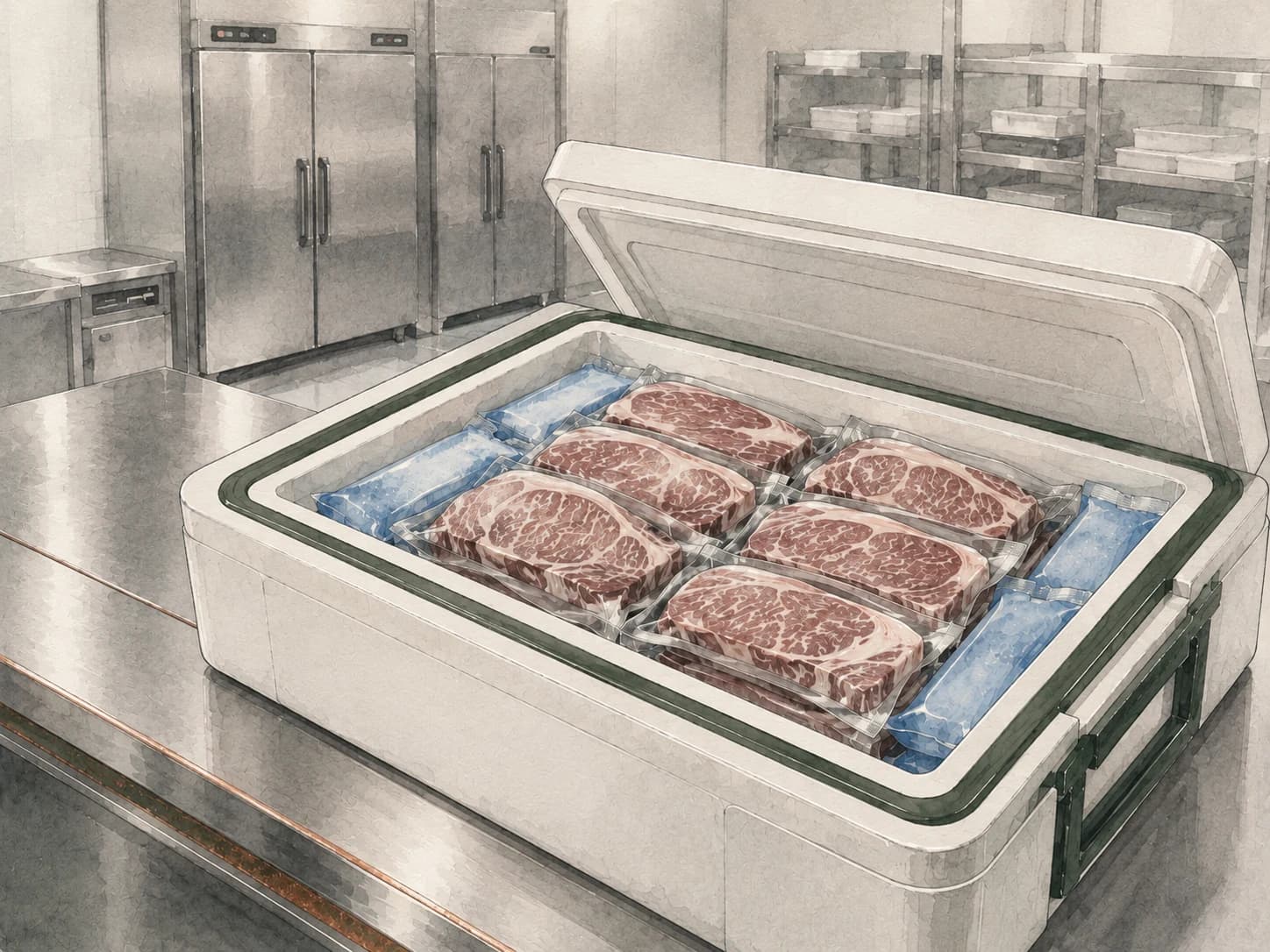
If your per-portion cost keeps drifting above the per-kilo number you agreed to, the problem is usually not arithmetic. It is that the quote is written in one unit (CIF kilos of a whole primal) and your P&L is written in another (sellable pounds of trimmed, portioned Wagyu). This article is about closing that gap for a US program: a yield ledger that walks one lot from quoted weight to sellable pounds, and separates the losses your cutting room owns from the losses that were fixed in Japan before the box was sealed.
It deliberately does not repeat what is already on this site. If you are weighing air-chilled against sea-frozen economics on a cut-by-cut basis, read the Singapore comparison of air-chilled versus sea-frozen per cut. If your question is how many days of chilled shelf life disappear in transit, that is the Taiwan day-loss ledger. If your PO, packing list, health certificate and invoice keep disagreeing with each other, see the UAE piece on document consistency across the PO chain. This one is neither a shelf-life piece nor a document piece: it is a weight piece, written around US-style seam trim, portion specs in pounds, mixed-grade lot assembly, and FSIS reinspection at the port of entry.
Why the quote and the plate disagree
A per-kilo CIF price describes a box on a vessel or a pallet at the airport. Between that box and a case-ready pack or a plated steak, weight leaves in at least five places: an entry inspection that can hold or reject part of a consignment, thaw and purge if the lot moved frozen, fat cap removal, seam and silverskin trim, and portion scrap when you cut to a fixed ounce weight. Each of those is a percentage. Multiply five percentages together and a quote that looked competitive per kilo can land ten or twenty percent off your expectation per pound — without anyone having done anything wrong.
The useful move is not to argue harder about the per-kilo number. It is to find out which of those five lines is actually costing you, and then to ask whether that line is yours or your supplier's. Some of them cannot be touched from a US cutting room at all. Fat cap thickness, whether the seam is left intact, boneless versus bone-in, piece weight range, chilled versus frozen, and how many A4 pieces are sitting in a case you priced as A5 — all of that is decided in Japan, at spec-writing time.
The ledger: seven rows, one number
Build this as a single page per lot. Do not average across lots until you have at least three of them; the point of the exercise is to see one real consignment end to end.
- Row 1 — Quoted CIF weight. The invoiced weight in kilos, per cut, per grade as stated. Convert once to pounds and never again.
- Row 2 — Weight after entry. What actually cleared and reached your cooler, after FSIS import reinspection and any hold, refusal, or sampled portion. Record the difference even when it is zero; a run of zeros is itself information.
- Row 3 — Thaw and purge. Weigh the primal in the bag, weigh it again drained. For chilled lots this is purge in the vacuum bag; for frozen lots it is thaw drip. This row is the honest answer to "does frozen really cost me anything".
- Row 4 — Fat cap removal. Weight removed to reach your service spec. On Wagyu this row is larger than crossbred beef people expect, and it is the row most directly written by the supplier's trim level.
- Row 5 — Seam and silverskin trim. Weight removed separating muscles and cleaning membrane. Track any of this that you resell as trim or grind separately — it is recovery, not loss, and it changes the final number.
- Row 6 — Portion scrap. The end pieces and off-spec cuts created by hitting a fixed portion weight. Driven by your ounce spec and by the incoming piece weight range.
- Row 7 — Sellable pounds. Row 1 minus rows 2 through 6, plus any recovered value from row 5. Divide the total landed cost of the lot by this number. That figure — cost per sellable pound — is the only one worth comparing between suppliers.
Add one column to the right of every row: who controls it. Mark each row supplier-controlled, buyer-controlled, or shared. Rows 4, 5 and 6 are shared but lean supplier — trim level, seam handling and piece weight range are written into the spec sheet before packing. Row 3 leans supplier as well, because it follows from chilled-versus-frozen mode and packing method. Row 2 is largely regulatory. Only your knife work inside rows 4 to 6 is genuinely yours.
We do not publish yield percentages for these rows, and you should be skeptical of anyone who does. Trim and purge yields for Japanese Wagyu under US cutting-room specs are not publicly documented, and they vary by cut, grade, mode and by how your butchers were trained. The ledger is worth something precisely because the numbers in it are yours.
What FSIS entry means for row 2
Beef imported into the United States is reinspected at the point of entry by USDA's Food Safety and Inspection Service; product from Japan must come from establishments certified as eligible under the equivalence system, and shipments can be sampled, held, or refused at reinspection. The governing requirements are maintained in the FSIS import library, including a country page for Japan (FSIS import and export; FSIS import requirements — Japan, accessed September 2026). Eligible-establishment lists and requirement details change; confirm current status with FSIS and with your customs broker before each program cycle rather than relying on a previous shipment.
For the ledger, the practical point is narrow: row 2 is not a yield you can negotiate. What you can influence is exposure — how many separate consignments carry your annual volume, how tightly the establishment on the certificate matches what you actually ordered, and whether a hold on one pallet stops one week of menu or one month of it. That is a lot-assembly decision, and it is made before shipment.
Grade mix is a yield question, not just a price question
US buyers commonly order mixed A4/A5 lots. USDA's own grading standards do not map onto the Japanese grading system, so a case labeled by Japanese grade has to be translated into whatever your sales sheet promises (USDA AMS beef grades and standards). The yield consequence is that grade mix changes fat cap and marbling behavior across the lot, so one blended trim percentage hides two very different sub-lots. If your ledger shows a wide swing in row 4 between deliveries, ask for the grade composition per case, not per shipment.
In our own export handling we see the same primal cut to noticeably different finished weights depending on whether the buyer specified a trim level or accepted the default — that is our operating experience across customer specs, not a measured study. It is the reason we would rather discuss spec than discount.
Three questions to put to your supplier
Once the ledger is filled from one real lot, you will usually find two or three supplier-controlled rows carrying most of the loss. Convert those into specific asks:
- Trim level and fat cap. State the fat cap you want in millimeters or inches and hold it constant across suppliers. An untrimmed primal is not cheaper if you are paying CIF freight on fat you will bin.
- Piece weight range. Give a minimum and maximum per piece tied to your portion spec. This is the single most effective lever on row 6, and it costs the supplier nothing but sorting discipline.
- Mode and packing. Chilled or frozen, and how packed. This drives row 3 and interacts with your entry exposure. Ask what the supplier can actually commit to for your routing and port, and treat any answer that is not cut-specific as provisional.
Whether a given supplier can hold a fixed trim level, a fixed piece weight band, or a per-customer grade composition is not a given — it depends on their cutting floor and their own procurement. Ask directly and get it written into the spec sheet, not the email thread.
Send the ledger with your RFQ
A per-kilo quote against an unstated spec is not comparable to anything. A per-cut quote against your filled ledger is. Send us the completed sheet — cut, grade mix, your row-by-row yields, and your target cost per sellable pound — and ask for a per-cut wholesale quote priced to that target, with trim level, fat cap, piece weight range, mode and grade composition per case written on the quote itself. Then the comparison you make next quarter is between two specs, not between two numbers.
Request a per-cut wholesale quote
Review note: requirements and eligibility for Japanese beef entering the US change. Verify FSIS requirements and establishment eligibility at the source before each buying cycle.