
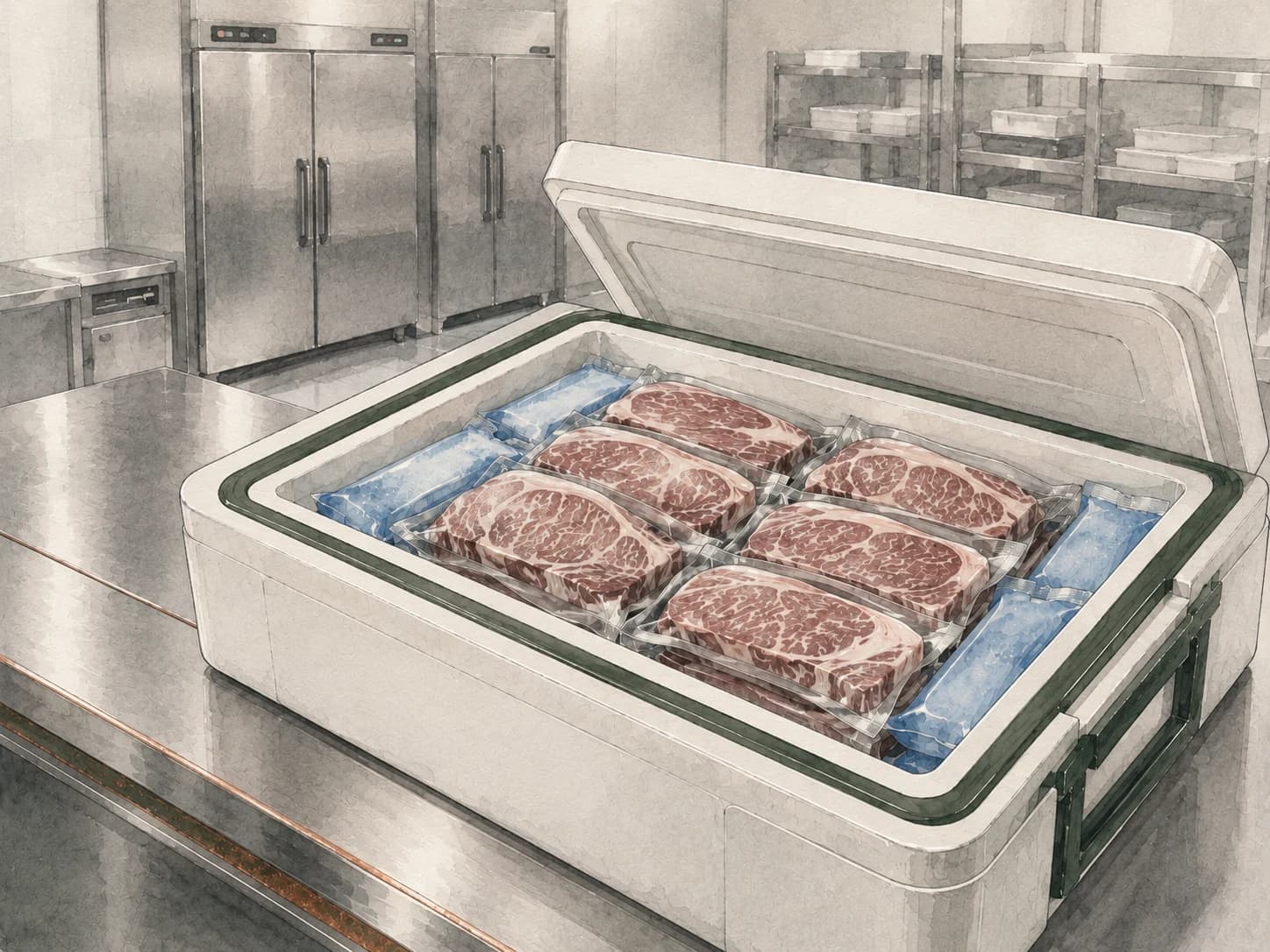
You signed the PO for chilled Japanese Wagyu. Weeks later the venue calls: the loin landed with four usable days, the kitchen wanted seven, and nobody can say which part of the chain ate the difference. The supplier points at the lane, the freight forwarder points at inspection, and the cold store points at the pack date. The argument is unresolvable because no one is keeping a day balance.
This article builds that day balance: a per-cut ledger that subtracts consumed shelf days at each custody handover from Japanese packing date to venue delivery, and turns the residual into a chilled-or-frozen decision for each PO line. It does not price those days. If you want the money side of an Australian clearance day, that is covered in the AU clearance-day cost ledger per cut, and if your issue is document fields not matching the PO, see the AU permit, certificate and label field map. The chilled-versus-frozen comparison also exists for a different lane in the Singapore air-chilled versus sea-frozen article; Australia differs because of DAFF biosecurity inspection and the long domestic run beyond the port of entry, so the arithmetic below is written for Australian conditions.
Why a flat lane figure fails
Most buying teams carry one number in their head: "Japan to Australia chilled takes about X days." That number is a lane average. It is useless at PO time for two reasons.
First, shelf-day loss is not spread evenly along the lane. It concentrates at handovers, where custody changes and the consignment waits. A flight hour is predictable; a Friday-afternoon consolidation cut-off, an inspection queue, or a Monday domestic linehaul is not. Second, cuts do not age at the same rate. A thick, intact primal with an unbroken vacuum seal and a trim-heavy or thinly portioned item do not have the same usable life even when they leave the same packing room on the same day and travel in the same consignment.
Averaging across both of those gives a figure that is right for the consignment and wrong for the line that matters — usually the one the venue is building a menu around.
The three handovers that consume days
In the Japan-to-Australia chilled lane, the shelf-day budget is typically spent in three places. The exact size of each is specific to your lane, your forwarder and your entry point, which is why the ledger below asks you to fill them in rather than handing you numbers.
1. Japanese consolidation and the departure slot
Days are consumed between the packing date printed on the carton and the moment the consignment actually departs. Export consolidation runs on fixed schedules, and a cut packed just after a cut-off waits for the next slot. This is the handover buyers most often fail to count, because the PO conversation is about the cut and the price, not about which slot the order lands in. A line that misses a slot can lose more usable days here than it will lose in the air and on the road combined.
2. Arrival, biosecurity inspection and release
On arrival, imported chilled beef sits under Australian biosecurity control until it is inspected as required and released. The duration depends on the entry point, the volume moving that week, whether the consignment is selected for inspection, and whether the accompanying documents reconcile cleanly with the consignment. Document mismatches extend this window, which is where the field-map article above becomes a shelf-day tool and not only a compliance one. Australian import conditions and inspection requirements are set by the Australian Government Department of Agriculture, Fisheries and Forestry; verify the current conditions applying to your product with that department before you rely on any assumption about this step.
3. The domestic leg past the entry airport
Australia's distances make this handover heavier than it is in compact markets. A consignment released in Melbourne or Sydney still has to reach the cold store, be broken down to venue orders, and then run to a regional venue. Each of those is a separate custody change with its own waiting time. Buyers supplying outside the capital cities routinely underestimate this leg, because the imported-goods conversation stops at the airport while the shelf life does not.
The Shelf-Day Handover Ledger (AU)
One row per cut on the PO. Fill each column with your own observed timings from the last three to five consignments on the same lane — not with figures from a supplier brochure or from this page. The ledger is a subtraction, and the only numbers worth subtracting are yours.
| Column | What you enter | Where the number comes from |
|---|---|---|
| Cut / PO line | The specific item, e.g. striploin whole, chuck roll, trimmed portions | Your PO |
| Starting days (A) | Usable chilled days from the packing date for that cut format, under unbroken cold chain | Confirmed per shipment with the supplier for that specific item and pack format |
| Pack date to departure (B) | Days lost to consolidation and the departure slot | Your forwarder's recorded departure versus the carton pack date |
| Transit to arrival (C) | Days from departure to arrival at the entry point | Airway bill / carrier records |
| Inspection and release (D) | Days from arrival to biosecurity release | Your customs broker's records for comparable consignments |
| Cold store handling (E) | Days from release to order being picked for the venue | Your cold store's receipt and pick timestamps |
| Domestic leg (F) | Days from pick to venue delivery | Your domestic carrier's proof of delivery |
| Residual days (R) | R = A − (B + C + D + E + F) | Calculated |
| Venue requirement (V) | Days the venue needs on arrival to run the item | Agreed with the venue, in writing |
| Buffer (S) | Days you hold back for one bad handover | Your own tolerance; set it before you see the result |
| Decision flag | Chilled if R ≥ V + S, otherwise frozen or next slot | Calculated |
Scroll sideways to see the whole table
The decision rule
For every line: if R ≥ V + S, keep the line chilled. If R < V + S, you have three moves, in this order of preference:
- Move the line to an earlier departure slot. This attacks column B, which is often the largest and the most controllable single number in the row.
- Reduce V by changing how the venue uses the item. A cut scheduled for a fixed menu launch date needs more days on arrival than one going into continuous service.
- Flip the line to frozen. This removes the line from the day budget entirely and is not a downgrade of the PO — it is a different specification for a cut whose arithmetic does not work on that slot.
Nothing in this rule requires you to change supplier or renegotiate price. It changes which lines on an existing PO are specified chilled.
A worked example
The figures below are illustrative placeholders, chosen to show the arithmetic. Replace every one of them with your own lane data before you use the result for anything.
Suppose a PO carries two lines into a Sydney entry point with onward delivery to a regional venue. Line 1 is a whole striploin, intact and vacuum sealed. Line 2 is a trim-heavy, pre-portioned item. Assume both are packed on the same day.
- Line 1: A = 30. B = 4, C = 1, D = 3, E = 2, F = 2, total consumed 12. R = 18. Venue requires V = 7, buffer S = 3. 18 ≥ 10, so the line stays chilled.
- Line 2: A = 16. Same lane, same consumed total of 12. R = 4. Same V = 7 and S = 3. 4 < 10, so the line fails. Moving it to a slot three days earlier gives R = 7, still below 10. The line should be ordered frozen.
Two lines, one consignment, one lane, opposite decisions. That is the point of running the ledger per cut instead of per consignment. The chain did not treat the two lines differently; their starting day figures were different, so the same subtraction produced different answers.
Note also what the example shows about where to intervene. On line 2, the air leg is a single day. No amount of pressure on the carrier recovers the shortfall. The slot and the starting day figure are the only levers with enough travel in them.
Filling in column A honestly
Column A is where ledgers quietly break. It is tempting to take the longest number anyone has ever mentioned for chilled Wagyu and apply it to every line. In practice the usable chilled life of a given consignment depends on the specific cut, the pack format, the seal integrity and the temperature history, so treat it as an item-level figure to be confirmed per shipment rather than a category constant. As a general rule, intact larger primals in unbroken vacuum packaging hold up longer than items with more cut surface area, and any break in the cold chain resets the assumption entirely.
If your supplier cannot give you a per-item figure for the exact pack format you are ordering, that is itself useful information: it means column A is an estimate, and your buffer S should be larger to compensate.
Using the ledger as a dispute record
Once the ledger exists, "it arrived too short" stops being an argument and becomes a comparison between the planned row and the actual row. Record actuals for B through F on every consignment. Over a handful of shipments you will see which column drifts, and drift is specific: a consolidation cut-off that moved, an inspection window that lengthened seasonally, a domestic carrier that added a depot.
That record also changes the conversation with the venue. A venue that sees the day budget in advance can agree on V, rather than discovering after delivery that its expectation was never achievable on that slot.
One caution on interpretation: a single short arrival tells you little. Lane timings move with carrier schedules and seasonal volume, so a column is only worth acting on once it has drifted across several consignments in the same direction.
What to settle before the next PO
Run your current cut list through the ledger once. You will usually find that the list splits: a group of lines with comfortable residual days, a group that fails on every slot, and a small group that passes only if the departure slot cooperates. The third group is where the planning effort belongs.
Three things are worth agreeing in writing before the next order: the per-item starting day figure for each cut and pack format, the departure slot your order is targeting, and the days on arrival the venue actually requires. Which cuts can be supplied chilled into a particular slot, and which are better specified frozen on the same PO, depends on the cut, the pack format and the schedule, and is confirmed case by case. Sample availability and terms are confirmed per inquiry.
Discuss your requirements with First Agri — bring your cut list, your required days on arrival and your target slot timing, and we can work through which lines the arithmetic supports as chilled.