
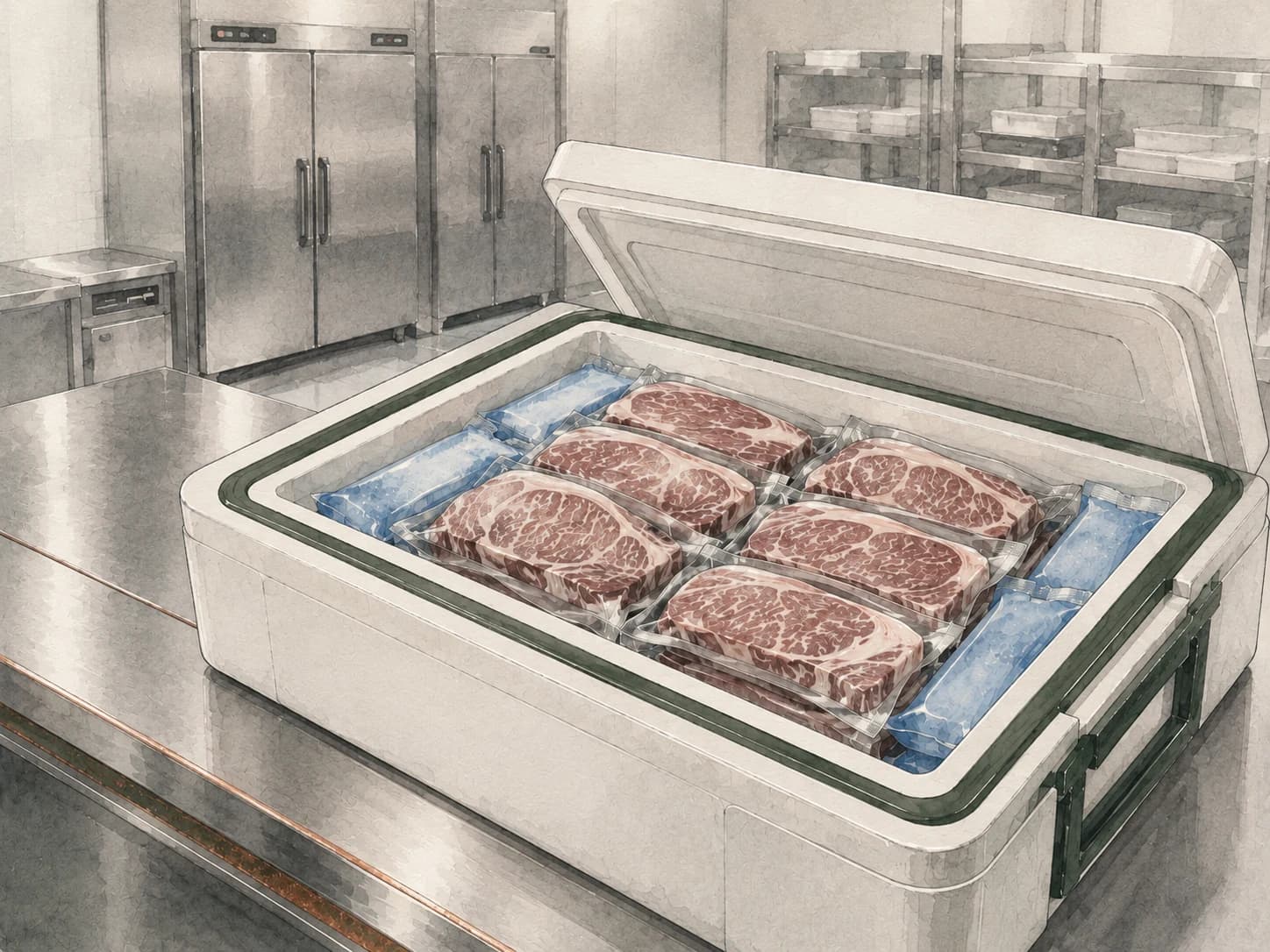
In an integrated resort, one pooled Wagyu lot is usually pulled by outlets with very different booking visibility. A Chinese banquet room knows its cover count days ahead. A 24-hour gaming-floor restaurant knows nothing until the guest sits down. Teppanyaki and VIP rooms sit somewhere between. The same lot serves all of them, and the result is familiar: a cut runs out in one outlet on Friday night while the same cut sits untouched in the chiller, booked to a banquet that is still three days away.
This article is about that internal pull contest — how much of each cut to commit to booked covers, how much to hold unallocated, and at what point in the chilled day-count an unallocated kilo stops being flexibility and becomes a loss. It does not recalculate yield, reorder timing, or purchase-order wording. For yield per cut on a single booked banquet, see the casino-hotel banquet yield article. For replenishment cadence between chilled and frozen, see the reorder-lag article. For getting the order document itself right, see the PO field-lock sheet.
Scroll sideways to see the whole diagram
The loss is mis-commitment, not over-ordering
Procurement reviews in pooled operations tend to focus on total volume: did we buy too much Wagyu this month? But in a property where the total is roughly right, the recurring damage comes from a different place. Kilos committed early to a booked banquet cannot serve a walk-in spike, even though they are physically in the same chiller. Kilos held back for walk-ins burn chilled days under no one's name — the banquet chef did not reserve them, the gaming-floor outlet did not sell them, and nobody is accountable for the day-count running down.
Two visible symptoms follow. First, emergency re-pulls: an outlet runs short, so a case reserved for another date is opened early, which shortens the usable window of everything inside it. Second, substitution: a frozen cut or a different cut is served in place of the menu item, sometimes without the guest noticing and sometimes with a downgrade the kitchen absorbs. Neither symptom appears in the purchase volume. Both appear in the chilled day-count.
What makes a cut "commit early" or "commit late"
The practical sorting rule is not grade or price. It is how predictable the demand for that cut is, and how many outlets can absorb it if the first plan fails.
Commit early applies to cuts with a narrow outlet base and a confirmed count. A large banquet-style portion specified in a signed event menu has one buyer and one date. Holding it unallocated gains nothing, because no other outlet is likely to sell it quickly, and the chilled days spent waiting are pure loss. Committing it on arrival day lets the kitchen plan portioning and trim use around a fixed date.
Commit late applies to fast-moving steak cuts that several outlets can sell on any given night. These are the cuts that walk-in demand hits first. Holding them unallocated for a defined number of days preserves the ability to answer a spike without opening another case. The cost of holding is real but bounded, because if the spike does not come, the cut still sells somewhere.
The failure mode is doing it backwards: committing the flexible steak cuts early because the banquet booking arrived first, then discovering on Friday that the only uncommitted kilos are the ones no outlet can move quickly.
The Outlet Pull Conflict Ledger
One row per cut per arriving lot. The point is not record-keeping for its own sake; it is to make the unallocated kilos visible and give them a deadline.
| Column | What goes in it | Why it matters |
|---|---|---|
| Lot / arrival date | Lot reference and the date the cut physically landed in the property chiller | Day-count starts here, not at the order date |
| Remaining chilled days | Days left against the window agreed for that consignment | The only number that converts holding into cost |
| Kilos committed — booked | Kilos assigned to banquet or VIP events with a confirmed cover count | These are unavailable to walk-in outlets, by decision |
| Kilos held — unallocated | Kilos deliberately left open for walk-in outlets | The figure nobody owns unless it is written down |
| Force-assign day | The day on which unallocated kilos must be assigned or moved to a secondary menu use | Turns an open position into a dated decision |
| Outcome | Served as menu item / substituted / downgraded to secondary use | Builds the pull pattern for the next shipment |
Scroll sideways to see the whole table
The force-assign day is the column that does the work. Without it, unallocated kilos drift to the end of their window and are then handled under pressure. With it, the decision happens while there are still enough days to sell the cut at its intended menu position.
Setting the force-assign day yourself
Do not take a day number from an article. Derive it from your own records, because it depends on your outlet mix, your routing, and the window agreed for each consignment. A workable procedure:
- For each cut, take the last eight to twelve weeks of outlet issue records. Count, per day of week, how many kilos each outlet type actually pulled — booked events separately from walk-in outlets.
- Find the typical walk-in pull per day for that cut, and the highest walk-in day in the period. The gap between them is the buffer that justifies holding kilos unallocated.
- Count how many days the cut needs, at the typical pull rate, to clear through walk-in outlets alone. Call this the clearance span.
- Subtract the clearance span from the remaining chilled days on arrival. The result is the last day on which unallocated kilos can still be sold normally — that is your force-assign day for that cut.
- If the result is on or before arrival day, that cut should not be held unallocated at all. Commit it on arrival.
Run this per cut, not per lot. Cuts in the same consignment will produce different force-assign days, and that difference is the whole point of the exercise.
Where Macau-specific handling enters
Remaining chilled days on arrival are not a property of the cut; they are a property of the route and the handling. A consignment that moves through a transit point before reaching the property has fewer usable days at the chiller door than one that does not, and the difference belongs in the ledger's arrival row rather than in a general assumption. Structurally, chilled consignments arrive with a finite window that has already been partly consumed, while frozen stock arrives with the day-count question deferred. That asymmetry is why a pooled property can hold a frozen backstop for substitution and still lose money on chilled mis-commitment.
Routing, handling, and the chilled day window applicable to a given consignment are confirmed case by case. Record the actual arrival condition and remaining window for each lot instead of carrying a standing figure forward.
Reading the ledger after a few lots
After three or four consignments, two patterns usually separate out. Some cuts repeatedly run short on the walk-in side and trigger early case-opening. Other cuts repeatedly sit unallocated until their force-assign day and then get downgraded to a secondary menu use. Both are allocation signals, and both point at the cut mix rather than at the kitchen.
The response is not to order more in total. It is to shift the composition: more kilos of the cuts that walk-in outlets consume reliably, fewer of the cuts that only clear when a banquet is on the books, and a reconsidered chilled/frozen split for the cuts that are most often substituted under pressure. A property that has run the ledger for a month can state this as a per-cut split rather than as a general request for "more Wagyu."
Taking it to the next shipment
The ledger output is the input for a supply conversation: these cuts short on walk-in days, these cuts unallocated to day N, this is the chilled/frozen split we want to test next. That is a different discussion from re-quoting the same mix. Cut availability, chilled and frozen handling, and consignment terms are confirmed per inquiry.