
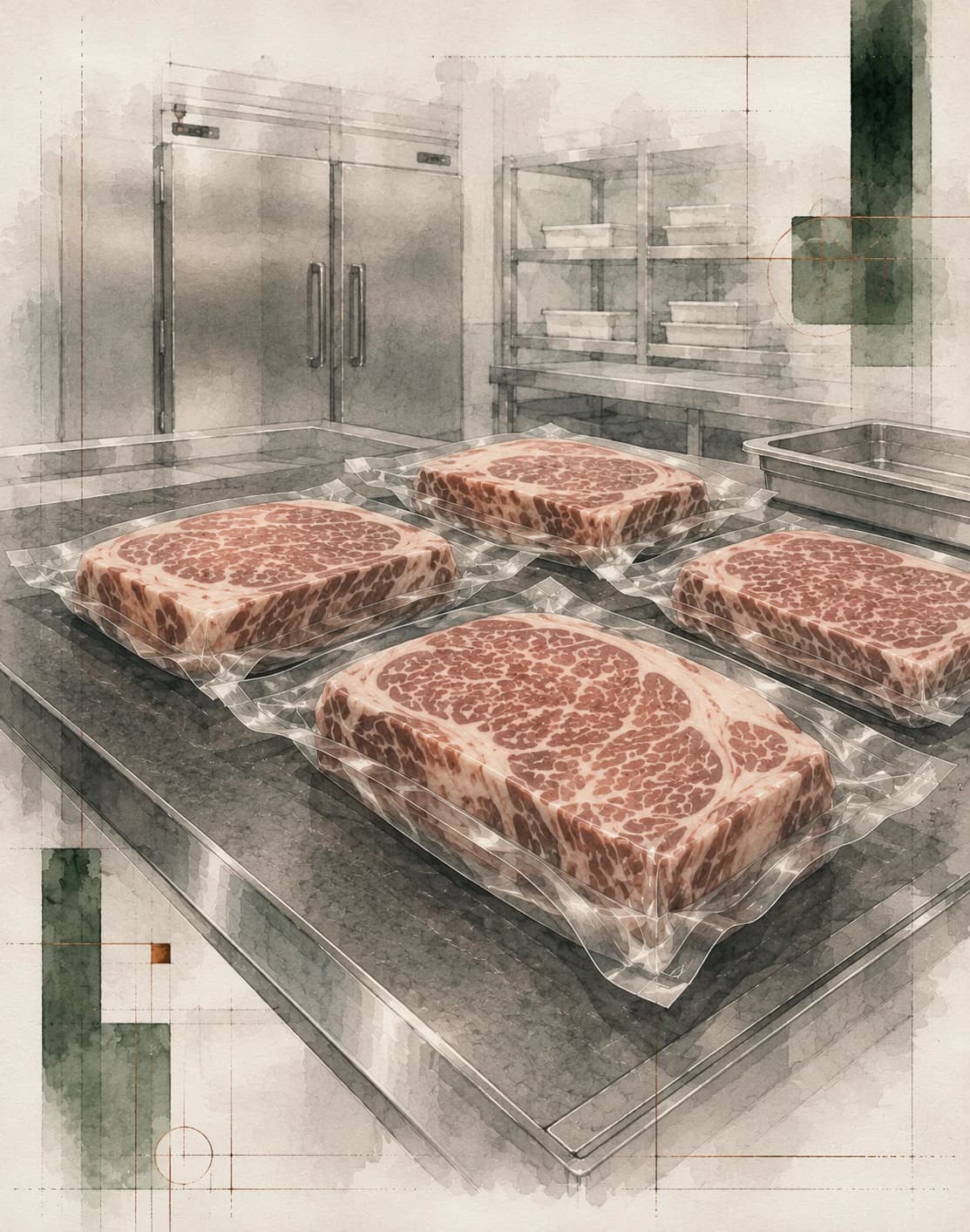
A Macau integrated resort can run 15 to 30 food and beverage outlets under one purchasing desk. The steakhouse wants loin. The buffet carving station wants volume and visual size. The banquet team wants 500 identical portions that plate in twelve minutes. The staff canteen wants whatever is left. All of it comes out of one consolidated purchase order, and in most groups that order is still built from last month's usage line rather than from what each outlet actually needs.
This article is about that allocation problem: which cut goes to which outlet type, and how many kilos of each, so a single Wagyu PO carries a higher-grade average without lifting the property's blended plate cost. It is a cut-mix planner, not an import procedure guide. If your question is how many days a chilled vacuum-packed loin holds at one receiving point, read our Hong Kong chilled shelf-life day count. If you need to turn a quoted kilo price into a sellable cost for one operation, that is the US quoted-kilo to sellable-pound ledger. If you are choosing between air-chilled and sea-frozen freight for a given cut, see the Singapore per-cut comparison. None of those answers the multi-outlet question, which is the one that defines Macau.
Why Macau is not simply "Hong Kong adjacent"
Three structural facts change the arithmetic here.
One buyer, many plate-cost targets. A standalone restaurant has one target. A resort group may run a fine-dining steakhouse at one plate cost, a buffet at a fraction of it, a banquet contract priced months earlier, and VIP gaming-floor room service where cost is almost irrelevant but consistency is not. The same primal has to serve all of them.
Storage is scarce. Macau property kitchens are built on expensive reclaimed land, and back-of-house chilled space is typically sized for a few days of service rather than for holding or dry-aging programs. This is a general property-economics point rather than a measured figure — measure your own walk-in capacity in days of chilled hold before you use the sheet below, because that number caps how much of any cut you can take in a single landing.
Registration and routing. Japanese beef entering Macau must come from establishments cleared under the arrangements administered by the Macao municipal authority, and some groups receive via Hong Kong importers rather than direct. Both the establishment listing and the transfer handling can change. We do not restate the current status here: confirm the registered-establishment position and any change in transfer or re-export handling directly with the Macao municipal authority (Instituto para os Assuntos Municipais) and with your customs broker before you commit a PO, and re-confirm at least every six months. Your exporter should be able to show you its own registration status for Macau in writing.
The core claim
Your Wagyu cost problem is usually not the per-kilo price. It is cut-mix mismatch. When every outlet orders the cut it likes best, the group buys loin repeatedly and buys it at loin prices, while chuck roll, blade, short rib and trim either never enter the building or enter and die in the walk-in. When instead you allocate by outlet demand pattern — loin to the steakhouse, chuck roll and short rib to banquet, blade and trim-heavy cuts to buffet and back-of-house menus — a single PO can carry a higher average grade at the same blended plate cost, because every by-product of a primal already has a named destination before the container lands.
The Macau multi-outlet Wagyu allocation sheet
Build this as one page. Rows are the cuts we can ship by the piece. Columns are the outlet types in your property. Each intersection holds four things: suggested share of the PO, target portion weight, an assumed yield after trimming, and a storage note in days of chilled hold.
Step 1: list your outlets and monthly covers
Write down every outlet that touches Wagyu, with actual covers for the last three months and the plate-cost target for each. Typical column set for an integrated resort:
- Steakhouse à la carte
- Buffet carving station
- Banquet set menu (300 to 1,200 covers)
- Chinese hot-pot or Japanese yakiniku outlet
- VIP room service and gaming-floor service
- Staff canteen and back-of-house menus
Step 2: assign a primary cut to each column
This is the judgment layer. From our own export handling experience — this is trade practice, not measured data — the pattern that keeps trim moving looks like this:
- Striploin and ribeye — steakhouse à la carte, and the top banquet tier. Portion-cut to a single specified weight so the steakhouse never trims a second time.
- Tenderloin — VIP room service and the smallest, highest-margin banquet tier. Low volume, low tolerance for variation.
- Chuck roll — banquet main course and hot-pot slicing. This is the workhorse: it takes a marinade or a sauce, it slices well frozen-tempered, and it absorbs volume that would otherwise pull loin out of the steakhouse.
- Short rib — banquet braise and yakiniku. Tolerates advance production, which matters when 500 covers plate at once.
- Blade / misuji and rump — buffet carving and hot-pot. Visual size at the station without loin pricing.
- Trim and off-cuts — staff menus, employee dining, minced applications. Decide the policy before you order, because the sheet only balances if this column is real.
Step 3: convert covers into kilos
For each intersection, calculate rather than estimate:
Monthly covers using that cut × target portion weight ÷ yield after trimming = kilos of primal to request.
Do not carry a yield number from an article, including this one. Weigh three primals of each cut as they arrive, weigh the saleable portions your own butchery produces, and use your own ratio. Yields differ by grade, by supplier specification and by how your team breaks the piece. Repeat the measurement when you change grade or supplier.
Step 4: run the leftover check
This is the line most order sheets are missing. For every primal you requested, write down what it produces that is not the target portion, and name the outlet that will take it. If a row has no named destination, you have three options: change the cut, change the portion weight, or add a menu item that uses it. If you cannot do any of the three, reduce that row.
Step 5: constrain by storage
Total the kilos landing in one delivery and compare it against your measured chilled hold capacity from earlier. If the total exceeds what you can hold at correct temperature until service, split the PO into more frequent, smaller landings, or move the tolerant cuts — short rib, chuck roll for slicing — to frozen and keep chilled space for the loin cuts the steakhouse serves rare.
What the sheet produces
The output is a cut-by-cut kilo request. Not "about 200 kg of beef", but a list: striploin at a stated portion weight and monthly kilos, chuck roll at stated kilos, short rib, blade, and so on, with the leftover check showing nothing orphaned. That list is directly quotable. It is also directly auditable at your next cost meeting, because each line traces to covers and a plate-cost target rather than to last month's habit.
Re-check schedule
The allocation logic itself is structural and stays usable for a year or more. Re-check these before each quarter's contract:
- Registered-establishment status for Japanese beef into Macau, and any change in Hong Kong transfer or re-export handling — confirm with the Macao municipal authority and your broker, with the date of confirmation written on the sheet.
- Your own trimming yields, re-measured after any grade or supplier change.
- Actual covers per outlet, since banquet volume moves with the events calendar and shifts the whole mix.
Send us the sheet
Because we export by the cut, the completed allocation sheet is exactly the input we need. Send the cut-and-kilo list — including the cuts your steakhouse would never order — and we will price it per cut, so the quote reflects your real outlet mix instead of a loin-only price list. Request a wholesale quote per cut and include your target portion weights and delivery frequency.