
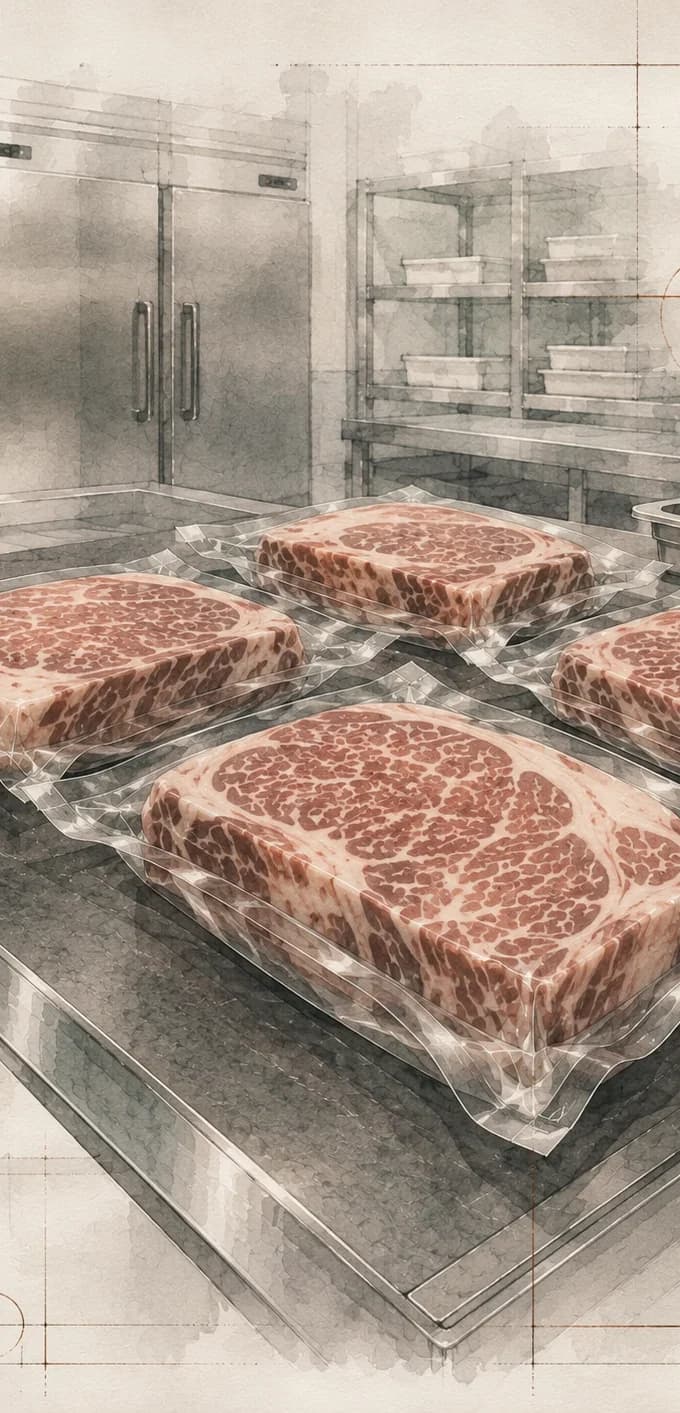
Most Wagyu lines in Singapore all-day dining rooms, hotel coffee houses and high-tea counters do not lose money at the moment of purchase. They lose it in the quiet block between lunch and dinner, when trays of pre-portioned steak, yakiniku slices or shabu sheets sit waiting for covers that arrive slowly. By the time they sell, the surface has darkened, purge has collected in the tray, and the kitchen trims again before plating. The kilo you paid for is not the kilo you serve.
This article deals with one thing: the in-outlet holding window after the case is opened, and how that window should decide your weekly cut mix before you ask anyone for a price. Related questions already have their own articles. If you want to recover value from trim and offcuts you have already produced, see the trim and offcut second-menu article. If incoming marbling does not match what the purchase order said, see the marbling spec drift audit. If you are comparing inbound transport modes, see air-chilled versus sea-frozen per cut. Those end at a logistics or acceptance decision. This one ends at a cut list.
Scroll sideways to see the whole diagram
The service-hour problem, stated in numbers you already have
A Singapore outlet with a long service window is not running one kitchen; it is running several dayparts with very different pull rates. Lunch may clear a tray in forty minutes. The mid-afternoon block may take three hours to clear the same tray. Dinner may clear it faster than you can portion. The portion that sold at 12:40 and the portion that sold at 16:10 cost you the same at landing, but they did not cost you the same by the time they reached the plate.
Two things change during that wait, and both are visible without instruments:
- Purge and surface drying. Cut muscle releases liquid. Thin slices with a large exposed surface release proportionally more than a thick steak of the same weight, because the loss scales with cut surface, not with mass.
- Surface color change. Freshly cut beef surface brightens on exposure to air, then darkens as that exposed layer ages. On a heavily marbled loin slice the fat also softens and smears under warm back-of-house air, which reads to a guest as a tired product even when the eating quality is intact.
Singapore back-of-house conditions make the second point sharper than many operators expect. Air conditioning runs continuously, but prep areas sit between a cold room and a hot line, and ambient humidity is high whenever a door opens. A tray that leaves the chiller for staging is not held at chiller temperature; it is held at whatever the pass actually is. Any holding number you borrow from another market is a number measured in a different room.
That is why this article does not give you holding hours per cut. It gives you a ledger to produce your own, because the only numbers that will survive an argument with your own finance team are the ones your own kitchen recorded.
The Service-Window Holding Ledger
Run it for one week, on the cuts and formats you already serve. One row per cut and format combination. No special equipment beyond the scale you already use for portioning.
| Column | What to record | How |
|---|---|---|
| Cut | The cut as it appears on your order, not the menu name | Striploin, ribeye, chuck roll, rump, shoulder clod, short plate, and so on |
| Portion format | Steak / yakiniku slice / shabu sheet / cube / tataki block | Record thickness for sliced formats, since thickness drives the result more than the cut name does |
| Portion weight at portioning | Grams, weighed immediately after cutting | Weigh a sample of three to five portions per batch, not the whole tray |
| Staging hours | Hours from portioning to the actual sale of the last portion in that batch | Write the portioning time on the tray label; the pass records the sale time |
| Purge and trim loss | Grams removed before plating: liquid blotted plus any surface trimmed or discarded | Reweigh the same sample portions at plating |
| Sellable grams | Weight at portioning minus loss | Simple subtraction; express also as a percentage of the starting weight |
| Rejected portions | Count of portions not served at all that day | Includes portions rolled to staff meal, re-cut into another item, or discarded |
Scroll sideways to see the whole table
The second block turns the record into money. For each row:
- Landed cost per gram. Your landed cost for that cut, divided by the grams you actually received after primal breakdown. Use your own figures and your own currency; this is not the quoted price per kilo.
- Cost per served portion. Landed cost per gram, multiplied by the starting portion weight, divided by the sellable-gram ratio from the ledger. A portion that starts at 120 g and plates at 108 g carries the cost of 120 g against the revenue of one sale.
- Rejection load. Spread the cost of unsold portions across the portions that did sell in that daypart. Operators often skip this, and it is usually where the mid-afternoon block stops looking harmless.
Then add the decision column. Three values only:
- HOLD-ABLE — sellable-gram ratio and appearance stay acceptable across your longest quiet block. These cuts and formats can be portioned in the morning and carried through the afternoon.
- SHORT-WINDOW — acceptable for roughly the length of a peak service period but not across a quiet block. These should be portioned in small batches timed to the daypart.
- CUT-TO-ORDER — loses saleable appearance or weight fast enough that advance portioning is not worth it. These belong on a to-order item, at a to-order price.
Set your own acceptance threshold before you start, so the ledger does not become an argument about taste. A common approach is to fix a sellable-gram floor and a visual pass or fail judged by the same person each day. The threshold matters less than applying it consistently.
What the ledger usually tells you about cut mix
The general pattern, stated as practice rather than as a measured claim you should accept without checking: the more heavily marbled the cut and the thinner the slice, the shorter the window. A shabu sheet from a high-marbling loin has the largest exposed surface per gram of any format you serve, and intramuscular fat at that thickness softens quickly once the sheet leaves the chiller. A yakiniku slice sits in the middle. A thick steak from the same loin holds better than either, simply because less of its mass is surface.
Firmer, leaner accent cuts from the chuck, shoulder or round behave differently. Less intramuscular fat means less smearing, and a denser muscle structure means less purge at the same thickness. They are also, generally, the cuts you can buy at a lower price per kilo, which compounds in your favor on the exact dayparts where volume is thin.
The practical conclusion is not "buy cheaper cuts." It is that one cut cannot carry every daypart. An outlet that buys a single premium loin and runs it from 11:00 to 22:00 is paying loin money for the afternoon hours and absorbing the worst holding losses at the same time. Splitting the order means:
- High-marbling loin in smaller, more frequent lots, used on to-order items and peak-hour sets.
- Accent cuts in larger lots, pre-portioned, carrying the quiet block and the counter display.
- Deliberately chosen formats: thick cuts where holding is needed, thin slices only where the pull rate supports them.
That split also changes what you should be asking a supplier for. A weekly standing order of one cut in one lot size is easy to quote and expensive to run. A cut list with different lot sizes per cut is harder to quote but matches how the outlet actually sells.
Lot size is part of the spec, not an afterthought
Once a cut is marked CUT-TO-ORDER or SHORT-WINDOW, the useful question is no longer only the price per kilo. It is how small a lot you can order without the per-kilo price moving against you, and how often. Frequent small lots of a short-window cut can be cheaper in served-portion terms than a large lot you have to hold, even at a worse headline price — but only your ledger can show whether that is true for your volumes.
When you ask for a quote, specify per cut: the format you will portion it into, the target portion weight, the lot size you want, and the delivery frequency. Availability of specific cuts, lot sizes and delivery cadence varies by season and by consignment, so treat all of these as items to be confirmed per inquiry rather than as standing terms. Sample availability and terms are confirmed per inquiry.
Review cadence
Holding behavior per cut and format changes slowly, so this is not a monthly exercise. Re-run the ledger when any of the following changes: your back-of-house layout or chiller capacity, your portion weights, your menu pricing, or your daypart pattern. Otherwise an annual review is generally enough. Keep the filled sheets — a year of them is the clearest argument you will have for changing a standing order.
Taking it to a quote
The filled ledger gives you a cut list: cut name, portion format, target portion weight, holding classification, preferred lot size and frequency. That is the input a per-cut quote needs. Without it, any quote you receive is priced against an order pattern that may not match how your outlet sells.
Send the cut list and we will come back with priced options per cut and lot size. Discuss your requirements.