
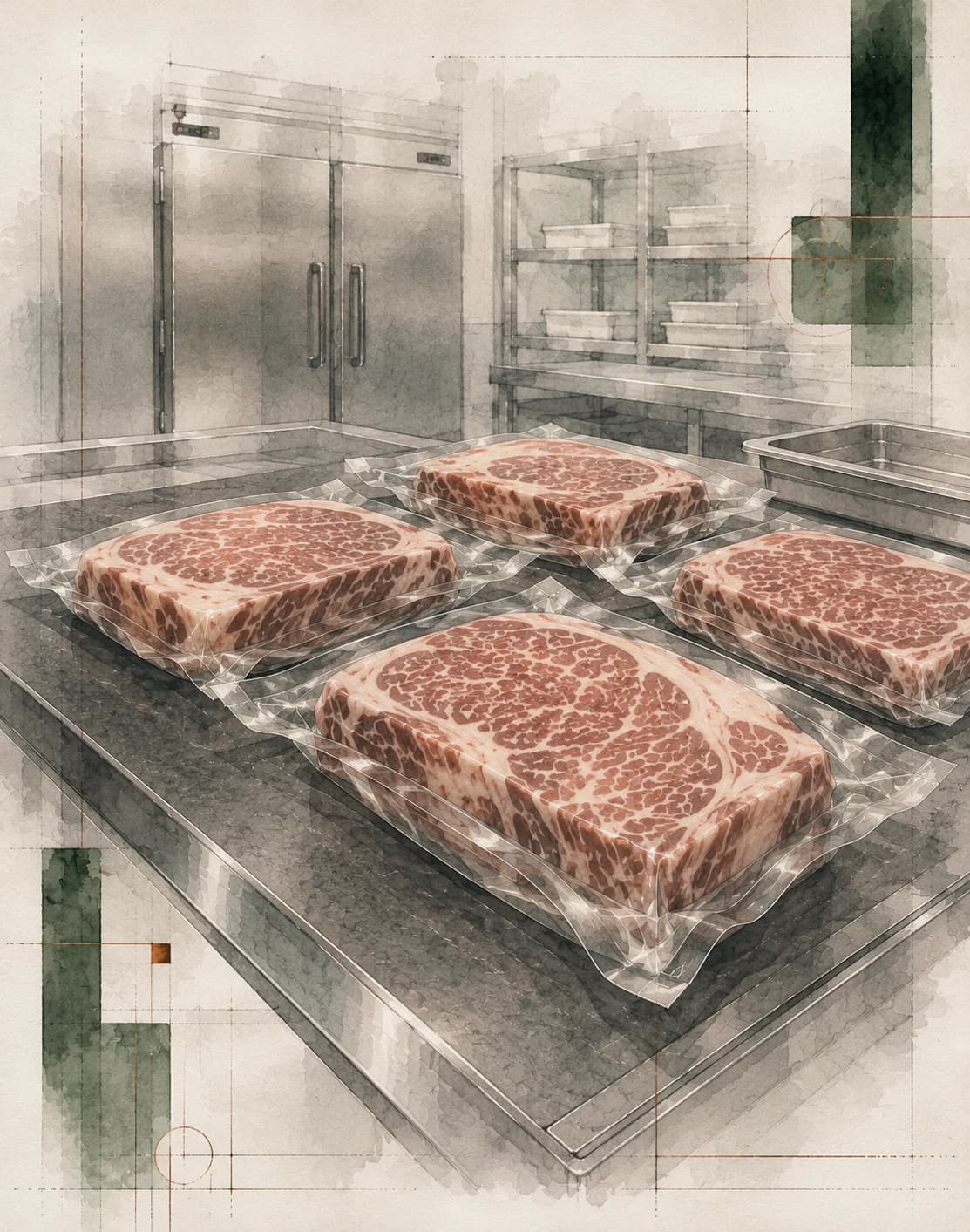
This article works a single upstream question for Taiwan banquet buyers: whether one course slot in a fixed-price per-table menu can carry a Japanese wagyu cut without breaking the food-cost line. It assumes no import project exists yet. If you have already decided to import and are managing chilled shelf-life days, see the Taiwan chilled wagyu day-loss ledger; if you are locking purchase-order fields with a supplier, see the Taiwan wagyu PO field lock sheet. For casino-hotel banquet economics with comped and gaming-subsidized covers, the Macau banquet yield-per-cut article covers that market; the Taiwan fixed-price wedding-table format and the course-slot substitution question are handled here.
The comparison that makes wagyu look impossible
Most Taiwan hotel F&B directors and banquet purchasing leads reach the same conclusion in the same way. They take the quoted per-kilogram price for Japanese wagyu, set it beside their current Australian or US grain-fed per-kilogram price, see a multiple, and stop.
That comparison is the error. It compares two per-kilogram numbers while holding portion size and course scope constant — but neither is constant in a banquet menu. A banquet beef course is not a steakhouse plate. It is one of eight to twelve courses, portioned to a fixed grams-per-cover figure that the venue already controls, and that figure is a design decision, not a fixed property of the protein.
The question worth asking is different: for one course slot only, at a portion size appropriate to that slot, what is the incremental cost per cover? That number is bounded and calculable from three inputs you already hold.
Scope first: one slot, not the beef program
Wagyu does not replace a banquet's protein program at Taiwan per-table price points. It occupies one slot. The distinction matters because it changes which cuts are candidates and which portion sizes are realistic.
Three slot formats dominate Taiwan banquet set menus, and each has a different portion logic:
- Sliced cold or lightly seared appetizer. Thin slices, presented for marbling visibility. The smallest gram figure of the three, because visual impact does the work rather than volume.
- Carved or portioned hot main. A cut portion per cover, plated hot. The largest gram figure, and the slot where cut choice matters most for portion consistency.
- Hot-pot or shabu portion. Sliced thin, served in volume on a shared plate. Perceived generosity comes from slice count and spread, not from weight.
In our own handling experience with banquet-format buyers (operational observation, not a measured study), the workable trimmed portion range for a wagyu course slot sits roughly between 60 and 90 grams per cover. Below that the plate reads thin; above it the incremental cost stops fitting inside a fixed per-table band. Your own venue's plating standard should override this range — use it as a starting figure for the worksheet, then substitute your number.
Choose the cut for portion consistency, not headline grade
The second common error is reaching for striploin or ribeye because those are the names that carry recognition. For a banquet slot, they are usually the wrong answer. Loin cuts carry the highest per-kilogram cost and, at high cover counts, the tightest supply. More importantly, they are not automatically the best performers at banquet portioning, where you need a large number of near-identical portions cut from a consistent cross-section.
Cuts worth naming instead:
- Chuck eye roll. Strong marbling continuity relative to its price position; holds up in sliced and hot-pot formats where slice appearance carries the course.
- Shoulder clod. Large, uniform muscle blocks; the easiest of the three to portion repeatedly to a fixed gram target for a carved or portioned main.
- Inside round. Leanest of the three, lowest per-kilogram position, best suited to thin-sliced cold presentation where the wagyu character shows on the surface rather than through the bite.
Each of these behaves differently once you cut it down to plate portions. Trim-to-plate yield — the share of purchased weight that reaches a plate after trimming, squaring, and end-piece loss — varies by cut family, and it varies further with how tightly your kitchen portions. We do not publish a fixed yield percentage here, because the honest figure depends on your banquet portioning standard and your butcher. What we can say structurally: loin cuts, chuck and shoulder cuts, and round cuts fall into three distinct yield bands, and round cuts generally give the highest plate yield of the three because there is less internal seam and fat cap to remove.
Measure it yourself before you commit. One test block per cut family, portioned by your own kitchen to your own gram target, weighed before and after, gives you a yield percentage you can defend — and it is the only figure in this worksheet that no supplier can hand you.
The course-slot substitution worksheet
Five rows, one course slot, one cut at a time. Run it on paper before you contact anyone.
- Baseline cost per cover. Current beef course grams per cover × your current landed cost per kilogram ÷ 1,000. This is what the slot costs you today.
- Target wagyu plate grams per cover. Set by slot format (appetizer slice / carved main / hot-pot portion), not by matching your current gram figure. This is where the cost is controlled.
- Purchased grams per cover. Target plate grams ÷ your measured trim-to-plate yield for that cut family. A 70 g plate portion at 80 percent yield means 87.5 g purchased.
- Wagyu cost per cover. Purchased grams × quoted landed cost per kilogram ÷ 1,000. The per-kilogram figure is the one variable you cannot fill in yourself — everything else is yours.
- Delta per table. (Row 4 − Row 1) × covers per table. Check it against the headroom in your per-table price band and against what the slot is worth in perceived value.
Two disciplines make the output trustworthy. First, use landed cost on both sides — your current grain-fed figure should include freight, duty, and storage, not the supplier's ex-works line, or you will compare unlike numbers. Second, run the worksheet on one slot only. If the delta per table only works when you also downgrade a second course, you have left the scope of this exercise.
What the output looks like
Done properly, the worksheet leaves you with three things: a named cut, a target grams-per-cover figure, and an estimated monthly cover count from your banquet calendar. Taiwan wedding and year-end banquet programs are typically planned two to six months ahead, so the cover count is usually already visible in your booking sheet.
Those three items are not a general interest in wagyu. They are a quotable request.
Notes on Taiwan conditions and currency figures
Per-table price bands for Taiwan hotel banquets, and the competing Australian and US grain-fed benchmark prices you are working against, move with season and exchange rates. Every currency figure in this worksheet is therefore a reader-filled input, not a published number. Re-run the worksheet when your benchmark price changes rather than treating a past result as settled.
Import conditions for Japanese beef into Taiwan — eligible establishments, certificate requirements, and the cuts those conditions permit — are set by the Taiwanese authorities and can change. Confirm the current requirements with the relevant Taiwan authority, or ask us to confirm cut availability at the time of quoting, rather than relying on a figure restated in an article.
Next step
You now have one cut and one portion size. Send those two numbers, plus your estimated monthly cover count, and we will come back with a landed per-kilogram quote at your volume — which is the only missing cell in row 4.
No import decision is required to ask. If the delta per table does not work, you have lost a worksheet, not a project. If it does, a sample block for a single menu trial is the natural next step, and we can arrange that alongside the quote.