
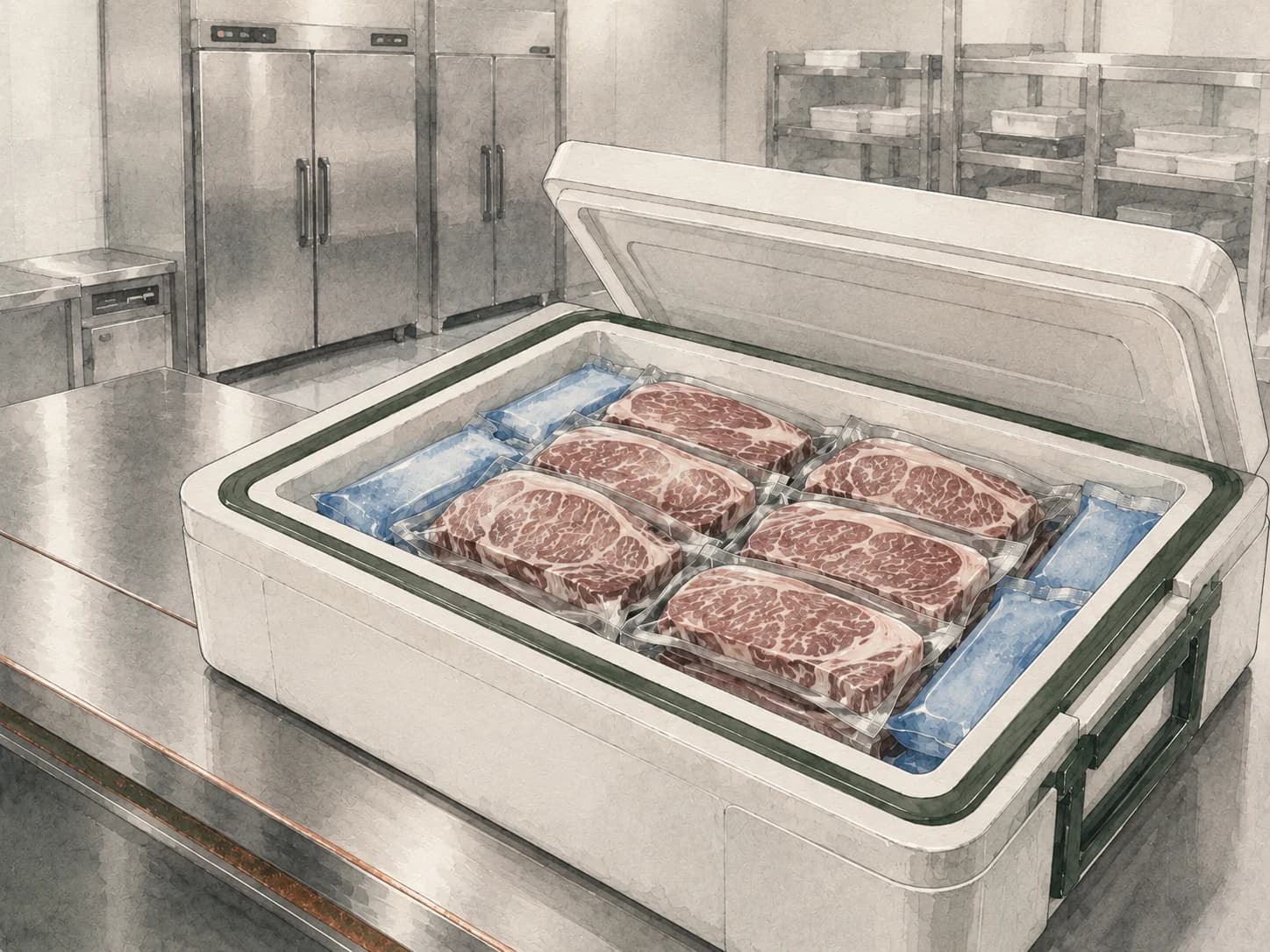
A chilled Wagyu consignment lands at TPE. The logger shows an excursion, or CIQ holds the lot for two extra days, or one carton is short against the packing list. Within days you have to decide: accept and sell as planned, redeploy the affected cuts to a lower-value application, or file a claim against the airline, the forwarder, or the Japanese supplier. The decision is rarely lost on the merits. It is lost because the records that would have made the deviation attributable to one party were never created.
This article covers what happens after a deviation at the Taiwan border: which records must already exist, per cut and per carton, at each custody handover, and how to read them into an accept / redeploy / claim decision. Two neighboring pieces cover the stages on either side of that moment — the PO field lock sheet fixes specification fields before shipment, and the chilled day-loss ledger counts remaining shelf days once a lot has already been accepted as normal. If your lot arrived clean, read the day-loss ledger instead. There is also a US version of this triage logic, but it is built around FSIS re-inspection and inland trucking; the Taiwan lane is air-only for chilled, inspection sits with CIQ/FDA, and the Chinese-language label fields are a separate failure mode. Those differences change which records matter, so this piece is written from the Taiwan side.
Scroll sideways to see the whole diagram
Why claims break at three points, not at the excursion itself
An excursion on a logger trace is a measurement. A claim is an argument about whose custody the goods were in when the measurement happened. On the Japan–Taiwan chilled lane the consignment passes through at least three handovers where custody changes hands and nobody is contractually obliged to record condition:
- Japanese cold store to air cargo terminal. The lot leaves a controlled room, is built onto ULDs or loose-loaded, and may sit on a ramp. If the logger was started at pack time and the terminal acceptance time is not recorded, every later excursion can be argued back to the exporter.
- TPE (or KHH) terminal to CIQ hold. Breakdown, transfer to the bonded chilled area, and any inspection hold. If the importer's representative never recorded carton count, pallet temperature, or seal condition at breakdown, the forwarder can argue the goods arrived already out of spec.
- CIQ release to the importer's own truck. The handover most often undocumented, because by this point the team is focused on getting the product to the chiller. A deviation first noticed in your own cold room, with no record at release, is in practice your deviation.
The common pattern in practice is not a dramatic failure. It is a lot with a credible logger trace, an undisputed shortage, and no timestamped condition record at the leg where the two could have been joined. The counterparty does not need to prove the goods were fine; they only need the gap.
The TW Arrival Deviation Evidence Pack
The pack is one page, built as three custody legs against four record types. Print it, assign a name to each cell, and treat an empty cell as a known exposure rather than an oversight.
| Record type | Leg 1: JP cold store → air terminal | Leg 2: TPE/KHH terminal → CIQ | Leg 3: CIQ release → your truck |
|---|---|---|---|
| Temperature logger trace | Logger ID started at pack, mapped to carton IDs; start timestamp on the trace | Spot reading at breakdown, with reader ID and time | Reading at loading and at arrival in your chiller |
| Carton / weight tally | Packing list with carton ID, cut, lot, pack date, net weight per carton | Physical carton count against AWB and packing list, signed | Re-count and weigh-back of any carton flagged at Leg 2 |
| Photo with timestamp and carton ID | Carton face and seal at dispatch | Pallet condition, wet cartons, broken seals, label damage | Carton face plus logger display in the same frame |
| Signed handover note | Terminal acceptance receipt with time | Breakdown note or exception note naming the handling party | Release note with time, plus your driver's signature |
Scroll sideways to see the whole table
The decisive cell is the top-left one. If logger IDs are mapped only to a pallet, a single excursion contaminates the whole consignment and you negotiate over the full value. If logger IDs are mapped to cartons, and cartons to cut and lot, the excursion attaches to a defined subset and the rest of the lot stays clean. That mapping can only be created on the Japanese side, at pack time. No amount of diligence at TPE recovers it.
The per-cut decision column
Once the deviation is attributable, the question becomes commercial rather than evidential: is this cut still fit for the use you bought it for? Cuts do not degrade on the same schedule, and the loss of value differs by intended application. The thresholds below are a planning frame, not measured limits — set your own against your HACCP plan, your supplier's stated handling conditions, and the shelf-life basis on the lot's own documentation. Where your QA policy and this table disagree, follow your QA policy.
| Cut | Typical TW use at risk | Redeploy direction if raw chilled service is withdrawn | Record that decides it |
|---|---|---|---|
| Striploin | Portioned steak, teppanyaki counter | Pre-portion and move to a cooked set-menu slot; shorten the hold window | Excursion duration plus days already consumed in transit |
| Ribeye | Steak service, sliced hotpot | Slice for cooked applications where surface condition is less visible | Surface photo at Leg 3 plus purge observed at cutting |
| Tenderloin | Highest per-portion value, raw-adjacent presentation | Rarely worth holding under doubt; move to cooked service early | Carton-level logger trace, not pallet average |
| Chuck roll | Sliced hotpot, buffet | Already a cooked application; usually absorbed rather than claimed | Weight tally — shortage matters more than temperature here |
| Short plate | Sliced, cooked | Absorb; claim only if shortage or label defect is documented | Packing list versus physical tally at Leg 2 |
Scroll sideways to see the whole table
The pattern worth noticing: for the high-value raw-service cuts, the deciding record is the temperature trace at carton level. For the sliced-and-cooked cuts, it is the weight and carton tally. Importers who photograph everything but never weigh back are collecting evidence for the wrong half of their own order book.
The claim clock
Notification windows are contractual, not regulatory, and they differ by carrier, by forwarder, and by your supply agreement with the Japanese exporter. Do not work from a remembered number. Before your next consignment, extract the following from your own documents and write the hours into the pack:
- Air carrier: the notice period for damage and for shortage under the conditions of carriage attached to your AWB. These are often different periods.
- Forwarder: whether their standard trading conditions shorten the window or require written notice in a specific form.
- Cargo insurer: the survey request deadline, and whether opening or moving cartons before survey prejudices the claim.
- Japanese exporter: the quality-complaint window in your supply terms, and what evidence format they accept.
Two practical consequences. First, the shortest of those four windows governs your behavior at release, so it belongs on the one-page pack where the person meeting the truck can see it. Second, several windows start at release, not at discovery — which is why the Leg 3 record exists. If you found the problem in your chiller on day three and your record set starts there, you may already be outside the window that mattered.
Where the regulatory side sits
Taiwan's import inspection for chilled beef, the required Chinese-language label fields, and the documents that must accompany the consignment are set by the competent authorities and are revised from time to time. This article was written in June 2025 and deliberately does not quote fixed inspection fees, hold durations, or clearance hour counts, because those are the figures most likely to be stale by the time you read it. Confirm current requirements with the relevant Taiwanese authority or your customs broker before each program, and treat a label-field rejection as a separate failure mode from a cold-chain deviation: it is resolved by documentation, not by triage, and it is preventable at the PO stage.
One thing worth separating clearly: a CIQ hold is not in itself a deviation. It becomes one when the hold consumes chilled shelf days that your menu plan assumed. The evidence that converts a hold into a quantified loss is the pack date per cut plus the logger trace through the hold period — both of which originate upstream.
What the exporter can pre-load
Working backward from the table, a meaningful share of the pack cannot be created in Taiwan at all. These items are produced at pack time in Japan or not at all:
- Logger ID mapped to carton ID, with the carton mapped to cut, lot, and pack date.
- Pack date stated per cut rather than per consignment.
- Lot split documentation when one cut is drawn from more than one lot.
- Net weight per carton on the packing list, in a form that supports weigh-back.
- Dispatch photographs tied to carton IDs.
Which of these can be issued depends on the pack line and the specification agreed for your consignment, so it is confirmed case by case rather than promised in advance. The useful move is to raise it as a specification question before the next order, not as a complaint after the next deviation. Sample availability and terms are confirmed per inquiry.
Using the pack
A workable sequence for the next consignment: fill the twelve cells with the name of the person responsible and the document that will prove it; identify the empty cells; ask the exporter which of the Japan-side items can be issued with your consignment and in what format; extract the four notification windows from your own contracts and write the shortest one at the top of the page; brief the person who meets the truck at release. The pack is only useful if it exists before the deviation, which is the whole point of writing it while nothing is wrong.
If you want to work through which per-carton records can be issued with your next shipment and how they lock to your PO fields, Discuss your requirements.