
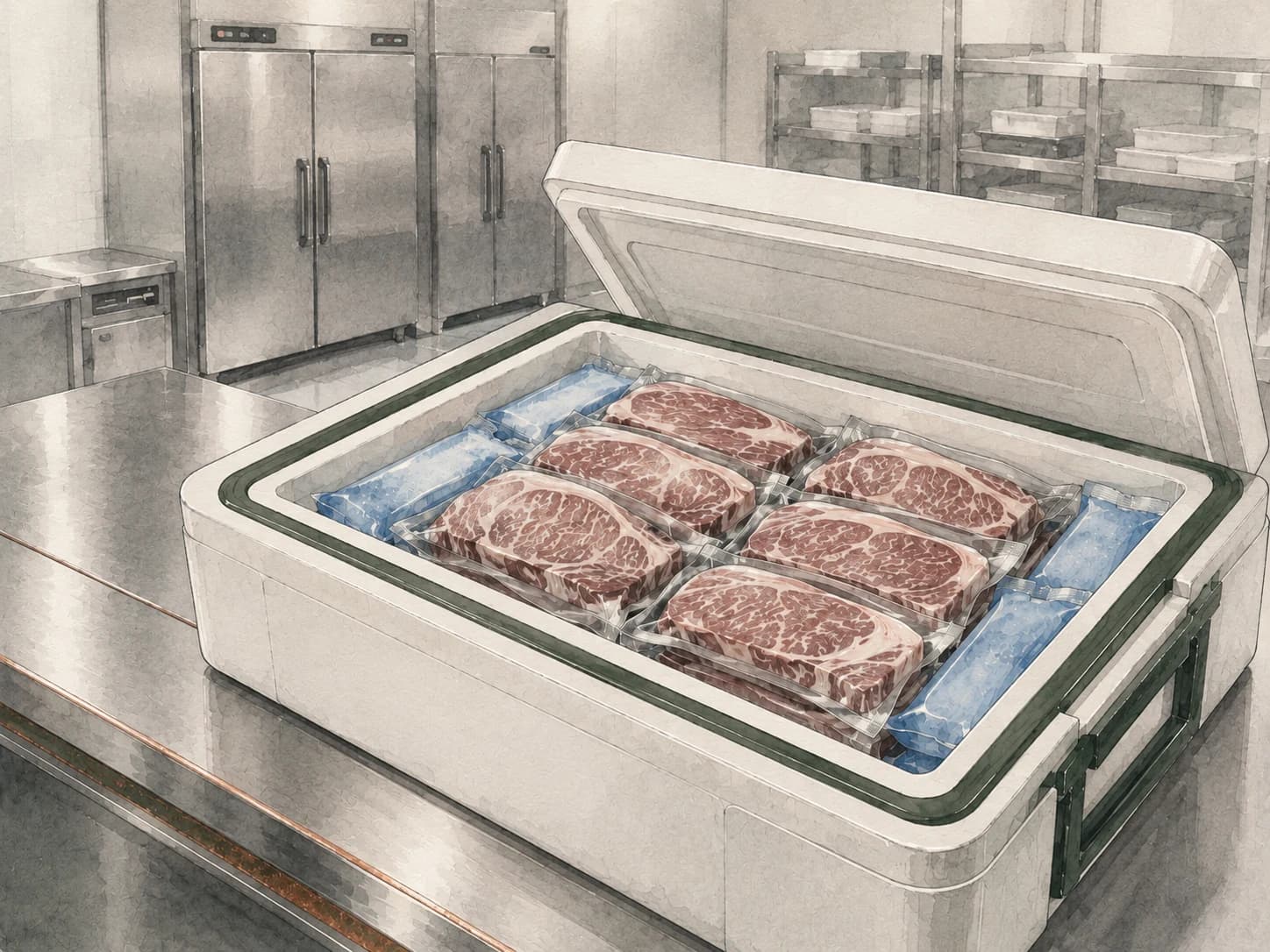
This article covers one narrow situation: a chilled Japanese Wagyu air shipment has landed at LAX, JFK, or ORD, the pallet is broken down, and the logger or the vacuum packs tell you something went wrong. You have to decide, carton by carton, what you accept at full value, what you accept at a negotiated discount, and what you reject — and you have to capture evidence before the product goes back into the cooler. It is the exception branch of receiving, not the normal one.
If your shipment arrived clean and you are matching FSIS label fields to lot splits at receiving, read the cut-to-lot split sheet instead. If your question is how a quoted kilo price becomes a sellable pound cost, that is the quoted-kilo to sellable-pound ledger. And if you are recording handover temperature in Vietnam, under a different regulatory chain, see the Vietnam handover custody sheet. None of those three tells you what to do with a loin carton that reads warm.
The deciding variable is the cut, not the shipment
The common mistake on arrival is to treat a deviation as a shipment-level event: the logger shows an excursion, so the whole AWB becomes a dispute. That is how buyers lose money twice — once on product they wrote off that was still fully sellable, and once on product they accepted and then could not sell at the price they paid.
Chilled Wagyu arrives as a mix of end uses. Striploin, ribeye, and tenderloin going to raw or rare service carry almost all of the value risk: their price depends on surface condition, purge, and remaining aging window, and a soft pack or a warm core shortens that window immediately. Shoulder clod, chuck roll, short plate, and trim destined for cooked, braised, or portioned applications usually come through a short excursion at full usable value, because the cooking step and the shorter intended shelf window absorb what the loin cannot.
So the first move at breakdown is not to open a dispute. It is to sort the cartons into raw-service and cooked-application groups, then judge each group against its own standard.
What to record per carton, not per shipment
Build one row per carton. A claim that lists "1 pallet, temperature excursion" is not actionable for a Japanese supplier who cannot see your cooler. A ledger with carton-level rows is.
Columns we would keep:
- Carton ID / lot — as printed, matching the packing list and the label.
- Cut and grade — striploin A5, chuck roll A4, and so on.
- Pack type — vacuum, skin pack, master carton with gel or dry ice.
- Logger reading — peak temperature and the duration above your agreed band, read off the download, not off the display.
- Core temperature at breakdown — probed between two primals inside the carton, with the probe time written next to the number.
- Pack integrity — intact / soft / leaking. Pick one word; do not write prose here.
- Purge level — none / light / pooled, and whether purge is clear or cloudy.
- Disposition — full accept / discount accept / reject.
- Re-quoted value — what you are now willing to pay for that carton, in your own costing terms.
- Evidence captured — logger file ID, photo IDs, and the time stamp of each.
The last two columns are the ones buyers skip and later need. A disposition without a re-quoted number turns into an open-ended email thread; evidence without time stamps is hard for a supplier or an insurer to reconcile against the flight.
Three dispositions, written before the shipment, not during it
The thresholds that decide full accept, discount accept, and reject are commercial terms, not regulatory ones. They should be agreed with your supplier in writing before the booking, so that on arrival you are applying a rule instead of arguing a case. In our own handling experience — this is operating practice, not measured data — the agreements that hold up share three features:
Full accept is defined by both a core temperature band and intact pack condition for raw-service cuts. One condition is not enough: a carton can read in range and still have a soft pack that will purge within days.
Discount accept names the alternative use and who bears the gap. For a loin that fails the raw-service standard but is sound, the sensible outcome is a redirect to cooked service at a re-quoted value, not a rejection. Write down which applications count and how the discount is calculated, because that is the clause that actually gets used.
Reject is reserved for leaking packs, off odor at opening, or readings outside the band you both signed, and it should specify disposal or hold instructions. Holding rejected product in your cooler without written instruction creates a storage cost nobody agreed to pay.
Public safety and import requirements sit on top of all this and are not negotiable between buyer and seller. Anything touching US import inspection, labeling, or product condition at entry should be confirmed with your customs broker and against your PO terms, since procedures change.
The first two hours
Evidence quality collapses once the cartons go back into the cooler and the surfaces equalize. Work through the following before re-chilling, and note the clock time at each step:
- Photograph the pallet as received, before any carton is moved: wrap, labels, any visible crush or wet spots.
- Download the logger file and save it with the AWB number in the filename. Do not rely on the display reading alone; the file is what the supplier and any insurer will look at.
- Probe core temperature on a defined sample of cartons per cut group, and on every carton flagged as soft or leaking. Photograph the probe display with the carton ID visible in the frame.
- Photograph each flagged pack individually — seal line, purge pooling, label — one carton per photo so the images can be matched to rows later.
- Write the disposition and re-quoted value into the ledger while you are still at the pallet, then re-chill everything, including rejected cartons, pending instructions.
Send the ledger and the logger file to the supplier the same day. A same-day carton-level file is the difference between a claim that gets settled and a claim that becomes a negotiation about memory.
Why this changes the number, not just the paperwork
Triage by cut recovers sellable weight that shipment-level thinking throws away. The chuck roll and short plate in a deviated shipment are usually still worth full value to a kitchen that braises them, and the loin that fails raw-service standards is usually still worth something to the same kitchen. What you lose is the spread between raw-service and cooked-application value on a few cartons — a known, quantifiable amount — instead of the whole consignment's margin plus a dispute.
It also changes the supplier's side. A Japanese exporter receiving carton IDs, probe times, and photographs can trace the problem back to a specific pallet position, gel pack configuration, or tarmac hold, and fix it on the next booking. A message saying the shipment arrived warm cannot be acted on.
Agree the terms before the next chilled booking
This ledger only works if the thresholds behind it are shared. Logger placement, the excursion band that applies to raw-service cuts versus cooked-application cuts, what counts as valid evidence, and how a discount accept is priced — all of that should be settled in writing before the product ships, not discovered on the dock.
If you buy Japanese Wagyu by the cut and ship chilled into the US, contact us to set those arrival-acceptance terms per cut ahead of your next booking, so the first exception is handled by a written rule rather than an email argument.