
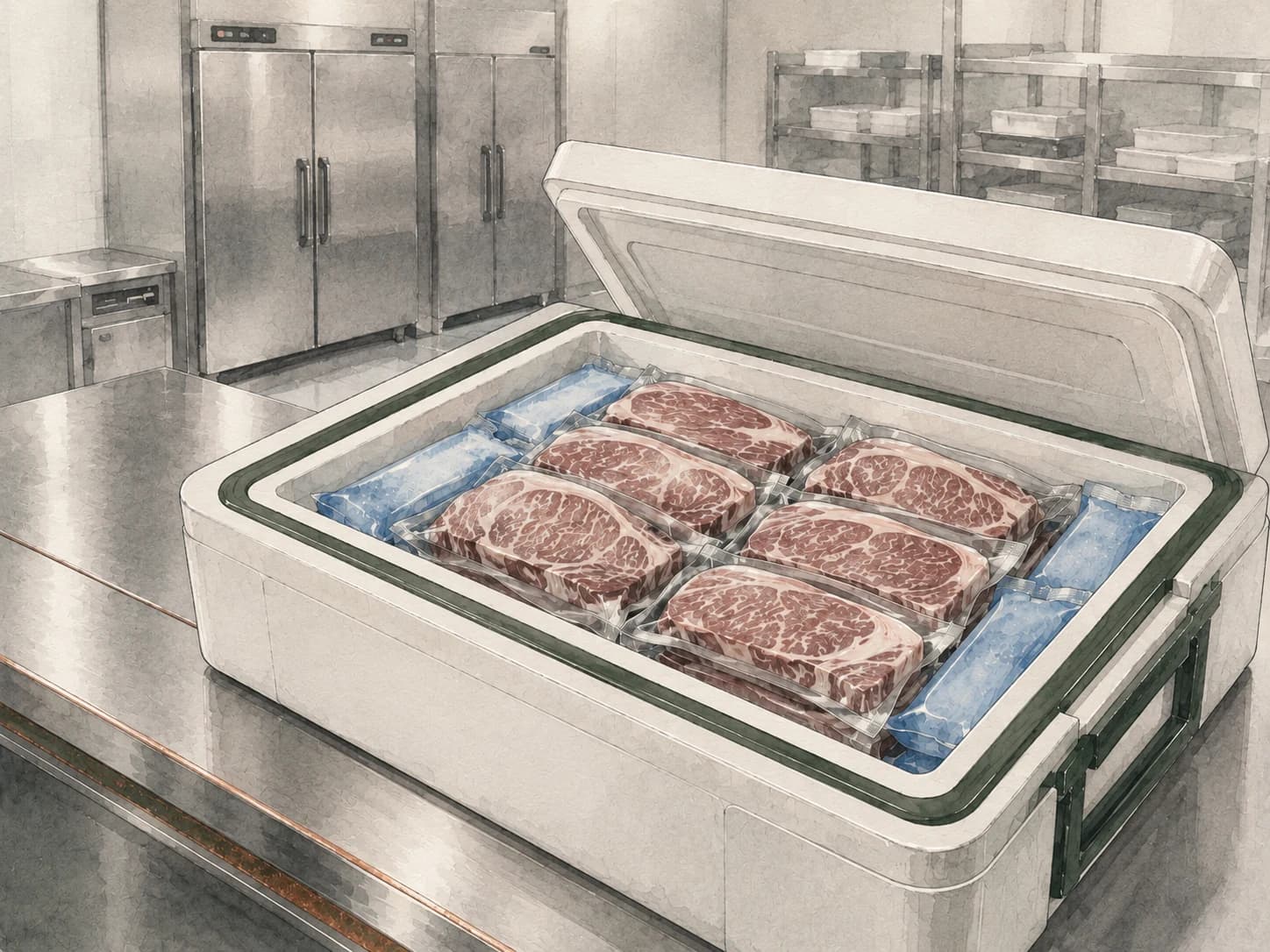
Two importers in Ho Chi Minh City can order the same cut, from the same Japanese supplier, on the same lane, and get different results: one ribeye set arrives with a clean logger trace and full carton count, the next arrives re-palletized, two cartons short of their original seals, and with a temperature record that stops somewhere between the aircraft and the cold store. The spec did not change. The custody record did.
This article maps where temperature and carton custody actually get recorded on a Vietnam import, and how to turn those gaps into purchase order and packing language that names a responsible party. It is a liability-attribution piece. If your question is how many days the import permit takes before shipping, that is counted in the Vietnam permit lead-time day ledger. If you are still choosing between air-chilled and sea-frozen for a given cut, see the air-chilled versus sea-frozen cost comparison per cut. If you want to count how many chilled shelf-life days a shipment loses, that is the chilled day-loss ledger. None of those tell you which party to name when a carton arrives off-spec.
The loss is usually not the mode. It is the two or three unrecorded handovers.
In our handling experience with Vietnamese consignees — this is an operating observation, not a measured study — the cartons that end up written off as shrink rarely fail because the shipment moved by the wrong mode. They fail at the points where the cargo physically changes hands and no one produces a record of the moment: the quarantine and customs inspection break, and the in-bound transfer into a third-party bonded cold store.
The mechanism is simple. A chilled Wagyu loin is a product whose value depends on a continuous, provable history. When the history has a hole in it, two things happen at once. The meat may genuinely have been exposed. And even if it was not, you cannot prove where any deviation occurred, so no counterparty accepts the claim. The carton becomes your loss by default. "Absorbed as shrink" is what we call a dispute we were never equipped to open.
So the practical question is not "how do I keep the cold chain perfect." It is: at which handover does the record stop, and whose name goes in the blank there?
The Vietnam handover chain, point by point
Below is the chain as it typically runs for chilled Wagyu shipped by the cut into Ho Chi Minh City, Hanoi or Da Nang. Your lane may add or merge steps; the point is to write yours down rather than assume it.
1. Japanese consolidator loading
Cartons are packed, master cartons sealed, and the consignment staged for the airline or ocean carrier. This is the only point where the cut-to-carton relationship is fully known — which cut, which grade, which weight, which carton. If that relationship is not printed on the carton and mirrored in the packing list, every downstream dispute becomes an argument about which carton contained what. Record to demand: carton-level marking with cut name and lot, seal numbers, logger ID and the time the logger was armed, and the position of the logger (inside the master carton, not taped to a pallet shroud).
2. Carrier acceptance
The airline or shipping line takes the cargo. Their record is a receipt for pieces and weight, not for temperature at the meat. Air cargo also usually involves a ramp and a build-up area. Record to demand: acceptance time, piece count against the packing list, and any exception noted on the air waybill or bill of lading.
3. Arrival and dwell before release
The consignment is on the ground, but not yours. Dwell time between arrival and release varies by airport, by day of week and by whether documents were lodged in advance. Do not accept a number from a general article — including this one. Measure your own: log arrival time and release time on your last ten consignments and you will have a lane-specific figure that is worth more than any published average.
4. Quarantine and customs inspection
This is the break that costs the most. Inspection may involve opening master cartons, sampling, and re-palletizing before the cargo goes back into a chilled environment. During that window, the original seals are gone, the carton count on the pallet may no longer match the packing list, and ambient exposure is real. Record to demand: who opened which carton, at what time, how long the cargo was out of temperature-controlled space, and a fresh carton count signed by someone. Whether current Vietnamese inspection practice routinely opens master cartons for chilled beef, and how long the typical exposure runs, should be confirmed with your customs broker and the inspecting authority for your specific port — practice varies and is revised from time to time.
5. Bonded cold store in-bound
A third-party cold store receives the cargo. Whether they issue you, the cargo owner, an in-bound record showing carton count, product temperature on receipt and time of placement into the chamber is a commercial question you settle in advance, not after a problem. If your cold store will not issue an in-bound record, you have chosen a facility at which your claims die.
6. Cold store out-bound
Product leaves for the kitchen or the reseller. Same requirement mirrored: count, temperature, time, signature. The difference between in-bound and out-bound records is what tells you whether a loss happened inside the store or before it.
7. Final delivery, including upcountry
Delivery to a hotel outlet in the same city is one risk. A run from Ho Chi Minh City to a resort property, or Hanoi to a provincial outlet, is another entirely — longer time, more door openings, often a smaller vehicle with weaker temperature control. Record to demand: a logger that travels with the delivery leg, and a receiving signature that states temperature and count rather than just "received."
The custody sheet: one page, seven rows
Build a single sheet with one row per handover point above and four columns:
- Who physically holds the cartons — a named company, not a role. "The forwarder" is not a party; a company with a contract is.
- What record exists — logger ID and reading, seal numbers, carton count, signed time. If the honest answer is "none," write "none." That blank is the finding.
- Maximum allowed exposure at that point — the window you are willing to accept, agreed in advance. You set this from your own product tolerance, not from a generic figure.
- Who pays if the record is missing — the column that converts the sheet from documentation into leverage.
Fill it for your actual last shipment, not a hypothetical one. Most importers who do this find two or three rows where the second and fourth columns are both empty. Those rows are the entire problem.
The carton-level dispute line
Underneath the seven rows, keep a short block you complete the moment a cut arrives off-spec. Four fields:
- Cut name and grade as ordered, and what actually arrived
- Carton ID and seal number, plus whether the seal was intact
- Logger reading at the break, with the logger ID and the time window
- The named party holding custody at that point, per your sheet
With those four fields you can send a claim. Without them, you can send a complaint, which is a different document with a different outcome. Whether Vietnamese authorities and your specific counterparties accept electronic data-logger downloads as evidence — and in which file format — is worth confirming with your insurer and your broker before you need it, not during a dispute.
What to write into the PO and the packing requirement
The sheet is diagnostic. The PO is where it becomes enforceable. Fields worth specifying for chilled Wagyu by the cut:
- Carton marking per cut. Cut name, grade, lot and net weight legible on the master carton, matching the packing list line by line. This is what lets you dispute one carton instead of one shipment.
- Logger placement and count. Specify inside the master carton versus on the pallet, and how many loggers per consignment. A single pallet-level logger tells you nothing about the carton that was opened at inspection.
- Seal numbers on the packing list. So a broken seal is an event with a number attached, not an impression.
- Which cut ships chilled and which ships frozen on this lane. A decision per cut, not per shipment — and one that changes what a temperature deviation means.
- Incoterm and the exact point it ends. CIF and DAP put the risk transfer in very different places relative to the cold store gate. Confirm with your own contract which party carries risk at inspection and at cold store in-bound; do not assume the common practice on your lane applies to your paperwork.
- Record delivery obligation. Who sends you the logger file, the signed count and the inspection record, and within how many hours of each event.
Review it on a schedule
Handover points and the need for a continuous record change slowly, but inspection procedures, accepted record formats and bonded cold store practice do get revised. Re-check the procedural items with your broker and the relevant Vietnamese authority before each contract renewal, and review the sheet roughly every six to twelve months. Nothing in this article carries a rate or a named facility, so it will not go stale on a tariff change — but the inspection step will change on you without notice.
The half of the sheet only the supplier can fill
Work through the custody sheet and you will find that several of the most useful fields are not yours to set. Per-cut carton and seal marking, logger placement inside the master carton, which cut goes into which carton, and whether a given cut ships chilled or frozen on your lane — all of these are decided on the Japanese side, before the cargo ever reaches a Vietnamese inspection bay. They are also the cheapest things to fix, because they cost packing discipline rather than freight.
If you want to agree those packing, marking and logger terms per cut for your actual lane into Ho Chi Minh City, Hanoi or Da Nang before your next PO, tell us your lane and cut list and we will work through the conditions with you.