
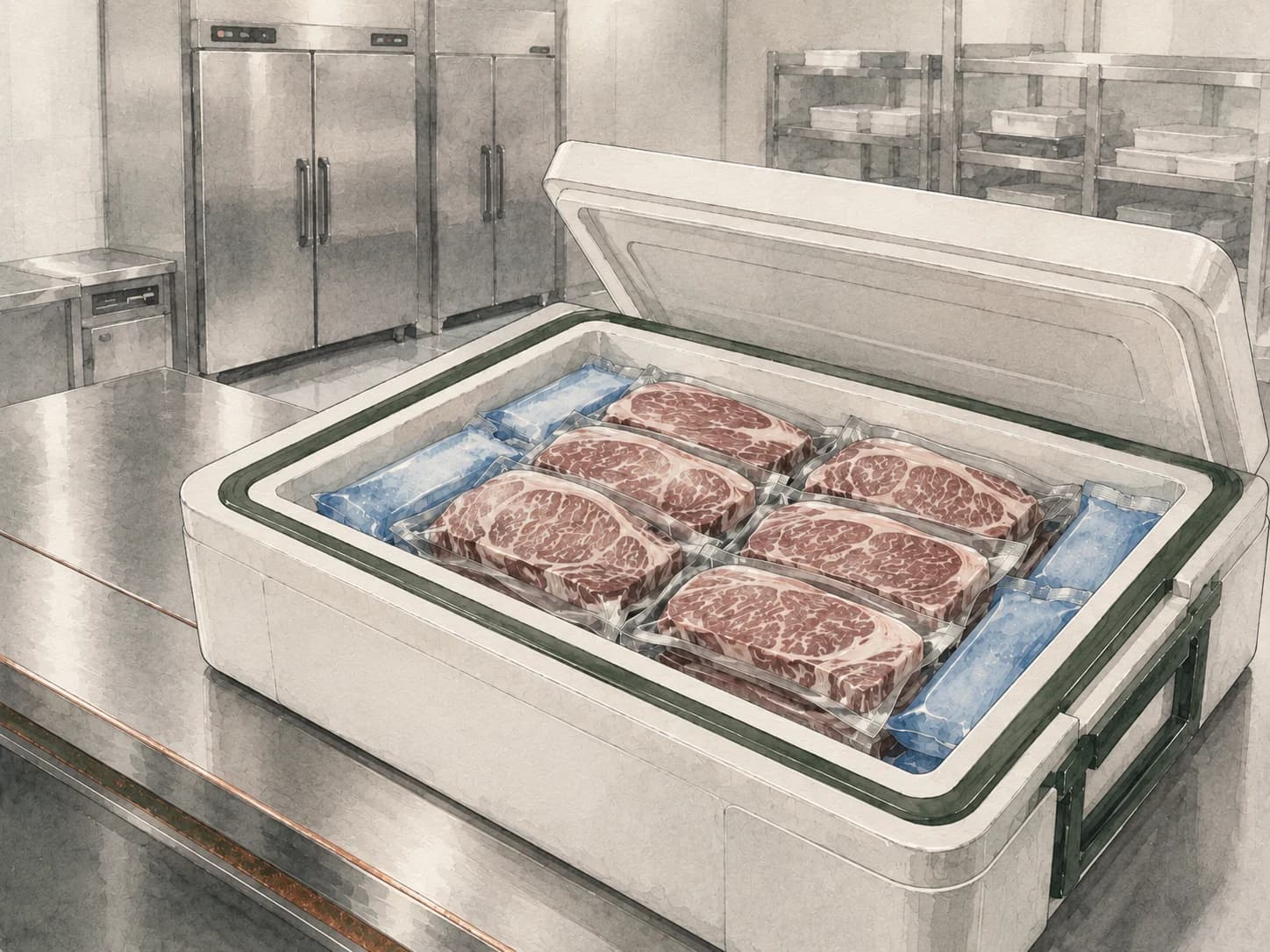
If you buy Japanese Wagyu into Vietnam, the decision you keep re-litigating is not "is Wagyu worth carrying" — it is why the chilled ribeye you flew in has three usable days on the pass instead of the ten you priced against. This article rebuilds that day count for Vietnam specifically, where the import permit is applied for per consignment against a named Japanese establishment and a specific product description, and where the clock that matters starts in Japan, before the shipment ever moves.
That is the difference from the neighboring articles on this site. If you want the per-cut air-chilled versus sea-frozen comparison in a market with standing permits and a short inland leg, read the Singapore per-cut comparison. If you want the arithmetic of shelf-life days lost after arrival, that is covered in the Taiwan day-loss ledger and the Hong Kong shelf-life day count. All three assume clearance is fast and predictable because the document set is checked against a permit you already hold. In Vietnam that assumption is the thing that breaks, so the same tool produces different arithmetic and a different break-even per cut.
Where the Vietnamese day count actually starts
Most importers build their landed-cost model from the airway bill: flight lands, clearance takes some hours, the truck runs, and the remaining shelf life is whatever the packing label says minus those hours. That model works where the regulatory check at the border is a comparison against a permit that already exists.
Vietnam's animal-product import flow works the other way around for most buyers. The consignment-level import registration ties three things together: the Japanese establishment that slaughtered and packed the product, the product description as it appears on the Japanese export health certificate issued by the competent authority, and the quantity and HS classification on your PO. Until those three agree, the shipment does not leave Japan — or worse, it leaves and the disagreement surfaces at the gateway, where a chilled consignment is burning shelf life by the hour.
So the honest first day of your ledger is not the flight. It is the day you asked for the permit, because that date determines whether the meat is packed and shipped fresh against a live permit window or sits in a Japanese cold store waiting for paperwork. Japan's Ministry of Agriculture, Forestry and Fisheries publishes the country-by-country export conditions and certificate formats for beef, including the requirements applied to Vietnam — see MAFF's certificate and facility application pages for Asia (Japanese). JETRO's Vietnam food-import pages and the Vietnam Customs portal are the reference points on the Vietnamese side. These change; confirm the current certificate format and the current registered-establishment position with your supplier and the Vietnamese authority before each new supplier relationship, and re-check at least every six months.
The Vietnam Wagyu day ledger
Below is the worksheet we use with Vietnamese buyers. The stage list is fixed. The day allowances are our observed ranges from handling Wagyu export consignments — they are operating experience, not measured data and not regulatory guarantees. The point of the sheet is not our numbers; it is the blank column where you enter your own last three shipments and discover which stage is actually eating your margin.
Stages, in order
- Permit / registration application to issuance. Our experience: allow one to three working weeks when the Japanese establishment and the exact product description are already on file, and materially longer for a first-time establishment or a new description. Buyers who apply per consignment carry this on every order; buyers who can group descriptions carry it once per period. Verify your own current lead time — this is the single number that most changes your answer.
- Japanese packing / slaughter date to health certificate issuance. Typically same week if the certificate description was pre-agreed against the permit. If the description has to be amended, the product waits in Japan and you lose those days off the chilled clock, not off the frozen one.
- Japan cold store to departure. Consolidation and airline acceptance. Short, but it is real, and it is chilled time.
- Flight or sailing. Air to Ho Chi Minh City or Hanoi is measured in hours. Sea freight to Hai Phong or Cat Lai is measured in weeks, which is exactly why frozen is the format for that leg.
- Gateway clearance and inspection. Documentary check plus any physical inspection and sampling. Whether Tan Son Nhat and Noi Bai differ materially for chilled air cargo depends on your broker, your consignment history and the day; do not assume they are identical, and log both if you use both.
- Cold-store transfer. Bonded or commercial cold store, break-bulk, re-labeling for the domestic market.
- Inland delivery. Within Ho Chi Minh City or Hanoi this is a same-day leg. To provincial hotel groups — Da Nang, Nha Trang, Phu Quoc, the northern resort corridor — it is another leg with another temperature risk, and it is where chilled Wagyu most often arrives with a shortened usable window.
- Service window. The days your kitchen or your reseller actually has before the cut is downgraded, discounted or trimmed away.
Fill each stage with three columns: your planned days, your actual days on the last three consignments, and the variance. Then read the ledger backwards from the last safe service date. The number you get is the only shelf life you are entitled to price against.
Reading the break-even per cut
Once you have your own remaining-days figure, the chilled-versus-frozen question stops being philosophical. Frame it as landed cost per usable kilo, not per kilo shipped:
Landed cost per usable kilo = (product + freight + duty + clearance + cold-store + inland) ÷ (kilos shipped × yield after trim × share sold at full menu price)
Air-chilled raises the numerator. It only wins when it raises the denominator by more — that is, when the cut is sold at full price, on the plate, within the days you actually have.
- Ribeye and striploin for steak service. These are the cuts where chilled visibly outperforms on the plate, and they are also the cuts your customers will pay a chilled premium for. Chilled by air pays back only when the permit is already in hand at packing and the certificate description matches the PO line exactly. If either condition is missing, you are paying air freight for days you already spent on paperwork.
- Chuck roll. Usually going into yakiniku, shabu or portioned pre-cut service. Frozen almost always wins on landed cost per usable kilo, because the format loss is small relative to the freight and shelf-life risk you avoid.
- Short plate. High turn, slice-oriented, and frozen slices cleanly. Frozen by sea is the default; chilled short plate is hard to justify unless it is riding along on a chilled ribeye consignment you were already flying.
- Tongue. Portion control and consistent slicing matter more than chilled texture. Frozen.
- Any consignment with an unresolved description mismatch. Ship it frozen or do not ship it. A chilled consignment held for a documentary discrepancy is the most expensive object in this business.
The general rule falls out of the ledger: the shorter your confirmed remaining-days figure, the fewer cuts justify air. If your ledger shows the permit stage consuming more days than the flight saves, chilled is subsidizing your paperwork.
The PO-line checklist that keeps the problem in Japan
Every mismatch you catch in Japan costs you email. Every mismatch you catch at the gateway costs you shelf life. Before you issue the PO, map these fields across three documents — your PO line, the Vietnamese import permit or registration, and the Japanese export health certificate:
- Establishment name and approval number of the Japanese slaughterhouse and packing facility, character for character.
- Product description wording — species, cut name, bone-in or boneless, chilled or frozen. "Beef ribeye, boneless, chilled" and "chilled beef rib eye roll" are not automatically the same string to a reviewing officer.
- HS classification consistent with the description and the temperature state.
- Net weight, number of cartons, lot or production date range.
- Packing and production dates, and the permit validity window they must fall inside.
- Consignee name and address exactly as registered.
- Marks, labels and the Japanese-side certification wording your buyer or authority expects to see.
Ask your supplier for a draft of the health certificate wording before production, not after. On our side, a Wagyu order for Vietnam is checked against the permit description before the cattle are allocated, because the description drives which establishment can fill the line.
What to do with the number once you have it
Run the ledger on your last three consignments this week. If the variance sits in the permit and certificate stages, the fix is a supplier and document fix, and it is worth more to you than any freight negotiation. If the variance sits in the inland leg to provincial properties, your chilled allocation is too aggressive and some of those cuts belong in the frozen program.
The sheet only produces a real number when it is filled with your cut mix, your gateway and your target service window. Send us your cut list, whether you clear through Ho Chi Minh City or Hanoi, and where the product finally gets served, and we will come back with a wholesale quote on a landed basis with the chilled and frozen split already applied per cut — and confirmation of which of our supplying Japanese establishments are currently registered for Vietnam for those descriptions.
Request a per-cut wholesale quote for Vietnam
Regulatory note: Vietnamese import permit procedures, registered-establishment lists and Japanese export health certificate formats are revised from time to time. The stage list above is stable; the day allowances are our handling experience and the procedural detail should be re-confirmed with the Vietnamese authority and with MAFF's published export conditions before each new supplier or product description, and reviewed every six months.