
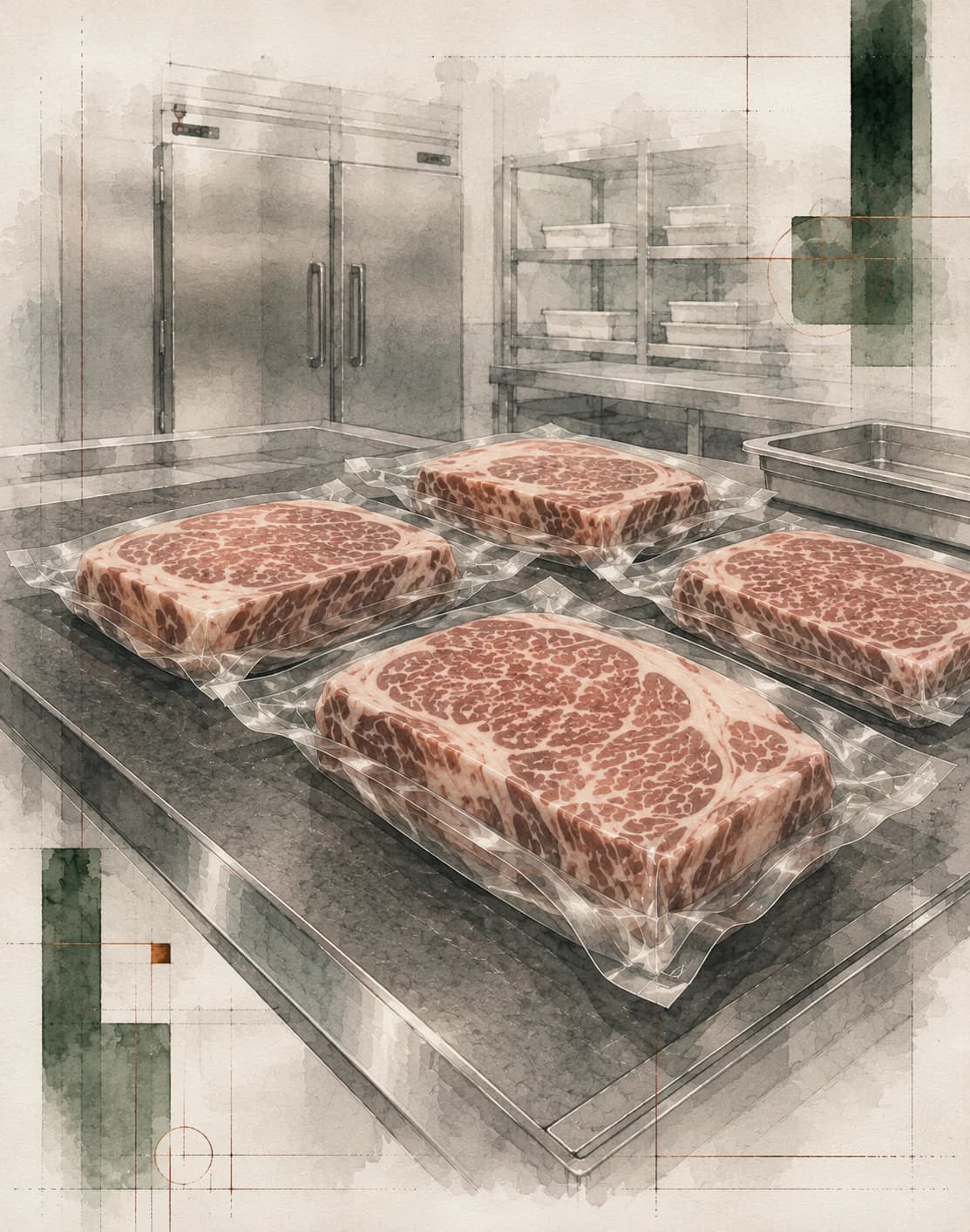
Most US holds on Japanese Wagyu are not arguments about grade. They are reconciliation failures: the purchase order describes the order one way, the Japanese export health certificate groups it another way, and the carton labels sitting on the pallet at the Import Inspection establishment agree with neither. That mismatch is created at PO time, months before anyone sees a carton.
This article is about lot structure on a US purchase order: how to write a cut-by-cut Wagyu order as lots that map one-to-one onto certificate lines and presentable carton labels for FSIS reinspection. If your open question is pricing — converting a quoted per-kilo cut price into sellable pounds and plate cost — that is a different article: the US quoted-kilo to sellable-pound ledger. If you are buying into Australia or the UAE, the certifying flow, label rules, and inspection body are different, and those are covered separately in the AU permit, certificate, and label field map and the UAE PO document consistency piece. What follows is US-specific and stays on cut-level lot design.
Why the PO is where lot structure is decided
A US importer of Japanese beef deals with two document families at once. On the Japanese side, product leaves a government-listed establishment under an export health certificate issued by the competent authority, and each certificate carries line items describing product, quantity, and the establishment it came from. On the US side, the shipment is filed for import inspection and presented at an official Import Inspection establishment, where FSIS personnel check that the product, the certificate, and the marks and labels on the cartons agree before the product is stamped into US commerce.
Nobody at the port re-creates your intent. They compare what is written. So the practical question is not "is my Wagyu eligible" — it is "can each carton in front of the inspector be tied, without interpretation, to one line on the certificate and one line on my entry."
The answer is decided when you write the PO, because the PO is what the Japanese exporter uses to decide how to pack and how to request the certificate. If your PO says "8 cuts, 400 kg total, A5," the exporter will make reasonable choices about grouping, production dates, and carton labeling, and those choices will be invisible to you until the container is already loaded. If your PO already states the lots, the certificate request follows your structure.
The rule: one lot = one cut × one production date × one temperature state
This is the single design rule worth memorizing. A lot on your PO should not span two cuts, two production or slaughter dates, or a chilled and a frozen portion of the same cut.
The reasoning is mechanical. A cut name is what appears on the carton label and on the certificate description. A production date is what distinguishes one batch from another and what your own traceability and shelf-life handling depend on. A temperature state changes both the label and, for chilled product, the time pressure on the whole entry. Any lot that spans two values of any of these three fields cannot be reconciled to a single certificate line without someone doing arithmetic at the port — and arithmetic at the port is how product ends up held while emails cross the Pacific.
The cost of the rule is that a mixed-cut order becomes more lines. An eight-cut order with three production dates can become twelve to fifteen lots instead of one block. That is the intended outcome. Lines on a PO are free; a held pallet of chilled ribeye is not.
The Cut-to-Lot Split Sheet
Build this as a one-page table and fill it before you send the PO, not after. One row per lot.
- Cut name (English + Japanese): write both. The English name is what your chef, your entry filer, and your retail partner use. The Japanese name is what the packer's label and the certificate description are generated from. Carrying both on the PO is what lets you prove they are the same item.
- Establishment number: the number identifying the Japanese slaughter and processing establishment for that lot. Do not assume one number covers a whole mixed order — different cuts can come from different establishments.
- Production / slaughter date: the date that defines the batch. One date per lot.
- Grade: JMGA class and BMS, written the same way in every document (for example A5, BMS 10). Nomenclature here is stable — A1 to A5, BMS 1 to 12 — so there is no excuse for it to drift between fields.
- Chilled or frozen: one state per lot.
- Net weight per carton and carton count: the two numbers that must multiply out to the lot weight on the certificate line.
- Intended lot ID: your own identifier, short and printable, that you ask the exporter to carry on the carton label.
The reconciliation strip: three columns, one tick each
Under the split sheet, add a three-column strip: PO field / export certificate field / carton label field. Walk each field across the three columns and tick it only when you have seen the actual value in all three — not when you have been told it will match. The realistic sequence is: you send the split sheet with the PO, the exporter returns a draft certificate and a label proof, you tick, and only then does the container leave Japan.
Five fields diverge more often than the rest, in our own handling of US-bound shipments (observation from our shipment files, not a measured study):
- Cut name granularity. The PO says "ribeye"; the label says a Japanese primal name that covers a broader or narrower piece. Fix by agreeing the pair of names per lot in writing.
- Establishment number. Present on the certificate, abbreviated or missing on the carton, absent from the PO entirely. Put it on all three.
- Net weight rounding. Carton labels carry actual catch weights; the PO carries a nominal weight. Decide which one the certificate line reflects and state the tolerance.
- Production date format. Year-month-day versus day-month-year, or a packing date substituted for a production date. Specify the format and which date you mean.
- Grade notation. "A5" on the PO, a marbling score alone on the label, or a BMS range instead of a single value. Pick one notation for the order.
How this plays out for two buyer types
For a distributor reselling cut by cut, the lot ID is the spine of your own downstream paperwork. If your lots match the certificate lines, you can hand a customer a carton and name its establishment, date, and grade without opening a file. If they do not, every claim from a restaurant customer becomes an investigation.
For a restaurant group buying for multiple outlets, the value is different: lot structure lets you allocate. One lot per cut per date means you can send a specific batch to a specific kitchen and keep menu descriptions honest, instead of averaging eight cuts of unknown provenance into one delivery.
What not to try to solve on this sheet
The split sheet is a product-and-document alignment tool. It is not a customs classification worksheet, not a substitute for your entry filing process, and not advice on general US food import procedure. Keep tariff classification, filing mechanics, and broker instructions in their own documents and let the split sheet do one job well.
One more note on currency of information: FSIS import reinspection procedures and the roster of Japanese establishments eligible to export beef to the United States change over time. This article deliberately does not reproduce any eligible-establishment list, because the list is the part that goes stale; the field-matching logic is the part that holds. Confirm current procedures and eligibility with FSIS and with the Japanese competent authority before you fix an order, and treat any inspection timing you have heard as shipment-specific rather than a service level.
Send us the sheet
The split sheet cannot be finished from your desk alone. Which establishment number applies to each cut, what production dates will actually exist inside your shipping window, and whether a given cut ships chilled or frozen are facts that sit on our side. Fill in what you can — even just the cut list and your target arrival window — and send it to us. We will confirm the lot structure against real availability, tell you where your requested dates and temperature states are not achievable, and return a sheet you can attach to the PO. Once the lots are fixed, pricing per lot follows naturally.