
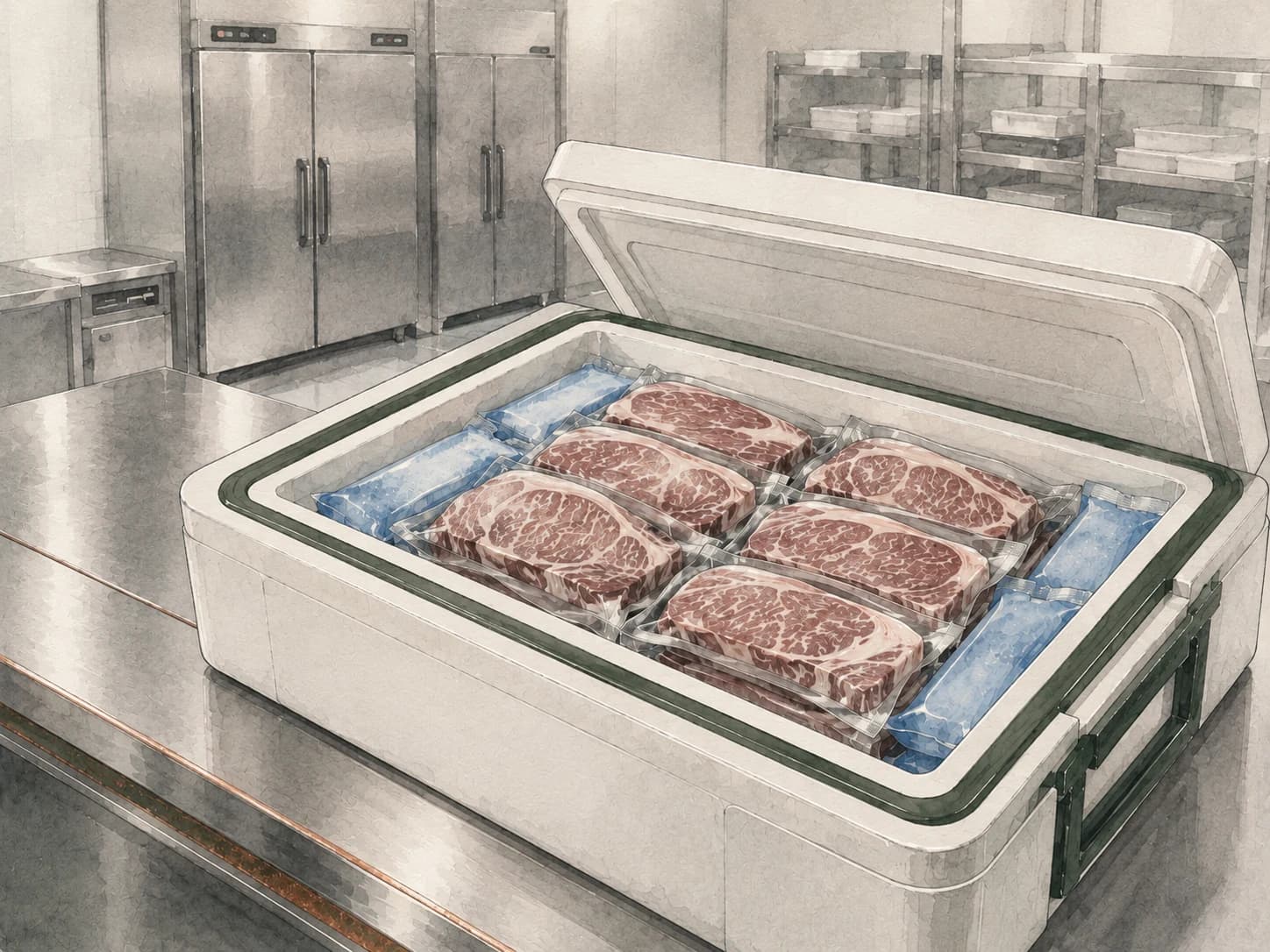
This article covers one decision only: when an order of four or more Wagyu cuts should travel as a single mixed consignment under one certificate set, and when it should be split into a chilled entry and a frozen entry with duplicated per-entry clearance cost. It is the allocation step that happens before the purchase order is written, and its output is the split instruction the PO then records.
If your question is which fields must appear on that PO once the structure is fixed, read the Taiwan PO field lock sheet. If you are measuring what chilled stock loses day by day after it reaches your warehouse, that is the chilled day-loss ledger. If you are working backwards from menu demand to grams per cover, see the banquet course slot math. None of those three answers the consignment-structuring question below.
Why the question appears at four cuts, not one
A single-cut order is trivial to structure: one temperature regime, one carton count, one entry. The problem starts when the same order sheet carries ribeye, striploin, chuck roll and tongue, and the volume you actually want of each is below what a carton holds. You then face a choice you cannot defer:
- Buy up to the carton minimum on each cut and accept that some of it sits in your cold room longer than you can sell it.
- Move the slow-moving cuts to frozen, which protects the value but creates a second temperature line in the same shipment.
- Split the shipment into two clearance entries so the chilled line clears fast and the frozen line carries no shelf-life pressure — and pay the per-entry fixed cost twice.
Broker fees, inspection handling and certificate work are largely per entry, not per kilo. That is why the second entry looks expensive on a spreadsheet and why many buyers default to one mixed consignment without testing the assumption. The test is arithmetic, and you already hold every number it needs.
The three numbers that decide it
You need exactly three inputs per cut, plus one shipment-level input.
- Carton minimum per cut (kg). Supplier-specific. It is not a published figure and it varies by cut and by whether the line is chilled or frozen — ask for it in writing before you model anything.
- Weekly offtake per cut (kg). Your own number. Use the last eight weeks of actual issues from stock, not the forecast. For hotel groups, use banquet-confirmed covers plus walk-in average, and treat the two separately if your banquet book swings hard by month.
- Remaining shelf-life days at warehouse receipt. Not the printed shelf life. The days left after export packing, flight, clearance and delivery. You can only know this from your own receiving records; if you have not logged it, log the next three arrivals before you run the sheet.
- Per-entry fixed clearance cost (shipment level). Your broker's charge per entry plus inspection handling plus any certificate or document re-issue cost. Ask your broker for the figure that applies to a chilled Japanese beef entry today — rates and inspection handling in Taiwan change by administrative notice, so use a current quotation rather than last year's invoice.
Deliberately absent from this list: duty rates, sampling percentages and inspection fee tables. Those are set by the authorities and change on notice. Confirm the current position with the Taiwan FDA and your customs broker at the time you write the order, and enter the resulting cost into the worksheet as your own figure.
The Split-or-Single Consignment Worksheet
One page. One row per requested cut. Six columns.
| Column | What goes in it |
|---|---|
| Cut | Ribeye, striploin, chuck roll, tongue, and so on — named as the supplier names it, not as your menu names it |
| Intent | Chilled or frozen, as you intend to sell it |
| Carton minimum (kg) | Confirmed by the supplier for that cut and that regime |
| Weekly offtake (kg) | From your issue records |
| Days of cover | Carton minimum ÷ weekly offtake × 7 |
| Shelf days at receipt | Your logged figure for chilled rows; leave blank for frozen rows |
Step 1: flag the overhang rows
For every chilled row, compare days of cover against shelf days at receipt. If days of cover is larger, that cut is an overhang row: the smallest quantity you are allowed to buy chilled is more than you can sell before it ages out. Mark it.
Step 2: price the overhang
For each overhang row, the quantity at risk is the carton minimum minus the kilos you can realistically move within the shelf days you logged. Multiply the at-risk kilos by your landed cost per kilo. That is your write-off exposure if you keep the row chilled inside a single mixed consignment. Sum it across all overhang rows.
Step 3: compare against one extra entry
Now set that sum against the per-entry fixed clearance cost of a second entry. The verdict is blunt:
- Total overhang exposure is below one extra entry cost: no split. Run a single mixed consignment and move the overhang cuts to frozen inside that same shipment, or reduce them to a cut your supplier can pack in a smaller unit.
- Total overhang exposure exceeds one extra entry cost: split. One chilled entry sized to what you can turn over, one frozen entry carrying the rest.
- The two are close: stay single, and re-run the sheet after you have three arrivals of logged shelf days. A near-tie usually means your shelf-day figure is a guess rather than a record.
In our own handling experience — an observation from working orders, not a measured study — the sheet most often flips to "split" when a buyer adds a fourth or fifth chilled cut to an order whose weekly offtake has not grown. The entry cost did not change; the number of slow rows did.
Step 4: write the verdict into PO lines
The worksheet is only useful if it leaves the spreadsheet. Convert it into explicit order lines the Japanese supplier can pack to:
- Consignee and importer of record for each entry, stated separately if you split
- Temperature regime per line, declared cut by cut rather than per shipment
- Carton count per cut per regime, not a total weight
- Certificate handling: state how many certificate sets you require, and confirm with your broker whether your intended structure can be served by one set or needs separate documentation per entry — treat this as a question to verify, not an assumption
- Labeling requirement in Traditional Chinese per cut, so the regime split does not create two different label specifications by accident
Those lines are what the PO field lock sheet then locks down field by field.
Three traps worth naming
Treating frozen as the safe default. Frozen removes shelf-life pressure but adds storage cost and, for cuts you intend to serve chilled, changes what you can put on a menu. Freeze the rows your sheet flags, not the whole order.
Splitting by supplier instead of by temperature. If you are comparing two or three Japanese suppliers on landed cost, it is tempting to split the order between them. That multiplies entries without solving the shelf-life overhang. Split by regime first; decide supplier count second.
Using printed shelf life as shelf days at receipt. This is the single most common reason a worksheet gives the wrong verdict. The number you need is what is left when the pallet reaches your cold room, and only your receiving log knows it.
Send the sheet with your quote request
Once the worksheet returns a verdict, you are holding a packing instruction: cuts, regimes, carton counts, consignees. That is precisely what a supplier needs in order to confirm carton minimums per cut and quote the chilled and frozen lines separately rather than as one blended price.
Send us the completed sheet with a wholesale quote request. We will confirm which carton minimums we can actually pack per cut, flag any row where a smaller unit is available, and return chilled and frozen pricing as separate lines so you can re-run the comparison against real numbers instead of estimates.