
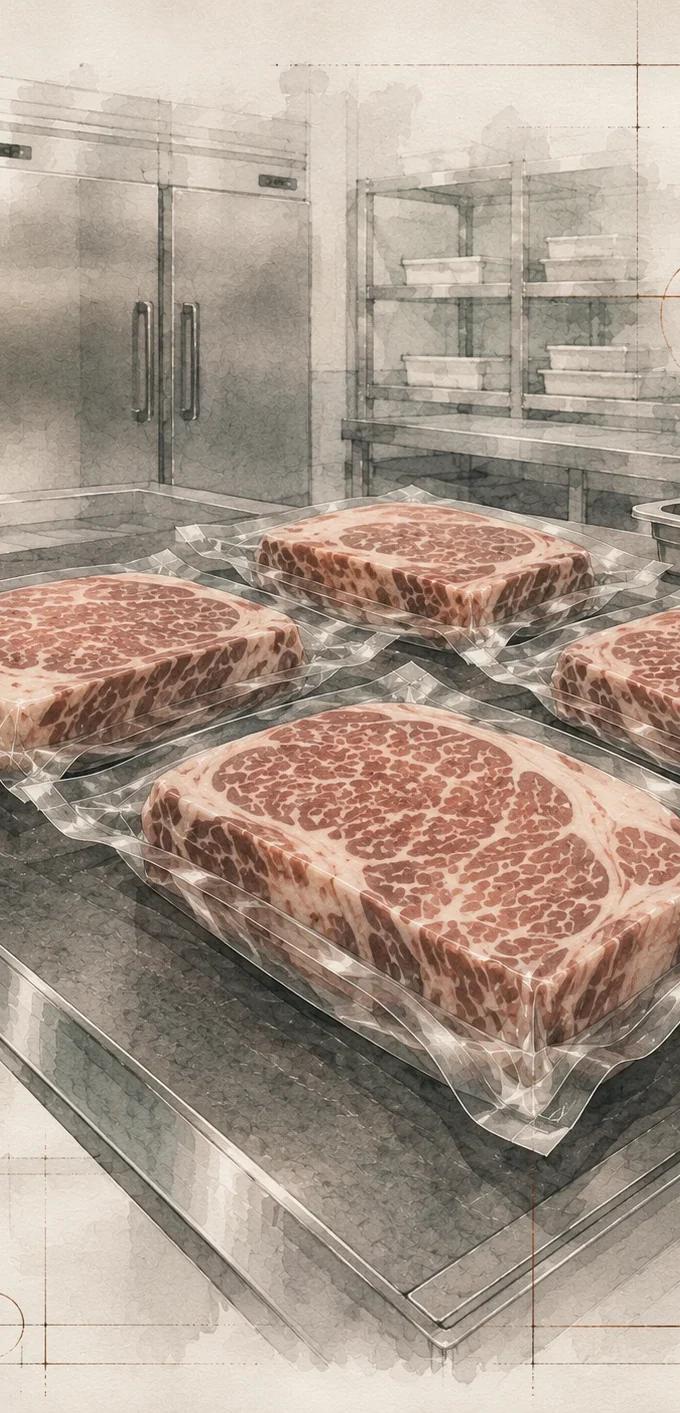
Most US groups running a Japanese Wagyu feature buy the same three or four loin cuts, serve them at dinner, and never ask what the other service periods are doing. This article works one step earlier than a menu decision: it organizes Wagyu buying by day part rather than by dish, and gives you a ledger that shows which service periods in your own operation can carry a Wagyu line item at a price your guests already pay — and which cut families you would have to order to make that true.
If you already have a Wagyu dish on the menu and want to swap accent cuts inside it, that is a different exercise and it is covered in the per-cover substitution table for accent cuts. If your question is how a quoted kilo price becomes sellable pounds on cuts you have already ordered, see the quoted-kilo to sellable-pound ledger. Recovering value from trim and offcuts of a running program, written for a different market's menu and price structure, is handled in the Singapore trim and offcut piece. This article does none of those: it produces a day-part × cut eligibility ledger that you fill in before you talk to a supplier at all.
The idle day part is a purchasing decision, not a menu problem
A dinner-only Wagyu order pattern is a choice about which hours of the week your most expensive protein is allowed to earn. Count the service periods you actually operate in a week: weekday lunch, weekend brunch, bar and late night, dinner, banquet and private dining. For most multi-unit groups and hotel outlets, Wagyu appears in exactly one of them. The other periods are not failing because of the menu — they are failing because the cuts in the walk-in were selected for a dinner check average and cannot be portioned down into a lunch or bar price point without destroying the gross margin on the plate.
The usual reflex is to shave the dinner portion. That rarely survives contact with guests. The alternative is to shift part of the same order volume into cut families that sit in a lower landed price band — chuck and chuck-adjacent muscles, short plate, brisket-adjacent cuts, intercostal and rib finger meat — which can be bought in the same shipment and allocated to the periods the loin set cannot reach.
What the ledger holds
Build one row per service period you operate. The columns are:
| Column | Source | What it decides |
|---|---|---|
| (a) Current check average | Your POS, trailing 13 weeks | The ceiling the period actually supports |
| (b) Maximum protein cost per cover | Your target food cost applied to (a) | The dollar room for the Wagyu component |
| (c) Grams of Wagyu that cost allows | (b) ÷ landed cost per gram, by price tier | Portion size the period can fund |
| (d) Cut families that fit (c) | Price-tier map below | What to put on the next PO |
| (e) Prep and holding constraint | Your kitchen, that period's staffing | Whether the cut is executable at that hour |
| (f) Idle flag | Set if no cut fits (c) and (e) | The period stays Wagyu-free this cycle |
Scroll sideways to see the whole table
Columns (a) and (b) come from your own data. We do not supply them, and any article that quotes a check average for "a US casual group" is guessing at your market. Column (c) is arithmetic you do once per price tier. Columns (d) and (e) are where this article is useful.
Price tiers, stated as tiers rather than figures
Landed cost per kilogram for Japanese Wagyu moves with grade, marbling score, lot, freight mode and exchange rate, so an absolute number printed here would be wrong within a quarter. Express the tiers relative to the loin set you already buy, and ask for current figures per inquiry:
- Tier 1 — loin set. Ribeye, striploin, tenderloin. Your current reference price. Highest landed cost per kilogram in the carcass set.
- Tier 2 — secondary muscles with steak behavior. Inside and outside round subprimals, rump, sirloin cap and similar. Below the loin set, still portionable as a center-of-plate item with trimming.
- Tier 3 — braise, slice and grind families. Chuck and chuck-adjacent muscles, short plate, brisket-adjacent cuts, intercostal and rib finger. Materially below Tier 1 per kilogram, and the tier that makes lunch and bar formats arithmetically possible.
Ask for the current spread between tiers, in your purchase currency, for the volumes and formats you actually order — chilled or frozen, whole subprimal or portioned. Tier spreads are not fixed ratios and they move by cut, season and grade.
Mapping tiers to day parts
Weekday lunch
Lunch check averages are usually a fraction of dinner, service windows are compressed, and the guest is time-constrained. Tier 1 rarely fits column (b). Tier 3 in a composed format — a braised chuck preparation, a thin-sliced plate item over rice or noodles, a Wagyu component in a bowl or sandwich rather than a steak — lets a small gram weight read as a Wagyu item. Column (e) matters here: braised and slow-cooked preparations are made ahead, which suits a lunch line that cannot run a grill station at volume.
Weekend brunch
Brunch tolerates a higher check than weekday lunch in many formats and the kitchen is often already running a flat-top. Tier 3 ground and chopped applications, and thin-sliced short plate, fit the gram budget. Tier 2 can appear in a limited brunch feature if your brunch check average genuinely supports it — check column (b) rather than assuming.
Bar and late night
The bar period has the shortest ticket times and the smallest plate. It is also the period where a small gram weight of a high-marbling cut reads as generous, because the item is a snack, not a meal. Tier 3 intercostal and rib finger meat, skewered or griddled, and small chopped or sliced formats, fit both the cost per cover and the equipment. Holding constraint: high-marbling cuts render fast, so the preparation needs to tolerate à-la-minute cooking on whatever equipment the bar actually has after the main kitchen closes.
Dinner
This is the period your current order already serves. The ledger's job here is to record how much of your total Wagyu volume dinner consumes, so you can see the share available to reallocate.
Banquet and private dining
Banquet is priced per head in advance, which makes column (b) known rather than estimated — the most favorable column in the ledger. Both Tier 1 and Tier 2 can fit depending on the package price. The binding constraint is usually (e): plated volume at a fixed service time, which rewards cuts that can be cooked in batch and rested, over cuts that need individual à-la-minute attention.
Restating the next PO without raising total spend
This is the line the ledger exists to produce. Take your last Wagyu purchase order. Write down the total landed spend. Then:
- Sum the covers per week in each period flagged eligible in column (d).
- Multiply by the gram weight from column (c) to get weekly kilograms needed per period.
- Reduce the Tier 1 line on the PO by the kilograms that spend buys at Tier 3 prices, and add the Tier 3 lines.
- Recheck the total against your original landed spend. Because Tier 3 sits below Tier 1 per kilogram, the same spend buys more kilograms — the question is whether your periods can sell them before the shelf-life window closes.
Step 4 is the one operators skip. Adding day parts adds throughput, but it also adds cuts with their own storage format and holding behavior. Confirm chilled versus frozen format, case weights and minimum order quantity per cut family before you restate anything; these differ by cut and by shipment, and should be confirmed per inquiry rather than assumed from your loin-set experience.
Constraints to verify before you commit
- Import eligibility and labeling. Which Japanese beef items may enter the US, and how they must be labeled, are set by USDA FSIS and APHIS requirements and are subject to change. Verify current requirements with your importer and the relevant US authority at the time you order rather than relying on what applied to your last shipment.
- Minimum order quantity per cut family. Secondary cuts are not always available in the same small quantities as loin subprimals. Confirm per cut family, per inquiry.
- Format. Thin-slice and portioned formats have different production and storage implications than whole subprimals. Specify the format you need in the inquiry, not after arrival.
- Shelf-life planning. Chilled product has a finite working window from arrival; frozen changes your prep sequence. Match the format to the day part's volume, not the other way around.
A worked shape, not a worked number
Three US formats tend to arrive at different ledgers. A multi-unit casual group typically flags lunch and bar as eligible on Tier 3 only, with dinner unchanged. A hotel with banquet volume typically flags banquet first, because column (b) is contractually known, then brunch. A cafe chain with no dinner period at all typically finds that its entire Wagyu opportunity sits in Tier 3 composed items, and that the loin set was never the right starting point. Run your own numbers; the shape of the answer is predictable, the figures are not.
Discuss your requirements
If your filled ledger flags cut families you have never purchased — chuck, short plate, brisket-adjacent, intercostal — the useful next conversation is about which of those are available in the formats, case weights and quantities your periods need. Send the flagged rows as the brief: service period, gram weight per cover, weekly covers, and the format your kitchen can hold. Availability, specification and terms are confirmed per inquiry.