
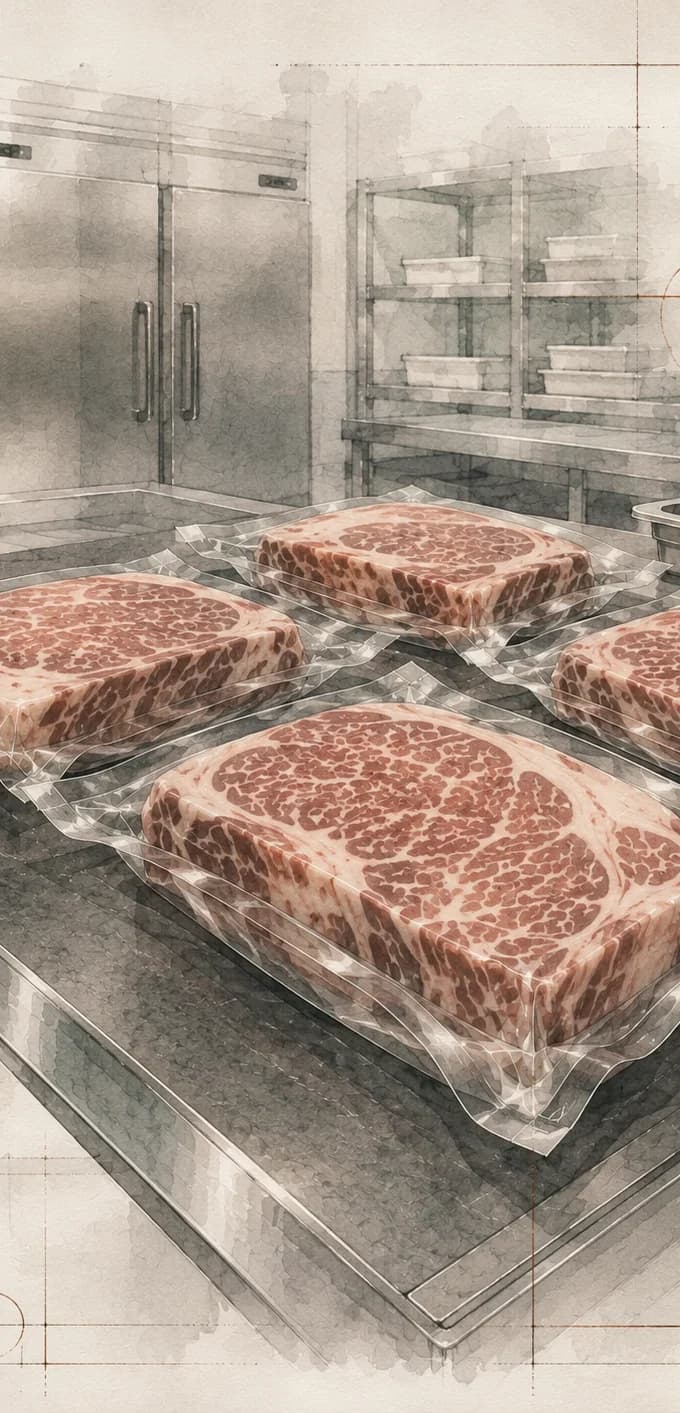
This article is about the wording you put into each field of a US purchase order before the order is placed: grade, cut identity, trim, weight tolerance, state, pack and the acceptance test at arrival. It is a drafting tool, not an arrival tool. If your cartons have already landed and you are matching lots to printed labels, read the cut-to-lot split sheet for FSIS label matching instead. If your question is cost per sellable pound from a quoted kilo price, that is covered in the kilo-to-pound ledger, and if you are deciding which cut carries which cover on the menu, see the per-cover substitution table.
The claim here is narrow. USDA grade language and IMPS cut numbers cannot carry a Japanese Wagyu order on their own. A PO that says "A5 ribeye, 10 lb average" looks complete to a US purchasing system and is still ambiguous at the point where someone in Japan has to cut, pack and document it. The ambiguity is not in the grade. It is in the cut-identity field, and it shows up as a carton that is technically in spec and commercially unusable.
Scroll sideways to see the whole diagram
Why the grade field and the cut field fail differently
Grade and cut fail for opposite reasons, and that is why they need opposite treatment in the PO.
Grade fails because there is no mapping. The Japan Meat Grading Association system assigns a yield grade (A/B/C) and a meat quality grade (1–5), with the beef marbling standard (BMS) running as a separate numbered scale underneath the quality grade. USDA grades (Prime, Choice, Select) are produced by a different body against different criteria. "A5 is above Prime" is a sales sentence, not a spec sentence. There is no conversion factor, so there is nothing to write in US terms. Any attempt to put a USDA grade into the acceptance criteria of a Japanese Wagyu PO creates a clause that no one can test against the arriving product.
Cut fails for the opposite reason: there is a mapping, it is close enough to feel safe, and it is wrong at the edges. Japanese primal breakdown and the IMPS/NAMP breakdown separate the carcass at different places. The nearest-equivalent name gets you to roughly the right muscle group. It does not tell the cutter where to stop. Two parties can both perform correctly against the same word and produce different pieces.
So: grade goes into the PO in Japanese terms only. Cut identity goes in both languages, with an explicit sentence about the boundary. Everything that is a number — weight, trim, temperature state, pack — goes in US terms, because those are the terms your receiving, QA and finance systems actually read.
The PO field translation sheet
One row per PO field. Fill this in before you ask for a price, not after.
| PO field | Write in Japanese terms | Write in US terms | Write in both |
|---|---|---|---|
| Grade | JMGA yield grade + quality grade (e.g. A5, A4) | — | — |
| Marbling | BMS number or accepted BMS range | — | — |
| Breed / designation | Breed designation and any regional brand name as written on the Japanese documents | — | Repeat verbatim in the English field; do not paraphrase |
| Cut identity | Japanese primal name | Nearest IMPS/NAMP item and number | Yes — plus one boundary sentence (see annex) |
| Trim level | — | Fat cover, surface fat limit, seam fat and silverskin treatment, cap on or off | — |
| Weight range | — | Per-piece range in lb or kg with a stated tolerance and what happens to out-of-range pieces | — |
| Chilled / frozen state | — | State, target temperature band, and whether freezing after chilled production is acceptable | — |
| Pack and carton marking | — | Pieces per carton, vacuum or other pack, carton net weight basis | Cut name on the carton in both languages, if agreed |
| Label language | — | English elements required by your import and receiving process | — |
| Acceptance test at arrival | Grade and BMS verified against the accompanying grading documentation | Weight, trim, count, temperature and pack verified on receipt | Cut identity verified against the agreed boundary sentence |
Scroll sideways to see the whole table
Two things about the last row. First, the acceptance test has to be split the same way the spec is split — you verify grade from documents, and you verify dimensions from the product. Second, a cut-identity dispute at arrival is only resolvable if the boundary was written down beforehand. That is the entire purpose of the annex below.
Per-cut annex: where the boundaries diverge
These are the five cuts where US POs most often leave a gap, and the sentence that closes it. Treat the wording as a starting draft to confirm with your supplier, not as a universal definition — Japanese cutting practice varies, and the point is to agree once, in writing, rather than discover the difference on the dock.
Ribeye
The ribeye roll and the Japanese ribloin do not necessarily start and stop at the same rib. The rib-end to chuck-end transition is also where the spinalis behavior changes most, which is exactly the part your menu is selling. Add to the PO: "State the rib numbers included at both ends, and state whether the lifter/cap muscle is retained in full, partially trimmed, or removed."
Striploin
The common dispute is the lumbar end and how much of the tail is left on. Tail length drives both portion yield and the usable width of the steak face. Add to the PO: "State maximum tail length measured from the eye at the widest point, and state the vertebra at which the loin was separated from the ribloin."
Tenderloin
Side muscle (chain) on or off, and head-end treatment, change the piece more than the grade does. A tenderloin with the chain on weighs within range and portions out quite differently. Add to the PO: "State chain on or off, state side-strap and silverskin treatment, and state whether the butt end is squared."
Chuck roll
This is the hardest one, because the Japanese shoulder breakdown separates several muscles that a single IMPS chuck roll keeps together — and the reverse is also true at the neck end. A chuck roll line on a PO without further text is close to meaningless. Add to the PO: "Name the specific muscles required and name the muscles that must be excluded; state the neck-end and rib-end separation points."
Short plate
Rib count, bone-in or boneless, and how far the plate runs toward the flank all vary. For thin-slice or yakiniku use, the fat-to-lean layering within the piece is the operative spec, not the primal name. Add to the PO: "State rib numbers, bone-in or boneless, membrane removal, and target thickness if the supplier is slicing."
How to use the sheet in your own drafting process
- Take your existing internal spec sheet and mark every field that currently holds a USDA grade word. Those fields are either deleted or moved out of the acceptance criteria.
- For each cut you intend to buy, write the two cut-identity lines — Japanese primal name and nearest IMPS item — side by side in the same field, not in separate documents.
- Add the boundary sentence from the annex under each cut-identity line.
- Fill the US-terms columns — trim, weight range, tolerance, state, pack — in the units your receiving team uses. Do not mix lb and kg within one PO.
- Write the arrival acceptance test as three separate checks: documents (grade, BMS), measurement (weight, count, temperature), and identity (boundary sentence).
- Send the completed sheet out for pricing before you finalize the menu description, so the description is written against the piece you are actually buying.
The reason the order matters: steps 1–3 cost nothing to do and are nearly impossible to fix after the first container. Step 4 can be renegotiated at the next PO. Step 5 is the only thing that makes steps 1–4 enforceable.
What this sheet does not settle
Three items stay outside the translation sheet on purpose.
Regulatory label elements. US import labeling and establishment-eligibility requirements for imported beef change from time to time. Verify the current required elements against current FSIS and USDA import guidance, or with your customs broker, at the time you draft the PO. Keep the translation sheet itself regulation-light so it stays usable when the rules move.
Achievable tolerances. Writing a weight range and a trim level into a PO does not mean they can be held on every cut, in every season, at every volume. Tolerances are confirmed per case. A tolerance that is agreed and narrow is better than one that is written and ignored.
Dual-language documentation. Whether export paperwork and carton markings already carry both Japanese and English cut names, or whether dual naming has to be requested at order time, is confirmed per case. Ask the question in the PO rather than assuming either answer.
Next step
Once the sheet is filled in, you have a draftable spec but no confirmation that the cut identity, trim and tolerance wording can be held on the cuts and volumes you want. Send the completed field sheet with a wholesale quote request so that pricing comes back against your exact cut-identity and tolerance wording rather than against a generic grade-plus-cut line. Discuss your requirements.