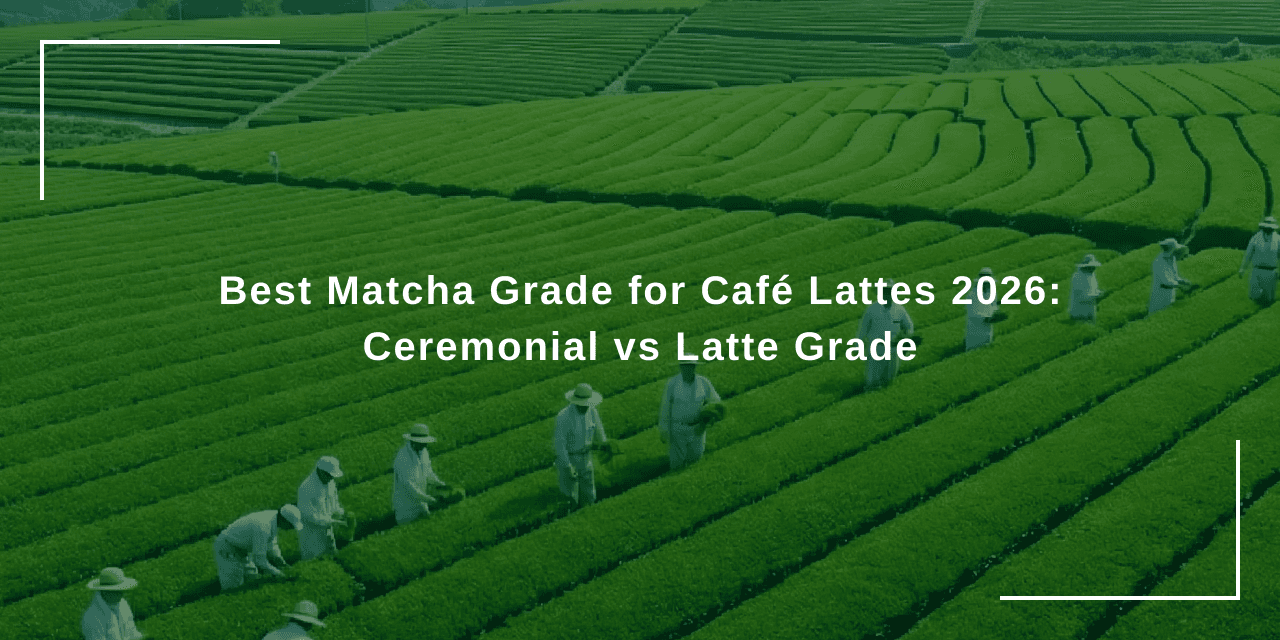
Using ceremonial-grade matcha in a café latte is the single most common and most expensive grade mismatch in the 2026 B2B matcha market. Every day, café operators pour USD 150–250/kg matcha into 250 ml of steamed oat milk, paying 2–3x the right price for a sensory result that customers describe as "mild" or "milky." The grade engineered specifically for café latte work—latte/barista grade—costs USD 55–90/kg direct from Japan, delivers a more assertive and recognizable matcha character once blended with milk, and lifts gross margin by four to eight percentage points. The operators winning the 2026 matcha latte category aren't spending more on matcha; they're spending smarter.
This guide is the complete grade-selection playbook for café operators, chain purchasing leads, and bakery-café beverage developers who serve matcha lattes as a core volume item. It covers the sensory difference between ceremonial and latte grade in a milk beverage, the 2026 direct-Japan pricing for each tier, the scientific reason catechin profile matters more than theanine content in lattes, the specific grade recommendations for hot latte / iced latte / frappé / flavored variants, and the step-by-step process for auditing and converting your current latte-grade supply.
Key takeaways for café latte matcha sourcing
- Ceremonial-grade matcha is engineered for straight service with water at 70–75°C. Its delicate umami disappears under steamed milk and added sweetener.
- Latte/barista grade, at USD 55–90/kg direct from Japan, delivers the punchy catechin-forward character that stays recognizable through milk and syrup.
- A 3 g latte dose at USD 75/kg = USD 0.225 per cup. The same dose at ceremonial USD 200/kg = USD 0.60 per cup—a USD 0.375 margin hit per cup with no customer-perceptible quality gain.
- Hot, iced, frappé, and flavored matcha lattes each have distinct grade and particle-size optimum points; a single grade across all variants is a compromise.
- Direct Japan sourcing from Kagoshima and Nishio origins now delivers latte-grade quality equivalent to mid-tier Uji at 25–40% lower landed cost.
Table of contents
- The ceremonial-for-lattes mistake
- What latte/barista grade actually is
- 2026 pricing and MOQ for café latte grade
- Sensory comparison: ceremonial vs latte grade in milk
- Grade selection by latte variant
- How to audit your current supplier's latte grade
- Converting from ceremonial to latte-grade without quality drop
- Sourcing latte-grade matcha in 2026
- FAQ
1. The ceremonial-for-lattes mistake
Walk into most specialty cafés in New York, London, or Melbourne in 2026 and ask the barista what grade of matcha they're using. Roughly half will proudly say "ceremonial," believing this represents a commitment to quality. Check the supplier invoice, though, and you'll discover the operator is paying USD 180–240 per kilogram for matcha that's being poured into 250 ml of oat milk alongside 10 ml of vanilla syrup. The delicate umami character that justifies the ceremonial price tag dissolves entirely under the milk and sweetener. Customers tasting the final beverage cannot distinguish it from a USD 75/kg latte-grade preparation.
This is not a speculative claim. Operations teams at several well-regarded specialty chains have run blind comparison tastings since 2024, blending the same latte recipe with ceremonial-grade and latte-grade matcha and serving them to regular customers. The consistent result: customers cannot reliably identify which cup is which. When asked which they prefer, preferences split roughly 50/50, with some customers actually preferring the latte-grade version because its stronger catechin character pushes through the milk more distinctly.
Why ceremonial grade underperforms in milk
Ceremonial-grade matcha is engineered for straight whisked service with water at 70–75°C. Its defining characteristics are high L-theanine content (typically 1.0–1.5% of dry weight), vivid chlorophyll intensity, and minimal catechin astringency—a combination that produces the clean, sweet, umami-forward character that defines premium Japanese tea ceremony drinking.
Every one of those attributes is either neutralized or irrelevant when the matcha is blended into a milk-based beverage:
- L-theanine's umami is a water-soluble phenomenon. Milk fat and casein proteins bind to theanine molecules and mask the umami signature at the tongue level.
- Chlorophyll intensity contributes color more than flavor, and color is reduced to a pale green once oat or dairy milk is added.
- Low catechin astringency—the reason ceremonial matcha is "smooth"—produces a flat, underwhelming matcha signal when there's 250 ml of milk to cut through. The beverage reads as "green-tinted oat latte" rather than "matcha latte."
The operator has paid a 2–3x per-cup cost premium for sensory attributes that are actively suppressed by their own recipe.
The cost math, cup by cup
Scenario | Grade | Per-kg cost | Per-3g-dose cost | Impact at 1,000 cups/month |
|---|---|---|---|---|
Ceremonial latte | Standard Ceremonial | $200/kg | $0.60 | $600/month = $7,200/year |
Premium latte | Latte/Barista | $75/kg | $0.225 | $225/month = $2,700/year |
Savings | — | — | $0.375 | $4,500/year per 1,000 monthly cups |
For a 10-store chain averaging 800 matcha lattes per store per month, the annual cost impact of running on latte-grade instead of ceremonial is approximately USD 36,000 in preserved margin—with no perceptible customer impact. This is before considering that the ceremonial-grade stock is being used on a workflow (steamed milk, sweetener) that actively destroys its premium character.
2. What latte/barista grade actually is
Latte grade—sometimes called barista grade or "super premium culinary"—is not a compromise. It is a specifically engineered product designed to hold its character through milk, heat, and sweetener.
Raw material profile
- Harvest timing: Late first-flush (typically early-to-mid May) through early second-flush (early June), rather than the first first-flush picking window that produces ceremonial grade.
- Tencha origin: Shade-grown, stem-and-vein-removed, same processing chain as ceremonial — what differs is the harvest timing and catechin / theanine ratio.
- Cultivars: Commonly Yabukita, Saemidori, or Okumidori, often in blend. Less commonly the Samidori or Asahi cultivars that define premium ceremonial grade.
Biochemistry
- L-theanine content: 0.6–0.9% (vs. 1.0–1.5% for ceremonial). Slightly lower but still far above sencha-derived "green tea powder."
- Catechin content: 12–18% (vs. 8–12% for ceremonial). The higher catechin profile is what gives latte grade its assertive astringency that cuts through milk.
- Chlorophyll: Equivalent to ceremonial when freshness is maintained; slightly lower under stress conditions.
- Caffeine: 3–4% (vs. 2.5–3.5% for ceremonial), contributing to the stronger stimulant perception of latte-forward drinks.
Particle size
Quality latte-grade matcha is stone-milled to 10–15 microns (D50), the same size range as standard ceremonial. The difference is not grinding quality — it is harvest timing and cultivar selection. Be suspicious of any "latte grade" priced at latte tier but with 20+ micron particle size: that product is typically jet-milled industrial-tier material relabeled for café sale.
3. 2026 pricing and MOQ for café latte grade
Direct-Japan pricing for latte-grade matcha in 2026 reflects a shortage that has not ended: cost floors sit materially higher than pre-2023 and have not settled, because 2026 first-flush tencha sold above 2025 prices in both Kyoto and Kagoshima, so treat the ranges below as a baseline for 2026-harvest quotes rather than a ceiling. Volume discounts remain steep, and the direct-Japan channel continues to run 25–40% below equivalent distributor pricing.
2026 Q1-Q2 latte-grade price matrix (USD/kg, FOB Japan, direct import)
Sub-tier | 1 kg | 5 kg | 10 kg | 25 kg+ | 50 kg+ |
|---|---|---|---|---|---|
Top-end latte (Kagoshima 1st flush late-pick) | $90–120 | $80–105 | $72–95 | $65–85 | $60–78 |
Standard latte/barista | $70–95 | $62–85 | $55–75 | $50–68 | $45–62 |
Entry latte (blended 1st/2nd flush) | $55–75 | $48–65 | $42–58 | $38–52 | $35–48 |
For independent cafés and 2–5 store chains, the 1–5 kg MOQ tier is economically serviceable. For 10–30 store chains, moving to 10–25 kg quarterly shipments unlocks a meaningful per-kg discount. For chains above 30 stores, a 50 kg+ quarterly cadence with annual allocation contract is the standard 2026 sourcing architecture.
Distributor comparison
Running the same latte-grade volumes through a US or EU distributor typically adds 25–40% to landed cost, for an equivalent or slightly older lot. The distributor channel retains three legitimate use cases: emergency replenishment between direct imports, single-location operators below 2 kg/month volume, and markets where direct customs clearance is operationally prohibitive. For any operator above those thresholds, direct Japan sourcing is the economic default.
4. Sensory comparison: ceremonial vs latte grade in milk
To make grade selection concrete, here is the side-by-side sensory profile of the same latte recipe prepared with ceremonial grade and latte grade, as evaluated by trained professional baristas in controlled blind tastings during 2024–2025.
Attribute | Ceremonial ($200/kg) in oat milk latte | Latte grade ($75/kg) in oat milk latte |
|---|---|---|
Initial aroma | Subtle oceanic note, quickly masked by oat | Slightly more assertive, cleaner "green" signature |
Color | Pale jade | Pale jade (equivalent) |
Mouthfeel | Creamy, smooth, minimal textural contrast | Creamy base with a light astringent edge |
Matcha presence on palate | Mild, subtle, "expensive but faint" | Clearly matcha-forward, "recognizable latte character" |
Finish | Brief, with slight umami | Lingering catechin astringency, classic "green tea" finish |
Balance with 10 ml syrup | Matcha signal disappears almost entirely | Matcha retains identity even at 15 ml syrup |
Customer preference (blind) | ~50% | ~50% |
Where ceremonial still makes sense
The argument for ceremonial-tier matcha in a café is not in the core latte volume program—it is in a single hero SKU. Reserving a small ceremonial allocation (typically 1 kg/month) for one of the following use cases extracts the value that justifies the price:
- Straight usucha service: Water only, whisked at 70°C, served in a bowl with appropriate narrative. Priced at USD 8–12 per serving.
- Single-origin tasting flight: Three small servings showcasing different origin or cultivar characters. Priced at USD 15–22.
- Hero seasonal drink: Ceremonial-grade iced matcha with no sweetener and minimal milk (or milk on the side), positioning as the cafe's quality statement. Priced at USD 9–12.
Outside of these narrow use cases, ceremonial in a café's core menu is margin leakage dressed up as quality commitment.
5. Grade selection by latte variant
Different matcha latte variants have different optimal grades. A single grade across the full menu is a compromise; a multi-grade strategy is a meaningful margin-and-quality optimization.
Hot matcha latte (core volume)
- Recommended grade: Standard latte/barista, 10–15 micron stone-milled, 0.7–0.9% L-theanine.
- Recommended origin: Kagoshima primary; Nishio secondary for slightly earthier profile.
- 2026 target cost: USD 55–75/kg at 10 kg MOQ direct import.
- Dose: 3 g per 12 oz cup.
Iced matcha latte
- Recommended grade: Standard latte/barista or entry latte; cold preparation further obscures premium attributes.
- Recommended origin: Kagoshima or Nishio. Entry-tier blends perform well here.
- 2026 target cost: USD 42–65/kg.
- Dose: 2–2.5 g per 16 oz iced cup.
Matcha frappé / blended
- Recommended grade: Entry latte or premium culinary. Heat and ice-blending destroys nuanced character anyway.
- 2026 target cost: USD 35–55/kg.
- Dose: 3–3.5 g per 16 oz (requires higher dose to cut through sugar and ice).
Flavored matcha lattes (strawberry, lavender, vanilla)
- Recommended grade: Standard latte/barista. Flavor modifiers demand assertive matcha to retain identity.
- 2026 target cost: USD 55–75/kg.
- Dose: 3 g per 12 oz cup; higher if modifier is intensely flavored (e.g., lavender syrup 15 ml+).
Dirty matcha (matcha + espresso shot)
- Recommended grade: Standard latte/barista. The espresso adds its own assertive character; mid-tier matcha holds its own.
- 2026 target cost: USD 55–75/kg.
- Dose: 2.5 g per 12 oz cup (lower than pure matcha latte because espresso is already 6–8 g of flavor base).
Matcha cold foam / cold foam matcha latte
- Recommended grade: Standard latte/barista. Cold foam preparation benefits from the catechin-forward profile.
- 2026 target cost: USD 55–75/kg.
- Dose: 2 g in the cold foam + 2 g in the base (total 4 g per 16 oz).
6. How to audit your current supplier's latte grade
The difference between a legitimately good latte-grade matcha and a mis-labeled industrial-tier powder dressed up as "latte grade" can be USD 30–60 per kilogram. A quarterly audit protects against grade drift, supplier substitution during shortages, and the silent quality decay that compounds through ongoing wholesale relationships.
The 7-point latte-grade audit
- Request the specification sheet. A qualified supplier produces a full spec sheet on demand. Refusal or excessive delay is a red flag.
- Verify particle size. Look for D50 at 10–15 microns, D90 below 25 microns. A D50 above 20 microns indicates jet-milled industrial product.
- Verify L-theanine. Latte grade should show ≥ 0.6%. Below 0.5% indicates either sencha-derived product or non-shade-cultivated tencha.
- Verify origin at prefecture level. "Japan" alone is insufficient; Kagoshima, Aichi (Nishio), Kyoto (Uji), Shizuoka, or Mie should be documented.
- Verify harvest year. 2025 or 2026 harvest for current year 2026 shipments. Older harvests indicate inventory-clearance product.
- Verify color against reference swatch. Establish a target-green reference at supplier onboarding; compare every lot.
- Conduct a blind latte tasting. Prepare a 12 oz latte with the new lot alongside your reference lot from the same supplier. Differences in catechin profile, aroma, and finish should be imperceptible. Any perceptible gap triggers a quality investigation.
Common audit findings (and what to do)
Finding | What it means | Action |
|---|---|---|
D50 at 22 microns, supplier calls it latte grade | Jet-milled industrial product mis-labeled | Reject lot, request replacement at supplier cost. Renegotiate spec sheet language. |
L-theanine at 0.4% | Sencha-derived product, not tencha | Reject. This is a material mis-grading issue, not a minor variance. |
Origin declared as "Japan" only | Blended multi-origin lot | Request prefecture breakdown. If supplier cannot provide, treat as disqualified for next-year contract. |
Color drift toward olive | Oxidation from storage or transit | Check cold chain documentation. If reefer was intact, investigate supplier-side storage. |
Catechin-forward character missing in cup | Possible sencha blend or aged inventory | Third-party lab test for L-theanine / caffeine ratio. |
7. Converting from ceremonial to latte-grade without quality drop
Operators concerned about a quality perception dip from switching to latte grade should follow a disciplined four-week conversion protocol. The transition is essentially invisible to customers when executed correctly.
Week 1: Internal baseline
- Document current beverage build: gram weight, water temperature, milk temperature, syrup volume.
- Sample current ceremonial-grade product for reference.
- Sample 3 candidate latte-grade matcha from qualified Japanese direct exporters.
Week 2: Blind internal tasting
- Build 12 oz lattes using the same recipe with each grade.
- Tasting panel of 6–8 operations staff, blind labeling.
- Document perceived color, aroma, matcha presence, balance with sweetener.
- Select the latte grade that most closely matches or exceeds the ceremonial reference in-cup.
Week 3: Customer-facing parallel test
- At a single store, prepare half of matcha latte orders with ceremonial and half with selected latte grade for one week.
- Record customer feedback: unprompted comments, return rate, drink completion rate.
- Expected outcome based on industry data: no perceptible difference in customer satisfaction or complaint rate.
Week 4: Rollout
- Transition full store, then full chain, to the selected latte grade.
- Brief barista team on the intentional grade choice — baristas who know the rationale communicate it better if customers ask.
- Reallocate freed-up budget: either to single-origin hero SKU or to margin preservation.
For a chain running 1,000 matcha lattes/month per store across 15 stores, conversion saves roughly USD 67,500 annually in matcha COGS with no measurable customer impact. That savings funds either a ceremonial-tier hero program or directly hits the bottom line.
8. Sourcing latte-grade matcha in 2026
The 2026 supplier landscape for café latte-grade matcha has four archetypes, each with different commercial fit for café operators.
Supplier archetype | Indicative cost tier (10 kg MOQ) | Best fit |
|---|---|---|
Heritage maker (Uji, Nishio) | Premium | Brands positioning on heritage storytelling regardless of cost |
US/EU distributor brand | Premium | Single-location cafés with < 2 kg/month volume |
Emerging OEM direct exporter (e.g., First Agri) | Mid | Independent chains, bakery-cafés, regional chains, private label brands |
Cooperative direct (Kagoshima) | Mid | Buyers with in-house customs, regulatory, and translation capability |
Where First Agri fits for café latte-grade
For café chains between 2 and 100 locations, direct Japan sourcing from an emerging OEM exporter is the dominant cost-quality-speed choice in 2026:
- Pricing: USD 55–75/kg at 10 kg MOQ, 25–40% below distributor equivalents.
- Origin: Kagoshima primary (the 2025 production leader in Japan), matching where tencha output is actually growing.
- Freshness: 7–14 day air freight from mill to destination hub, with product milled within the preceding 30–60 days.
- Documentation: Lot-level Certificate of Analysis. Ask us which lots come with harvest-year and cultivar records, and which lots are Organic JAS.
- Flexibility: 5 kg entry orders acceptable for proof-of-concept; annual allocation contracts available at 25 kg+ monthly volumes.
Request a latte-grade sample from First Agri. Our Kagoshima 2026 first-flush late-pick is engineered for café latte applications. Ask us which particle-size and L-theanine data are available for each lot.
Request a 2 kg latte-grade sample →
FAQ
What's the difference between ceremonial and latte grade matcha?
Ceremonial grade is engineered for straight whisked service (water at 70°C, no milk) with high L-theanine and minimal astringency. Latte grade has slightly lower L-theanine and higher catechins, producing an assertive character that stays recognizable when blended with milk and sweetener. Both are tencha-derived, stone-milled, and appropriate for their respective applications.
How much matcha should I use in a 12 oz latte?
3 grams is the 2026 industry standard for a hot 12 oz matcha latte. Iced 16 oz lattes typically use 2–2.5 g; frappés use 3–3.5 g to cut through ice dilution. Dirty matcha (with espresso) uses 2.5 g because espresso contributes its own flavor density.
Is latte grade worse quality than ceremonial?
No — it is differently engineered. For straight water service, ceremonial is superior. For milk-based applications, latte grade's catechin profile actually delivers more recognizable matcha character in the finished beverage, making it functionally better for its intended use.
Can I use a single grade across all matcha menu items?
Yes, latte-grade is the most versatile single-grade choice for a café. It performs well in hot latte, iced latte, frappé, flavored variants, and dirty matcha. Only straight-service usucha and hero flight SKUs benefit meaningfully from ceremonial grade.
How often should I re-audit my latte-grade supplier?
Quarterly at minimum. Annual on-site factory audits for contracts above USD 50,000/year. Blind tastings against a reference lot every new lot received. Spec-sheet verification on each shipment.
Should I worry about the 2024–2026 shortage affecting latte grade?
Yes. Latte grade has not been insulated from the shortage, which is still running in 2026. Kagoshima, Japan's largest tencha-producing prefecture and a leading source of latte grade, saw its 2026 first-flush tencha average at the prefecture's tea market come in about 2.3 times the previous year's price, and Kyoto's 2026 first-flush tencha again sold above 2025 levels. Kagoshima's growing tencha output gives latte grade more supply depth than Uji-only ceremonial, but not protection from price rises. Secure volume on an annual allocation contract and budget against 2026-harvest quotes.
Related reading
- Matcha for Cafés: The Complete 2026 B2B Sourcing, Menu & Profit Guide
- Matcha Wholesale 2026: The Complete B2B Buyer's Guide to Sourcing from Japan
- Matcha Grading Systems Explained: JAS vs Trade Grades and Quality Classifications
- Bulk Matcha Buying Guide 2026: MOQ Tiers, Shipping & TCO for B2B Buyers
- How to Choose Matcha for Your Café: A Buyer's Guide
- Matcha Menu Engineering: Calculating Gross Profit Margins and Pricing Strategies
Build your café latte program with First Agri.
Kagoshima latte-grade matcha, engineered for 250 ml milk applications. USD 55–75/kg at direct-Japan pricing and 7–14 day air freight. Ask us which L-theanine, particle-size and other documents are available for each lot. Request samples for a blind comparison against your current supplier.