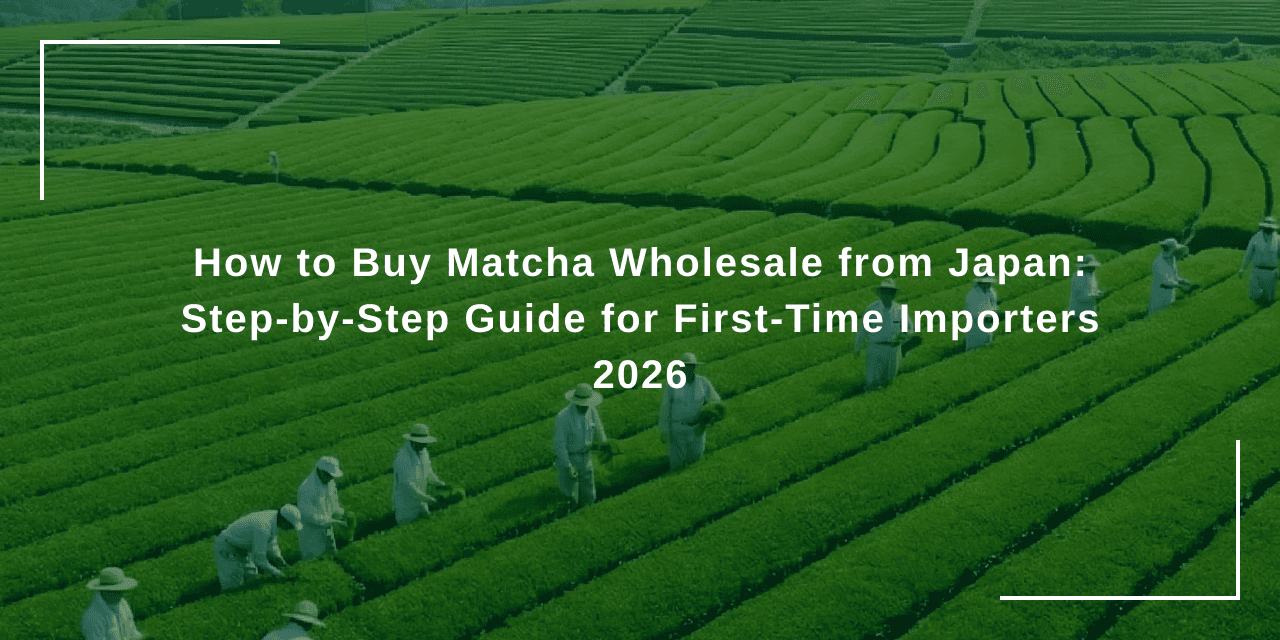
If you have never bought matcha wholesale from Japan, the process looks complicated from the outside — and most first-time importers pay 30–50% more than they need to simply because they don't know which steps are actually required and which are myths. The 2026 reality is that direct Japan wholesale import is accessible to any B2B buyer with monthly volumes above roughly 3–5 kg, takes 4–5 weeks from first inquiry to first shipment, and can be executed by a single person with no prior customs or international-trade experience. Qualified Japanese exporters have lowered entry order sizes for smaller accounts in recent years, but the tencha shortage that began in late 2024 has not ended — Kyoto's 2026 first-flush tencha sold 10.9–21.9% above 2025's record prices — so in 2026 they compete on allocation security rather than price.
This guide is the step-by-step import playbook for first-time matcha wholesale buyers: café owners adding matcha as a second revenue center, bakery operators, D2C brand founders, small beverage manufacturers, and supplement formulators ordering their first 5–50 kg from Japan directly. It covers how to decide between direct Japan import and US/EU distributor sourcing, which supplier archetypes to contact, what a qualified sample process looks like, how to negotiate your first contract, what the customs and freight steps actually involve, and what to do when the first shipment lands.
Key takeaways for first-time matcha importers
- Direct Japan import is the correct first choice for any buyer above ~3 kg/month monthly consumption; below that, distributor sourcing still makes sense.
- Qualified Japanese direct exporters in 2026 accept 5 kg entry orders; pre-2023 baselines of 25–50 kg MOQ are obsolete.
- First-shipment lead time is 4–5 weeks from initial inquiry; shortens to 2 weeks for subsequent orders.
- Documentation required is less complex than most first-time importers expect: commercial invoice, packing list, COA, and destination-specific customs forms.
- As of September 2026, unflavored matcha from Japan enters the US duty-free: its general tariff rate is Free, tea was excluded from the temporary Section 122 surcharge (February 24–July 24, 2026), and tea is exempt from the Section 301 duties that took effect on July 24, 2026. EU MRL updates (March 2026) should still be factored into landed cost modeling.
Table of contents
- Step 1: Decide between direct import and distributor
- Step 2: Shortlist 2–3 qualified Japanese exporters
- Step 3: Request samples and evaluate
- Step 4: Negotiate your first commercial terms
- Step 5: Understand the documentation
- Step 6: Choose freight mode and Incoterms
- Step 7: Navigate customs clearance
- Step 8: Receiving and first-order audit
- Step 9: Scale into annual allocation contracts
- FAQ
Step 1: Decide between direct import and distributor
Before contacting any Japanese supplier, confirm that direct import is the right channel for your volume. The decision matrix is straightforward.
Monthly matcha consumption | Recommended channel | Why |
|---|---|---|
Under 2 kg | US/EU distributor | Fixed customs and freight costs don't amortize below this volume |
2–3 kg | Boundary — either works | Distributor for convenience; direct for cost-optimization and freshness |
3–10 kg | Direct Japan import | Direct import saves 20–30% even after customs and freight |
10–50 kg | Direct Japan import | Savings grow to 25–35%; annual allocation contracts become viable |
50+ kg | Direct Japan import with annual contract | 25–40% savings plus allocation priority during shortages |
First-time import reality check
Many buyers above 3 kg/month stay on distributor supply because they overestimate the complexity of direct import. Here is what direct import actually involves in 2026:
- Contact a supplier: Email inquiry, typically answered within 24 hours.
- Request samples: Most suppliers ship 50–200 g samples within a week.
- Negotiate terms: Email-based, typically 1–2 weeks of back-and-forth.
- Place order: Commercial invoice, pay T/T (bank wire), supplier ships within 5–10 days.
- Customs clearance: If volume is under 20 kg, typically 1–2 hours of customs broker work, ~USD 150–300 in fees.
- Receive: Delivered to your door within 7–14 days of order placement.
This is less complex than setting up a new wholesale account with a major US distributor in many cases. The only genuinely new skill is paying via T/T (bank wire) to a Japanese bank account, which any commercial banking relationship supports.
Step 2: Shortlist 2–3 qualified Japanese exporters
The Japanese matcha supplier landscape has four archetypes; first-time importers should focus on the one that fits their profile.
Supplier archetype | First-time-importer fit | Rationale |
|---|---|---|
Heritage makers (Ippodo, Marukyu Koyamaen) | Weak | Strict MOQ (25–50 kg+), 3–6 month onboarding, pre-payment demands |
Industrial integrators (Ito En, Aiya) | Weak | 500 kg+ typical minimums; designed for large customers |
Emerging OEM direct exporters (First Agri and peers) | Strong | 5–10 kg entry MOQ, 2–4 week onboarding, English account management |
Cooperatives / prefectural bodies | Mixed | Attractive pricing but documentation and communication gaps often problematic for first-timers |
Qualification criteria
Whichever archetype you shortlist, verify the following before investing time in a relationship:
- Export experience to your destination market. A Japanese supplier with no US export history will face steep FDA learning curve; same for first-time EU exporters facing MRL 2026 updates.
- English-language account management. Confirm written and spoken English competency with a 20-minute video call or detailed email exchange before sample orders.
- Documentation capability. They should produce lot-level COA, origin certificates, and destination-specific customs documentation without extraction effort.
- Certification alignment. JAS Organic if you need organic; FDA-registered facility if you ship to US; Certificate of Inspection (COI) issued in TRACES for each organic shipment to the EU.
- Acceptable MOQ for your volume. Target suppliers whose entry MOQ matches your first-order size.
Where to find qualified exporters
- Direct web research: Search for "matcha B2B wholesale Japan" and follow to supplier websites. Legitimate exporters have clear wholesale-page information, not just retail storefronts.
- Trade shows: JFEX Tokyo (food exhibition), Foodex Japan — qualified exporters have booths and can be qualified in person.
- Industry associations: Japan Tea Export Promotion Council, Global Japanese Tea Association.
- Peer referrals: Independent café operators and D2C founders in your network who already import directly.
Step 3: Request samples and evaluate
Sample evaluation is where most direct-import relationships are made or broken. Spend real time on this step — the difference between a good supplier fit and a poor one compounds over years of reordering.
What to request
- 50–200 g per grade of the grades you plan to order in production.
- Full specification sheet for each sample: origin (prefecture level), cultivar, harvest year, particle size (D50 and D90), moisture content, L-theanine content, microbial results, heavy metals, pesticide residue screen.
- Certificate of Analysis for the sample lot (not a generic template).
- Packaging specification: how will the production order be packaged? Nitrogen-flushed foil bag, aluminum-lined carton, vacuum-sealed?
Sensory evaluation protocol
Evaluate each sample in its intended application. For a café buying latte grade, the test is a blind latte tasting — not a ceremonial whisked preparation.
- Color check against reference. Open the bag, compare against a known-good benchmark (an existing supplier's sample, or a high-quality retail ceremonial for the visual color expectation).
- Dry aroma. Fresh matcha has a clear grassy-oceanic aroma; a musty or hay-like scent indicates oxidation or aged inventory.
- Prepared in final application. For latte: prepare a 3 g dose in 60 ml 70°C water, shot-style. Add 250 ml steamed oat milk. Taste for matcha-signal strength, astringency balance, aftertaste quality.
- Blind comparison. If evaluating against an incumbent supplier, prepare both samples identically, label A and B without revealing which is which, have 3+ tasters score each on specific attributes.
Red flags that disqualify samples
- Color noticeably more olive / yellow than reference — oxidation or mis-origin
- Hay-like or dusty aroma — aged or improperly stored product
- Grittiness in prepared drink — particle size too coarse, indicates jet-milled industrial tier
- Fishy aftertaste — advanced oxidation
- Supplier unable to provide origin at prefecture level — traceability gap
- Supplier unable to document harvest year — potential inventory-clearance product
- L-theanine content below 0.5% on latte-grade — likely sencha-derived, not tencha
Step 4: Negotiate your first commercial terms
First-time import commercial negotiations are simpler than multi-year contract negotiations. Focus on five items:
1. Unit price
Ask for pricing at your intended first-order MOQ and at the next tier up. Most suppliers offer 10–15% discount at the next volume tier, which informs your scaling plan.
2. MOQ flexibility
Confirm the supplier will accept your first-order size. If they quote 25 kg minimum and you want to start with 10 kg, ask if a reduced first order is possible to establish the relationship, with volume commitment on subsequent orders.
3. Lead time
Confirm production + shipping lead time. Qualified exporters should commit to 7–14 days total for first-order air freight. Ocean freight (culinary or industrial grades only) runs 25–40 days.
4. Payment terms
First orders are almost universally 100% T/T advance (wire transfer before production). This is standard and not negotiable for new accounts. By third or fourth order, negotiate to 30/70 split (30% advance, 70% against shipping documents). By year 2, Net 30 is achievable for established customers.
5. Incoterms
For first-time imports, DDP (Delivered Duty Paid) is the simplest option — the supplier handles all freight, customs, and delivery. It costs 10–15% more than FCA but eliminates nearly all first-timer friction. Graduate to FCA on subsequent orders as you learn the customs process.
Step 5: Understand the documentation
First-time importers sometimes delay direct import because they expect documentation complexity. The reality is that the paper trail is well-standardized and predictable.
Documents you will see on every shipment
- Commercial Invoice: Price, description, quantity, Incoterms. Used for customs valuation.
- Packing List: Physical packaging details (how many cartons, weight each). Used for customs inspection and receiving.
- Airway Bill or Bill of Lading: Shipping document from the freight forwarder. Used for customs clearance and freight tracking.
- Certificate of Analysis (COA): Lot-specific test results. Required for FDA FSVP documentation (US) and for your quality records.
- Certificate of Origin: Confirms product is of Japanese origin. Supports the declared country of origin at customs and your marketing claims.
Additional documents by destination
Market | Additional required documents |
|---|---|
United States | FDA Prior Notice (filed by importer before arrival); FSVP compliance records maintained by importer |
European Union | EU organic Certificate of Inspection (COI) issued in TRACES (if organic); pesticide residue test report (post March 2026 MRL updates) |
United Kingdom | UK Organic certificate (if organic); pesticide residue report checked against GB MRLs (GB MRL Statutory Register), which differ from the EU's: the EU's March 7, 2026 cut of the clothianidin and thiamethoxam tea MRLs to 0.05 mg/kg does not apply in Great Britain, where they remain 0.7 and 20 mg/kg. Northern Ireland follows EU MRLs under the Windsor Framework. |
Canada | SFC (Safe Food for Canadians) license on importer; bilingual labeling |
Australia / NZ | No phytosanitary certificate for pure green tea (Camellia sinensis only). Australia requires no import permit when the tea is fully dried and in new, clean packaging free of soil, seeds and insects; blends with other plant or animal ingredients may need one. FSANZ food standards and labeling apply. |
GCC states | GSO 1016 microbial test report; Arabic labeling for retail |
What your Japanese supplier should handle vs what you handle
- Supplier handles: Commercial invoice, packing list, airway bill, COA, certificate of origin, phytosanitary certificate (only where the destination requires one), organic certificates.
- You handle (or your customs broker): FDA Prior Notice, FSVP documentation, destination-country customs declaration, duty/tax payment.
A qualified Japanese exporter will coordinate with your customs broker or, if you don't have one, can typically recommend brokers who have handled matcha imports from them before. This is a significant first-time-importer accelerator.
Step 6: Choose freight mode and Incoterms
Freight mode decision (first-time import)
For first-time imports of latte-grade or ceremonial grade matcha, air freight is the only reasonable choice. The per-kg cost premium (USD 5–12/kg vs USD 1–2/kg sea) is small relative to matcha's value, and ocean shipping in dry containers damages matcha quality in ways that don't show up on paper but do show up in customer cups.
- 10–50 kg orders: Air courier service (DHL, FedEx) direct from supplier.
- 50–500 kg orders: Consolidated air freight via freight forwarder.
- 500 kg+ orders: Reefer sea freight (refrigerated container) becomes economically attractive and operationally sound.
Incoterms for first-time imports
Three viable options for first orders:
- DDP (Delivered Duty Paid) to your warehouse: Easiest. Supplier manages everything end-to-end. +10–15% cost premium. Recommended for first 1–2 orders.
- CIP (Carriage and Insurance Paid To) to destination port: Supplier manages shipping to port; you handle customs clearance and inland transport. Medium complexity. Recommended for orders 3–5.
- FCA (Free Carrier) at Japanese port: Most cost-efficient. You arrange freight forwarder, insurance, customs, inland transport. Recommended for ongoing established imports.
Finding a customs broker (US market example)
For US-based first-time importers not using DDP, a customs broker handles the actual clearance. Cost runs USD 150–350 per shipment for matcha-scale cargo.
- Search "food import customs broker" + your arrival airport (LAX, JFK, ORD, etc.).
- Ask broker for references from food-import clients.
- Confirm they have experience with FDA Prior Notice filings (standard for all food imports).
- Obtain quote for CIP or FCA scenarios before you commit.
Step 7: Navigate customs clearance
Customs clearance is the step first-time importers fear most and learn to handle fastest. The mechanics depend on destination, but the pattern is consistent.
US customs clearance (most common first-time scenario)
- Before arrival: FDA Prior Notice filed electronically (typically by customs broker or supplier under DDP) — required for all food imports, typically 4–24 hours before arrival.
- Arrival: CBP (Customs and Border Protection) receives shipment manifest.
- Entry filing: Customs broker files entry documents (typically CBP Form 3461 for immediate release + CBP Form 7501 for consumption entry) within hours of arrival.
- Duty calculation: Bulk matcha is classified under HTS 0902.20 (0902.10 for packs of 3 kg or less). Unflavored green tea carries a Free general rate; only flavored green tea is dutiable, at 6.4%. As of September 2026, tea is exempt from the Section 301 duties in effect since July 24, 2026, and it was excluded from the Section 122 surcharge that ran from February 24 to July 24, 2026. Where duty does apply, it is assessed on the transaction value, which excludes international freight and insurance.
- Release: Typically 24–72 hours from arrival for non-inspected shipments; can extend to 5–7 days if flagged for FDA examination.
- Inland delivery: Customs broker or freight forwarder arranges delivery to your facility.
Duty calculation example (first-time US import)
Component | Amount |
|---|---|
Product value (CIP): 20 kg × USD 75/kg | $1,500 |
Freight + insurance (included in CIP) | $280 |
Customs duty (unflavored matcha, HTS 0902.20.90: Free) | None |
Additional duties (tea is exempt from Section 301 duties and was excluded from Section 122) | None |
Merchandise Processing Fee (MPF) | $33 |
Harbor Maintenance Fee (HMF, ocean only) | N/A (air) |
Customs broker fee | $225 |
Inland delivery | $85 |
Total landed cost | Product value + MPF + broker fee + inland delivery (no duty owed) |
Effective per-kg landed cost | Total landed cost ÷ 20 kg |
Compare the per-kg result against US distributor equivalent at USD 135–145/kg for the same latte-grade product: with no duty owed on unflavored matcha, direct import saves roughly a third after all fees.
EU customs clearance
The EU process follows the same pattern, with pesticide residue compliance and VAT as the main items to plan for. The process:
- Pre-arrival: Pesticide residue test report verified against the MRLs applicable since March 7, 2026 (clothianidin and thiamethoxam limits for tea at 0.05 mg/kg).
- Arrival: Customs entry filed.
- Duty: 0% across the EU on Japanese-origin matcha under the EU–Japan Economic Partnership Agreement.
- VAT: Member-state VAT applied at CIF + duty value (rates vary by member state: several apply a reduced food rate to tea, for example 7% in Germany, while others apply their standard rate). Recoverable for registered businesses.
- Release: Typically 24–48 hours.
Step 8: Receiving and first-order audit
The first shipment receiving is your opportunity to verify everything you negotiated and to establish your ongoing quality baseline.
Receiving checklist
- External packaging condition: Cartons intact, no moisture damage, no temperature-logger alarm data (if included).
- Unit count: Match packing list; any missing units documented within 24 hours per contract terms.
- Label condition and accuracy: Production lot codes match COA; best-before dates match expectation.
- Inner packaging integrity: Nitrogen-flushed bags intact (no bulging, no punctures); seals uncompromised.
- Color and aroma of first opened bag: Matches reference sample; no off-notes.
- Particle size spot check: Visual or tactile consistency with reference.
First-order sensory re-validation
Even after successful sample evaluation, re-validate the production shipment on receipt:
- Prepare a latte with the production matcha alongside a retained sample from the evaluation phase.
- Blind-taste with 3+ team members.
- Document any perceptible difference.
- If substantial difference: invoke quality-warranty clause within the 30-day window.
- If equivalent: note the baseline for future lot comparison.
Retention samples
Pull 20–30 g from the first lot and store sealed in your freezer at -18°C as a reference for future shipment comparison. A simple practice that saves you from diagnostic ambiguity on future lots.
Step 9: Scale into annual allocation contracts
Once you've completed 2–3 successful direct orders, the economics strongly favor graduating to annual allocation contracts. The benefits compound.
Annual allocation benefits
- Pricing: Typically 5–10% off spot pricing in exchange for annual volume commitment.
- Supply security: Contractual priority during shortages (minimum 75–85% of contracted volume even in constrained supply).
- Payment terms: Graduation from T/T advance to 30/70 or Net 30 as relationship matures.
- Extended payment terms on later orders: Net 30 or Net 45 possible by year 2.
- Priority communication: First-look on new grades, harvest updates, and seasonal production schedules.
When to start annual contract discussions
After 3 successful orders (typically 6–12 months into the relationship). Time the contract discussion to coincide with Japan's post-harvest window (July–August) to lock pricing for the following 12 months before supplier capacity is fully allocated to other customers.
Typical first-year annual contract structure
- Annual volume commitment: 12× your average monthly volume
- Quarterly delivery scheduling (e.g., 25 kg per quarter for 100 kg annual)
- Price locked for 12 months from signing
- Supplier allocation priority clause (standard 75% minimum in supply-constraint events)
- 30-day quality-warranty window on each delivery
First-time importer onboarding with First Agri. 5 kg entry MOQ, DDP option for first orders, English-language documentation support, and customs broker referrals for US / EU / GCC / APAC destinations.
FAQ
Do I need a license to import matcha from Japan?
In the US: no import license. FDA does not license food importers; your Japanese supplier's facility must be registered with FDA, each shipment needs Prior Notice, and you keep FSVP records and provide a DUNS number at entry. In the EU: general food business registration. In Canada: SFC license. No special matcha or tea-specific licensing in any major market.
What is the minimum order I can place for my first direct Japan import?
5–10 kg is the typical minimum for qualified Japanese direct exporters in 2026. Some accept 2–3 kg for committed first orders with volume growth commitment. Pre-2023 minimums of 25–50 kg are obsolete for mid-market-focused exporters.
How much does the US Section 122 duty add to my cost?
Nothing. Tea, including matcha under HTS 0902.10 and 0902.20, was on the exclusion list (Annex II) of the Section 122 surcharge, which expired on July 24, 2026. As of September 2026, tea is also exempt from the Section 301 duties that took effect that day, and unflavored matcha carries a Free general rate, so it enters the US duty-free. Customs fees such as the Merchandise Processing Fee still apply, and only flavored green tea is dutiable, at 6.4%.
How long does the first-time import process take?
4–5 weeks from initial supplier inquiry to first shipment arrival at your facility. Subsequent orders compress to 2 weeks. The pacing is: sample request (1 week), evaluation (1 week), contract + production (1–2 weeks), freight (1 week).
Should I use DDP or FCA for my first order?
DDP. The 10–15% cost premium is worth it to eliminate first-time-customs-clearance friction. Graduate to CIP on order 3 and FCA on order 6+ as you build in-house or broker-relationship expertise.
What if my first shipment has a quality issue?
Document immediately with photos and samples. Invoke your contract's quality-warranty clause within the retention window (typically 30 days from receipt). A qualified supplier replaces non-conforming product at their cost, including re-freight. Do not pay for replacement shipment — this is the warranty test.
Related reading
- Matcha Wholesale 2026: The Complete B2B Buyer's Guide to Sourcing from Japan
- Bulk Matcha Buying Guide 2026: MOQ Tiers, Shipping & TCO for B2B Buyers
- Matcha Wholesale Pricing 2026: Complete Cost Breakdown & Tier Analysis
- Matcha Wholesale Negotiations 2026: The Tight-Supply B2B Playbook
- FDA Requirements for Importing Matcha to the US: A Complete Compliance Guide
- Matcha Minimum Order Quantities (MOQs): Negotiating Flexible Terms
Start your first direct matcha import with First Agri.
5 kg entry MOQ, 7–14 day air freight, DDP option for first-time importers. Ask us which documents are available for your US / EU / GCC / APAC destination, and whether our English-speaking team can file FDA Prior Notice for your shipment or connect you with a customs broker.
Related import roadmap: After reviewing first-time wholesale steps, use the Import Matcha from Japan 2026 guide to connect supplier checks, FDA documents, MOQ, duties, and quote preparation.