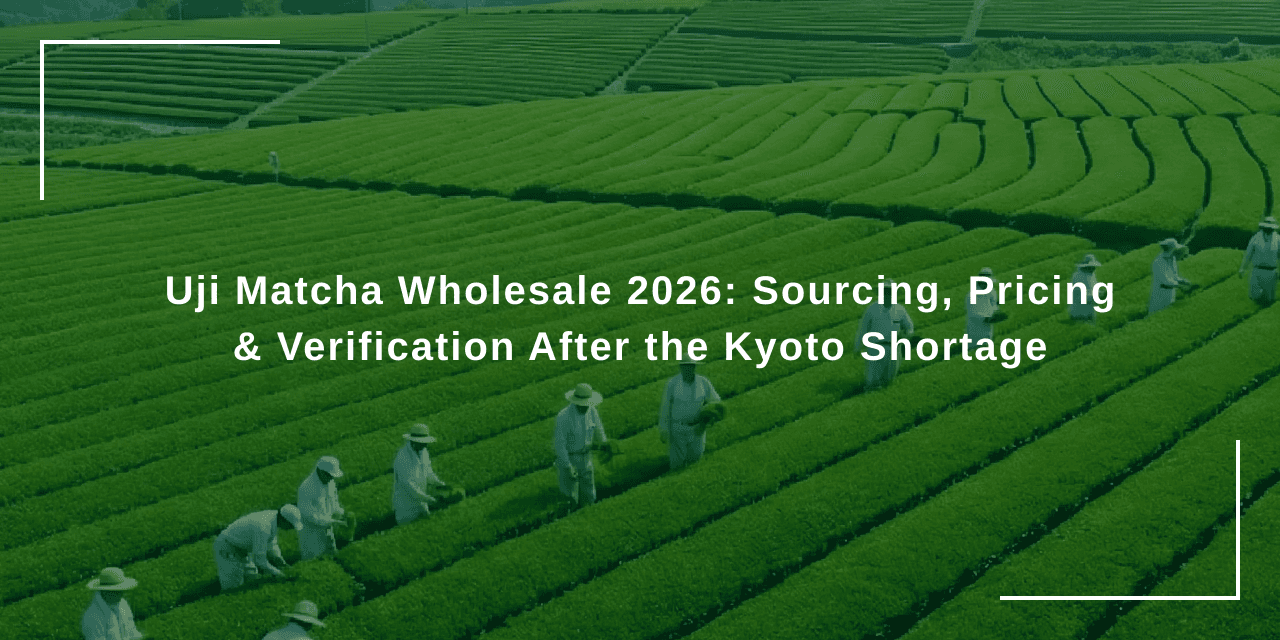
Uji matcha — the matcha grown in and around Kyoto's Uji region — remains the most recognized premium origin on the global market in 2026, but the path to buying Uji matcha at commercial wholesale volumes has fundamentally changed since the 2025 tencha shortage. At the JA Zen-Noh Kyoto tea market, the average price of hand-picked Uji tencha rose 135% in 2025 as traded volume fell 21%, and the 2026 first flush cleared about 11% higher again. Kyoto heritage makers such as Ippodo put quantity limits on matcha sales, and wholesale buyers now compete for tighter allocations. B2B buyers who were comfortable buying Uji matcha at USD 180/kg direct from Japan in 2023 now face either USD 280/kg pricing or "allocated out" messages from their preferred suppliers. Uji wholesale sourcing in 2026 is a different game, and the buyers who understand the new rules win.
This guide is the 2026 Uji matcha wholesale playbook for brand owners, premium retailers, luxury foodservice operators, and private-label buyers who need to source Uji matcha at commercial volume. It covers what makes Uji matcha distinct at the agronomic and chemical level, the production reality in a market that is still tight in 2026, the 2026 wholesale pricing matrix for Uji-origin ceremonial and premium tiers, how to verify Uji origin claims (and why counterfeits are prolific in 2026), the supplier archetypes that can actually deliver Uji matcha at wholesale scale, and the strategic question of whether Uji still belongs in your sourcing architecture or whether Kagoshima has surpassed it for your use case.
Key takeaways for Uji matcha wholesale in 2026
- Traded volume of hand-picked Uji tencha fell 21% in 2025 while its average auction price rose 135%. The 2026 first flush brought more volume, but prices rose again. Heritage makers such as Ippodo limited matcha sales.
- 2026 Uji ceremonial wholesale pricing runs 30–60% above equivalent-grade Kagoshima at 10–25 kg MOQ direct from Japan. Quotes below the red-flag thresholds in Section 4 are a counterfeit signal.
- Uji-claim verification requires prefecture- and district-level origin documentation, cultivar declaration, and increasingly third-party traceability audits.
- Uji is now correctly positioned as a premium storytelling SKU, not a commodity production grade. Volume sourcing should use Kagoshima or Nishio.
- Allocation contracts signed in the July–August post-harvest window are the only reliable way to secure the following 12 months of Uji wholesale supply.
Table of contents
- What makes Uji matcha distinct
- Uji production through the ongoing shortage
- 2026 Uji wholesale pricing and MOQ
- Verifying Uji origin and avoiding counterfeits
- Supplier archetypes for Uji wholesale
- Strategic question: Uji or Kagoshima?
- Practical sourcing plan for 2026
- FAQ
1. What makes Uji matcha distinct
Uji matcha carries a combination of terroir, cultivation tradition, and cultivar selection that produces measurable differences from matcha grown in other Japanese prefectures — though the magnitude of those differences varies by grade tier, and the premium pricing is driven as much by heritage and brand as by cup-perceptible attributes.
Agronomic profile of the Uji region
- Geography: Uji city and surrounding districts in southern Kyoto Prefecture. Historic tea-production region dating to the 13th century.
- Climate: Continental with strong seasonal temperature variation, significant morning mist from the Uji River, and moderate rainfall — producing slower leaf growth and higher amino acid concentration in shaded tencha.
- Soil: Clay-rich alluvial soils along the river systems, supplemented by traditional compost practices that preserve organic matter.
- Terrain: Largely hillside cultivation — labor-intensive, difficult to mechanize. This is the root of Uji's pricing premium: yield per hectare is materially lower than Kagoshima's flat-field cultivation.
Cultivation specifics
- Shading: Traditional "honzu" shading using rice straw and reed mats over bamboo frames — labor-intensive but produces deeper chlorophyll development than synthetic shade netting.
- Shading duration: 20–30 days before harvest; premium Uji lots run to the longer end.
- Harvest: Hand-picked for the highest-tier production. Machine-assisted for mid-tier Uji.
- Processing: Steam-fixing within hours of harvest, drying in traditional tencha ovens, stem and vein removal by hand or machine, aging before stone-milling.
Cultivars commonly associated with Uji
Cultivar | Sensory character | Typical use |
|---|---|---|
Samidori | Strong umami, deep green color | Top-tier ceremonial |
Asahi | Sweet, delicate, high theanine | Premium ceremonial, limited availability |
Okumidori | Balanced umami and sweetness, vivid color | Mid-tier ceremonial |
Yabukita | Traditional baseline; moderate character | Standard ceremonial and premium culinary |
Gokou | Intense umami, classical Uji character | Heritage ceremonial |
Biochemistry delta vs Kagoshima or Nishio
Premium Uji matcha consistently shows:
- L-theanine content: 1.3–1.7% (vs 1.0–1.3% typical Kagoshima ceremonial)
- Chlorophyll: slightly higher when shading duration is extended to 25+ days
- Catechin: slightly lower, producing less astringency in straight service
- Aroma compound complexity: more pronounced "ooika" (covered-tea aroma)
These differences are perceptible to trained tasters in straight-service preparation. They are largely imperceptible in milk-based applications. The Uji premium, therefore, captures value primarily for ceremonial and premium retail positioning — not for volume latte programs.
2. Uji production through the ongoing shortage
The 2024–2025 tencha shortage, when surging demand met a smaller 2025 Kyoto harvest, is the defining event in the modern matcha wholesale market. It is still running in 2026 and will influence pricing and availability through 2028.
What happened
- Demand driver: Demand for tencha, the raw material for matcha, surged with overseas buying, while every tea type traded at the Kyoto market came in smaller in the 2025 first flush.
- Yield impact: Traded volume of hand-picked Uji tencha at the JA Zen-Noh Kyoto tea market fell 21% in 2025, and machine-picked first-flush tencha fell 8%.
- Reserve depletion: Japanese heritage makers traditionally blend frozen prior-year tencha into each production run to smooth quality. The 2024–2025 demand surge exhausted these reserves.
- Auction price response: The average price of hand-picked Uji tencha rose 135% in 2025, and machine-picked first-flush tencha rose 162%, an unprecedented jump for the Kyoto market.
Market response through 2025–2026
- Heritage makers' moves: Ippodo had quantity limits on matcha sales in place by August 2025 as overseas demand outran supply, and in February 2026 it announced the discontinuation of several hojicha and genmaicha products because the shift of tea fields into tencha had cut bancha supply. Wholesale allocations tightened across the category.
- Trading company reactions: Mid-market trading exporters increased Kagoshima and Nishio sourcing to fill Uji supply gaps, accelerating the production geography shift.
- End-consumer impact: US and EU retail matcha pricing rose 25–40% through 2025–2026. Premium Uji-origin retail SKUs saw the largest increases.
2026 supply outlook
- Volume recovery: Partial. In the 2026 first flush, traded volume of hand-picked Uji tencha rose about 19%, still below 2024, while machine-picked first-flush tencha rose about 20% as growers shifted other tea types into tencha.
- Price stabilization: Not yet. Average 2026 first-flush prices rose again, about 11% for hand-picked Uji tencha and about 22% for machine-picked tencha, and the Kyoto tea industry council reports no sign of the surge easing. Industry consensus is that 2023 Uji pricing floors will not return. Labor, fertilizer, and energy cost increases have integrated permanently.
- Allocation capacity: Still tight. Hand-picked Uji tencha volume in the 2026 first flush remained below 2024 while prices rose again, and annual allocation contracts are signed in the July–August post-harvest window.
3. 2026 Uji wholesale pricing and MOQ
Uji wholesale pricing sits at the top of Japan's matcha price structure and carries a 30–60% premium over equivalent-grade Kagoshima matcha in 2026. The matrix below reflects direct-Japan wholesale pricing from qualified exporters with verifiable Uji-origin supply chains.
2026 Uji wholesale price matrix (USD/kg, FOB Japan)
Tier | 1 kg | 5 kg | 10 kg | 25 kg+ | Notes |
|---|---|---|---|---|---|
Heritage competition grade | $550–850 | $480–750 | $420–680 | Contract | Single-cultivar, hand-picked, auction-tier stock |
Standard Uji Ceremonial | $280–420 | $250–380 | $220–340 | $200–310 | Stone-milled, high-grade harvest |
Uji Premium Latte | $150–220 | $130–195 | $115–175 | $100–160 | Uji-origin latte grade — premium-tier milk applications |
Uji Culinary | $80–130 | $70–115 | $60–100 | $55–90 | Rare: most Uji production concentrates on higher tiers |
Volume availability reality
Unlike Kagoshima or industrial-tier grades where pallet-scale (500 kg+) orders are routine, Uji wholesale supply is volume-constrained. 2026 realities:
- 5–25 kg orders: Generally available from qualified exporters, though allocation priority applies during peak demand periods.
- 25–100 kg orders: Require annual allocation contracts signed in the July–August post-harvest window.
- 100 kg+ orders: Require multi-year relationships with heritage makers or large trading exporters; typically unavailable to new accounts in 2026.
- 500 kg+ pallet orders: Effectively unavailable at commercial pricing; large beverage manufacturers operate through different contract structures or blend Uji with other origins.
Pricing comparison: Uji vs Kagoshima vs Nishio vs Shizuoka (ceremonial and premium latte, 10 kg MOQ, 2026)
Origin | Ceremonial 10 kg MOQ | Premium Latte 10 kg MOQ | Notes |
|---|---|---|---|
Uji | $220–340 | $115–175 | Heritage brand premium; limited availability |
Kagoshima | $140–220 | $70–100 | Largest 2026 production volume; equivalent cup quality at latte tier |
Nishio | $160–240 | $75–110 | Stable B2B supply; moderate brand recognition |
Shizuoka | $120–200 | $60–90 | Budget-sensitive alternative; variable quality |
4. Verifying Uji origin and avoiding counterfeits
The 2025 shortage attracted opportunistic mislabeling. Latte-grade "Uji matcha" at USD 80/kg is almost certainly not genuine Uji-origin product. Latte-grade "Uji matcha" at USD 150/kg might be Uji, but requires verification. Counterfeit Uji is one of the most common scams in the 2026 B2B matcha market.
Red-flag pricing thresholds (Uji-claim, 10 kg MOQ)
- Ceremonial claim below USD 180/kg: Counterfeit signal. Genuine Uji ceremonial production cost economics do not support sub-USD 180/kg wholesale pricing at any MOQ.
- Premium latte claim below USD 90/kg: Counterfeit signal. Likely Kagoshima or blended product mis-labeled as Uji.
- Any tier marketed as Uji with origin documentation only at country level ("Japan"): Disqualifying. Genuine Uji wholesale always documents origin at municipal or district level.
Verification documentation required
- Prefecture and district origin statement: "Kyoto Prefecture, Uji District" or specific sub-region. Generic "Kyoto" alone is insufficient.
- Cultivar declaration: Specific cultivar(s) used. Uji production concentrates on Samidori, Asahi, Okumidori, Yabukita, and Gokou — these cultivar names should appear.
- Harvest date and year: Current-year 2026 or prior-year 2025 for 2026 shipments. Older harvest dates indicate inventory-clearance product.
- Processing chain documentation: Where was the tencha harvested? Where was it processed? Where was it milled? Uji-origin tencha can legitimately be milled by non-Uji facilities, but chain-of-custody should be traceable.
- Organic certification (if claimed): JAS Organic certificate, plus the per-shipment import certificate for the Uji-origin lot (NOP Import Certificate for the US, COI for the EU).
- Third-party verification (for contracts above USD 50K annual): Eurofins, SGS, or Japan Food Research Laboratories reports cross-referencing the origin and cultivar claims with isotope ratio analysis or DNA markers where contested.
How counterfeit Uji is typically constructed
- Mis-labeling of Kagoshima or Nishio premium: Legitimate Japanese matcha relabeled as Uji origin. The product is real matcha but not Uji.
- Blending: Small percentage of genuine Uji mixed with majority non-Uji, sold as "Uji blend." Legal in some framings, deceptive in others.
- Chinese-origin relabeling: Chinese-origin green tea powder relabeled as Japanese or specifically Uji. More common at the industrial-tier price point; rarer at ceremonial tier but increasing.
- Aged-stock repositioning: Real Uji that has been in warehouse storage 2+ years, sold at current-year price. Often accompanied by newer-looking COAs or reluctance to document harvest year.
5. Supplier archetypes for Uji wholesale
Sourcing genuine Uji matcha at commercial wholesale volumes in 2026 requires working with specific supplier archetypes. Not all Japanese matcha suppliers can or do supply real Uji.
Heritage makers headquartered in Uji
- Examples: Marukyu Koyamaen, Horiishichimeien, Yamamasa Koyamaen.
- Uji supply: 100% direct from own farms and contracted growers in Uji district.
- Wholesale access: Very limited for new accounts in 2026. Requires relationship cultivation (in-person visits, 3–6 month onboarding), prepayment terms, rigid MOQs.
- Pricing: At the high end of the 2026 matrix. Negotiation flexibility is limited.
- Best for: Luxury retail brands, hospitality groups, and established wholesale accounts with years of relationship history.
Trading exporters with Uji supply chains
- Examples: First Agri (with Uji origin allocation), mid-market Kyoto-based exporters.
- Uji supply: Direct purchasing relationships with Uji farmers and tencha auction access. Supply volumes are more constrained than their Kagoshima/Nishio inventory.
- Wholesale access: More accessible for new accounts than heritage makers. 6–10 week onboarding. MOQ 10–25 kg typical.
- Pricing: Competitive with heritage makers (sometimes 5–15% below for equivalent grade), but still at premium-tier prices.
- Best for: Mid-market brands, premium retail, independent luxury cafés, private-label programs that want Uji origin without heritage-maker relationship complexity.
Industrial integrators with Uji blends
- Examples: Ito En, Aiya industrial division.
- Uji supply: Partial — these integrators blend Uji-origin tencha into some premium products rather than offering 100% Uji wholesale.
- Wholesale access: Volume-driven; minimum commitments typically 500 kg+.
- Pricing: Blended, often not transparent at the Uji-percentage level.
- Best for: Large beverage manufacturers, RTD product developers.
US/EU distributor-brands claiming Uji
- Uji supply: Verification required. Some distributor brands legitimately source Uji; others mislabel.
- Wholesale access: Typically lower MOQ than direct Japan, higher per-kg cost.
- Pricing: 25–40% above equivalent direct Japan pricing.
- Best for: Small-volume buyers needing US/EU-warehoused stock who can verify origin claims through direct supplier back-channels.
6. Strategic question: Uji or Kagoshima?
The most consequential decision facing 2026 premium matcha buyers is whether Uji origin still justifies its 30–60% pricing premium over Kagoshima. The honest answer varies by application.
Where Uji still wins
- Luxury retail packaged product: Uji-origin narrative on a 30g consumer tin at USD 45–65 retail is a meaningful purchase driver. The brand story is the product.
- Ceremonial service in premium hospitality: A tea ceremony in a luxury hotel, a Michelin-starred restaurant's tea course — here the straight-service preparation rewards the premium theanine and aroma profile of Uji.
- Single-origin café flagship SKU: The USD 9–12 ceremonial service that sits at the top of a café's matcha menu. Customers ordering this specifically want origin-driven quality.
- Retail gifting (Japan domestic market): Uji heritage is a strong purchase driver in Japan itself. Matters less outside Japan.
Where Kagoshima equals or exceeds Uji
- Volume café latte programs: In milk and sweetener, the sensory differences between Uji and Kagoshima ceremonial disappear. Kagoshima is the right choice and avoids the 30–60% Uji premium.
- Bakery and confectionery: Heat-processed applications destroy the delicate character that Uji premium commands. Kagoshima Premium Culinary performs equally at lower cost.
- RTD beverage and supplement manufacturing: Industrial-tier Kagoshima is the default; Uji in industrial applications is economically unjustified.
- Private-label D2C brands where brand not product is the narrative: Brand storytelling about wellness, sustainability, or founder story often trumps origin storytelling. Kagoshima delivers better unit economics.
Portfolio approach: both origins
Sophisticated 2026 buyers often run both:
- Core volume (80–90%): Kagoshima ceremonial and latte grades. Delivers the economic engine.
- Premium showcase (10–20%): Uji ceremonial for flagship SKUs, retail gifting, or narrative-driven product lines.
This structure is what sophisticated multi-location chains and premium D2C brands have adopted through 2025–2026 as the shortage forced pragmatic sourcing reassessment.
7. Practical sourcing plan for 2026
Assembling an actual 2026 Uji wholesale supply plan involves five steps.
Step 1: Define the role of Uji in your portfolio
- Volume driver (not recommended — use Kagoshima)
- Premium showcase SKU only (recommended for 90% of buyers)
- Retail gifting / brand heritage product (Uji-appropriate)
- Ceremonial hospitality service (Uji-appropriate)
Step 2: Size the allocation
Calculate monthly and annual Uji consumption for defined role. For most café and D2C buyers, Uji allocation sits at 1–5 kg/month — meaningfully less than total matcha consumption.
Step 3: Qualify 2–3 suppliers with verifiable Uji supply
- Contact 2–3 candidates (heritage maker, trading exporter, premium distributor)
- Request Uji-specific spec sheets and sample shipments
- Verify origin documentation against the checklist in Section 4
- Conduct blind tasting against current or reference Uji product
Step 4: Negotiate allocation contract during post-harvest window
July–August is when Japanese producers are finalizing allocation commitments for the following 12 months. Contracts signed in September or later typically face harder terms because capacity is committed elsewhere.
Step 5: Secure complementary non-Uji supply
A Uji-only supply plan is fragile. Pair the Uji allocation with a larger Kagoshima or Nishio volume contract to cover the rest of your matcha consumption. This is also a buffer against Uji supply disruption in future harvest shocks.
Build your Uji + Kagoshima portfolio with First Agri. Single-supplier cross-origin sourcing: Uji for showcase SKUs and Kagoshima for volume. 7–14 day air freight and allocation contracts. Ask us which provenance documents are available for each lot.
Request a Uji-inclusive sourcing plan →
FAQ
What's the minimum order I can place for Uji matcha wholesale in 2026?
5–10 kg at qualifying trading exporters; 25 kg+ for most heritage makers. Uji allocations are tight because the tencha shortage is still running in 2026, but mid-market buyers can still access Uji at meaningful wholesale volume.
Is Uji matcha really better than Kagoshima matcha?
For straight ceremonial service and luxury-tier applications, Uji consistently shows higher theanine content and more complex aroma. For milk-based, bakery, and industrial applications, the differences are imperceptible to customers and Kagoshima delivers equivalent or better value.
How much does authentic Uji ceremonial matcha cost at wholesale in 2026?
USD 220–340/kg at 10 kg MOQ direct Japan import for standard Uji ceremonial. Heritage competition-tier Uji runs USD 420–850/kg at 1–10 kg MOQ. Below USD 180/kg for any Uji ceremonial claim is a counterfeit signal.
How do I verify a Uji matcha claim?
Require prefecture-district origin documentation, specific cultivar declaration, harvest date, processing chain documentation, and organic certification with the per-shipment import certificate (NOP Import Certificate for the US, COI for the EU) if applicable. For contracts above USD 50K annual, commission third-party verification via Eurofins, SGS, or Japan Food Research Laboratories.
Will Uji pricing come back down as production recovers?
Not so far. The 2026 first flush brought back some volume, with hand-picked Uji tencha up about 19%, but average auction prices rose again: about 11% for hand-picked and about 22% for machine-picked first-flush tencha. Cost-side drivers (labor, fertilizer, energy) remain elevated, and industry consensus is that 2023 Uji pricing floors will not return. Plan for USD 200+/kg ceremonial Uji as the 2026+ baseline.
When should I sign a Uji allocation contract?
July–August post-harvest is the optimal window. Producers finalize 12-month allocation commitments during this period. Signing in September–December typically means accepting harder commercial terms or smaller allocations.
Related reading
- Uji Matcha: Why Kyoto's Tea Region Produces the World's Finest Matcha
- Matcha Wholesale 2026: The Complete B2B Buyer's Guide to Sourcing from Japan
- Matcha Wholesale Pricing 2026: Complete Cost Breakdown & Tier Analysis
- Matcha Grading Systems Explained: JAS vs Trade Grades
- Matcha Contamination Risks: Heavy Metals, Pesticides, and Third-Party Testing
- Matcha Supplier Auditing: Essential Factory Inspection Checklist
Source Uji wholesale matcha with First Agri.
Ask us which origin, cultivar and harvest-year documents are available for the Uji lots you are evaluating, and check them against the Section 4 checklist. 5–10 kg entry MOQ, 7–14 day air freight, and complementary Kagoshima supply for volume sourcing. Build a premium + volume portfolio under a single supplier relationship.