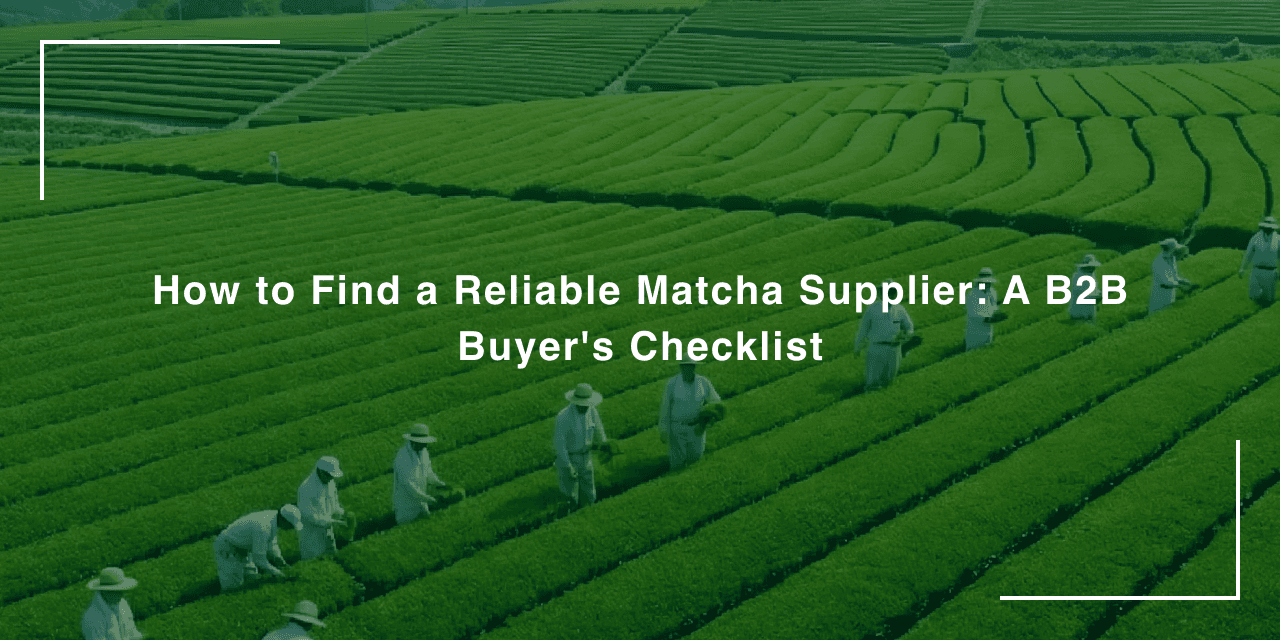
Demand for matcha continues to expand, driven by consumer demand for plant-based wellness products and clean-label caffeine alternatives. For cafe owners, food manufacturers, and beverage companies looking to source wholesale matcha, choosing the right supplier is arguably the most consequential decision you will make.
Next step: if your shortlist includes 50kg+, 100kg+, distributor, manufacturer, private label, or annual allocation requirements, use the pricing and allocation framework in the 2026 matcha wholesale pricing guide, then request a wholesale quote.
A reliable supplier does more than ship green powder — they ensure consistent quality batch after batch, navigate complex export regulations on your behalf, and serve as a long-term partner in your business growth. A poor choice, on the other hand, can result in inconsistent products, regulatory issues at customs, and ultimately, disappointed customers.
This guide presents a practical 7-point checklist to help you evaluate matcha suppliers with confidence.
Certified Matcha Supplier Requirements in 2026
A certified matcha supplier should be able to prove more than origin. For B2B buyers, the minimum package is current certification documentation, batch-level test records, traceability back to the production region, and export support for the destination market. Use this checklist with the quality control testing guide, contamination risk guide, organic certification comparison, and specification sheet guide.
Document or system | What to request | How to verify |
|---|---|---|
JAS Organic | Current certificate covering the product and certified operator | Check validity dates, certifying body, product scope, and whether the grade is actually covered. |
USDA Organic | JAS Organic certificate under the U.S.-Japan equivalence arrangement (or a USDA NOP certificate if the operator is certified directly), plus an NOP Import Certificate for each shipment (required for all organic imports since March 2024). The MAFF-accredited certifier issues it in the Global Organic Integrity Database with the statement "Certified in compliance with the terms of the U.S.-Japan Organic Equivalence Arrangement", and the importer enters its data in CBP's ACE system. | Confirm the exporter can support US import documentation and labeling claims. |
EU Organic | EU-recognized certificate and COI support where required | Confirm importer responsibilities and certificate scope before quoting. |
HACCP / FSSC / ISO 22000 | Food safety system certificate or documented HACCP plan | Check site scope, expiration date, and whether blending, packing, or storage is included. |
COA and pesticide panel | Batch-level certificate of analysis and residue test records | Match the lot number on the COA to the quoted product, grade, and shipment. |
Why Supplier Selection Matters More Than Ever
The matcha supply chain is under unprecedented pressure. Climate-related harvest disruptions in Japan have tightened supply, pushing wholesale prices to historic highs — particularly for premium Uji-origin matcha. At the same time, the surge in global demand has attracted suppliers of varying quality into the market, including those selling lower-grade green tea powder mislabeled as authentic Japanese matcha.
For B2B buyers, this means due diligence is no longer optional. The supplier you choose directly affects your product quality, regulatory compliance, cost stability, and brand reputation.
The 7-Point Supplier Evaluation Checklist
1. Verified Origin and Traceability
Authentic Japanese matcha comes from specific tea-growing regions, each with distinct characteristics:
Region | Characteristics | Best For |
|---|---|---|
Uji, Kyoto | Rich umami, complex aroma, centuries of tradition | Premium menus, ceremonial-grade products, brand positioning |
Nishio, Aichi | Vibrant color, consistent quality, large-scale production | Food manufacturing, beverage companies needing stable supply |
Kagoshima | Cost-effective, strong organic farming, high volume | Organic product lines, value-oriented latte-grade matcha |
Shizuoka | Japan's largest tea region, refreshing and clean flavor | Everyday culinary use, general food service |
A trustworthy supplier should be able to tell you exactly which prefecture — and ideally which farms or cooperatives — their matcha comes from. Be cautious of suppliers who only state "Made in Japan" without specifying the region, as this can sometimes indicate repackaged imports from other countries.
One practical way to test traceability claims before committing: pick a lot number from the supplier's COA and ask them to trace it backward — to the tea garden or cooperative, harvest date, processing records, and quality test results. A professional supplier can complete this exercise within 24 hours and provide supporting documentation. A supplier who cannot connect a finished lot to its origin within a day is unlikely to handle a recall or a customs inquiry well either.
2. Quality Testing and Documentation (COA)
Every reputable matcha supplier should provide a Certificate of Analysis (COA) for each batch. At minimum, this document should cover:
- Microbiological safety: Total plate count, E. coli, Salmonella, mold and yeast
- Heavy metals: Lead, arsenic, cadmium, and mercury levels
- Pesticide residue screening: A comprehensive panel of 500+ substances, compliant with your target market's regulations
- Radiation testing (only if needed): No longer a government requirement for the U.S. or EU — FDA deactivated Import Alert 99-33 in September 2021 and the EU repealed its Fukushima-era import controls in August 2023 — so request it only when your hazard analysis or a customer calls for it
Beyond lab reports, evaluate the matcha yourself. High-quality matcha should display a vibrant emerald green color (not yellowish or dull), a fresh grassy aroma with subtle sweetness, and a silky texture when rubbed between your fingers — indicating proper stone-milling with particle sizes under 10 microns.
3. Relevant Certifications
For certified matcha supplier evaluation, ask for the certificate itself rather than accepting a logo or a one-line claim. The certificate should name the certified operator, the product scope, the certifying body, and the validity period. If the supplier cannot connect the certificate to a specific batch or product grade, treat the claim as incomplete until clarified.
Certifications serve as third-party verification of your supplier's claims. Key certifications to look for include:
- JAS Organic: Japan's official organic standard — mandatory for products sold as organic in Japan
- USDA Organic: Matcha sold as organic in the U.S. must meet USDA organic rules. Under the U.S.-Japan organic equivalence arrangement, Japanese matcha certified JAS Organic (produced in Japan, or with final processing or packaging in Japan) can be sold as organic in the U.S. without a separate USDA certificate. It may use the USDA or JAS organic seal, as long as each shipment has an NOP Import Certificate.
- EU Organic: Required for the European market, with an equivalence agreement with JAS
- HACCP: Demonstrates systematic food safety management at the processing facility
- FSSC 22000: A GFSI-recognized certification accepted by major global retailers
Always request current certification documents — not just logos on a website. Certifications older than 12 months may have lapsed.
4. Appropriate MOQ and Pricing Transparency
Understanding current market pricing helps you spot both overcharging and suspiciously low prices. Here are approximate wholesale ranges for 2025–2026:
Grade | Typical Use | Wholesale Price (USD/kg) | Common MOQ |
|---|---|---|---|
Ceremonial | Straight drinking, premium shots | $120 – $350+ | 5 – 20 kg |
Premium / Latte | Specialty lattes, light desserts | $65 – $110 | 10 – 50 kg |
Culinary | Baking, ice cream, smoothies | $45 – $65 | 20 – 100 kg |
A good supplier offers clear, tiered pricing and is willing to explain what drives the cost. Be wary of any supplier offering "premium matcha" at prices significantly below these ranges — it may indicate adulteration or mislabeled lower-grade product.
5. Sample Program Availability
Never commit to a bulk order without first evaluating samples. A professional supplier will offer a structured sample program that allows you to:
- Evaluate multiple grades side by side
- Test the matcha in your actual recipes and equipment
- Assess how it performs in lattes, baked goods, or whatever your intended application is
- Compare color, flavor, and frothability under real service conditions
When tasting samples, prepare the matcha exactly as your customers will receive it. A matcha that tastes great whisked in hot water may behave differently in a milk-based latte.
6. Export Compliance and Regulatory Knowledge
This is where many supplier relationships break down. International food trade involves layers of regulatory requirements that your supplier must understand and actively support.
For the U.S. market (FDA):
- The supplier's facility must be registered with the FDA
- Prior Notice must be filed electronically before each shipment arrives
- Labeling must comply with Nutrition Facts requirements
- Health claims like "detox" or "antioxidant-rich" without scientific backing can trigger enforcement action
For the EU market:
- The EU applies some of the world's strictest Maximum Residue Limits (MRLs) for pesticides — in many cases at the detection limit of 0.01 mg/kg
- Each organic shipment requires a Certificate of Inspection from an authorized body
- Pesticides that are legal in Japan may exceed EU limits, so your supplier must test specifically for EU compliance
A supplier who understands your target market's regulations and proactively provides the right documentation will save you significant time, cost, and risk at customs.
7. Communication and Long-Term Partnership Mindset
The best supplier relationships go beyond transactions. Evaluate how a potential supplier communicates:
- Responsiveness: Do they reply promptly and clearly to inquiries?
- Language support: Can they communicate effectively in English (or your preferred language)?
- Flexibility: Are they willing to work with you on custom packaging, private labeling, or adjusted MOQs as you scale?
- Proactive updates: Do they inform you about harvest conditions, pricing changes, or regulatory updates before they impact your orders?
A supplier who invests in the relationship — offering recipe development support, market insights, or help navigating new regulations — is a partner worth keeping.
Know Which Type of Supplier You Are Evaluating
Japanese matcha suppliers fall into two structurally different types, and the answers you get on MOQ, pricing, and export support will differ depending on which one you are talking to. A direct factory is the production facility itself — often family-run, focused on milling and processing, with thin margins and limited English-language or regulatory support. A trading company contracts production with one or more factories and adds a service layer on top: English-speaking account management, destination-market documentation (FDA, EU Organic, GCC), multi-grade portfolios, and custom packaging coordination. For equivalent product, trading company pricing typically runs 10–18% above factory direct — and buying through a US or EU distributor adds a further 25–40% on top of that.
Which type fits depends on your volume and in-house capability. Most buyers below roughly 5,000 kg per year — including first-time importers and anyone without an in-house compliance team — are better served by a trading company, because the service premium costs less than doing the regulatory and coordination work yourself. Factory direct becomes attractive at enterprise volumes with in-house regulatory capability, an existing Japan presence, or a single-grade, single-origin program; many buyers graduate to it after 3–5 years, once volume and supplier knowledge justify the switch.
Apply the checklist above with this in mind: a factory may score poorly on communication and export documentation yet still be an excellent partner for a sophisticated buyer, while a trading company should be held to the full standard on responsiveness, documentation, and destination-market compliance — that service layer is exactly what its premium pays for.
Red Flags to Watch Out For
During your evaluation, these warning signs should prompt caution:
- Unusually low prices: Given recent supply constraints, bulk matcha priced well below $30/kg for any grade claiming Japanese origin is highly suspect
- Missing or outdated certifications: Inability to produce current JAS, USDA, or HACCP certificates suggests lapsed quality management
- Vague origin claims: "Japanese matcha" without specifying a prefecture or production region may indicate repackaged imports
- No COA available: Any supplier unable or unwilling to provide batch-level test results should be avoided
- Poor packaging standards: Matcha shipped in transparent bags or without nitrogen flushing will degrade rapidly during transit
Making Your Final Decision
Choosing a matcha supplier is not just a procurement decision — it is a strategic one. The right partner will help you maintain product quality as you scale, stay compliant as regulations evolve, and adapt to supply chain disruptions that are becoming increasingly common.
Start with samples from two or three suppliers. Evaluate each against this checklist. Then, before committing to a long-term contract, place a smaller trial order to test the full process — from order placement through delivery, documentation, and product quality upon arrival.
The matcha market rewards businesses that prioritize quality and consistency. Your supplier is the foundation of that promise.
Planning a 50kg+ or 100kg+ matcha program? If you are sourcing for a distributor, manufacturer, private label brand, or annual allocation contract, request a wholesale quote so First Agri can prepare volume, logistics, and documentation options. Need samples first? Start with Product Request.