Key Takeaways
- Color is measurable — don't trust your eyes alone. Request CIELAB values: a* should be -14 or lower (more negative = greener)
- The Finger Test reveals particle size — high-quality matcha feels like baby powder (5-10 microns), not sand (15-25 microns)
- Clumping is actually a good sign — ultra-fine particles naturally aggregate due to static electricity
- Bitterness indicates low quality — premium matcha tastes like umami (savory broth), not astringent tea
- Always verify with documentation — request Certificate of Analysis (CoA), harvest dates, and pesticide reports before committing to volume orders
Why Quality Verification Matters Now More Than Ever
Matcha supply has been tight since 2025. Demand for matcha surged at home and abroad just as spring weather cut Japan's first-flush yields to 80-90% of the prior year. At the JA Zennoh Kyoto tea market, traded volume of hand-picked Uji tencha fell 21% in 2025 while its average auction price rose 135%, and the average price of machine-picked first-flush tencha rose 162%. The 2026 first flush brought back some volume, but prices rose again. When supply is tight and prices spike, counterfeit and low-quality products flood the market.
Without standardized grading (remember: "ceremonial" is marketing, not regulation), B2B buyers must become their own quality control experts. Subjective advice like "look for vibrant green" isn't enough — you need measurable, verifiable criteria.
This guide provides exactly that: five scientific indicators with practical tests you can perform yourself, plus the documentation you should demand from every supplier.
Sign #1: Vibrant Green Color (And How to Measure It)
Color is the most immediate quality indicator — but human perception varies with lighting. Professional buyers use objective measurements.
The Science Behind the Green
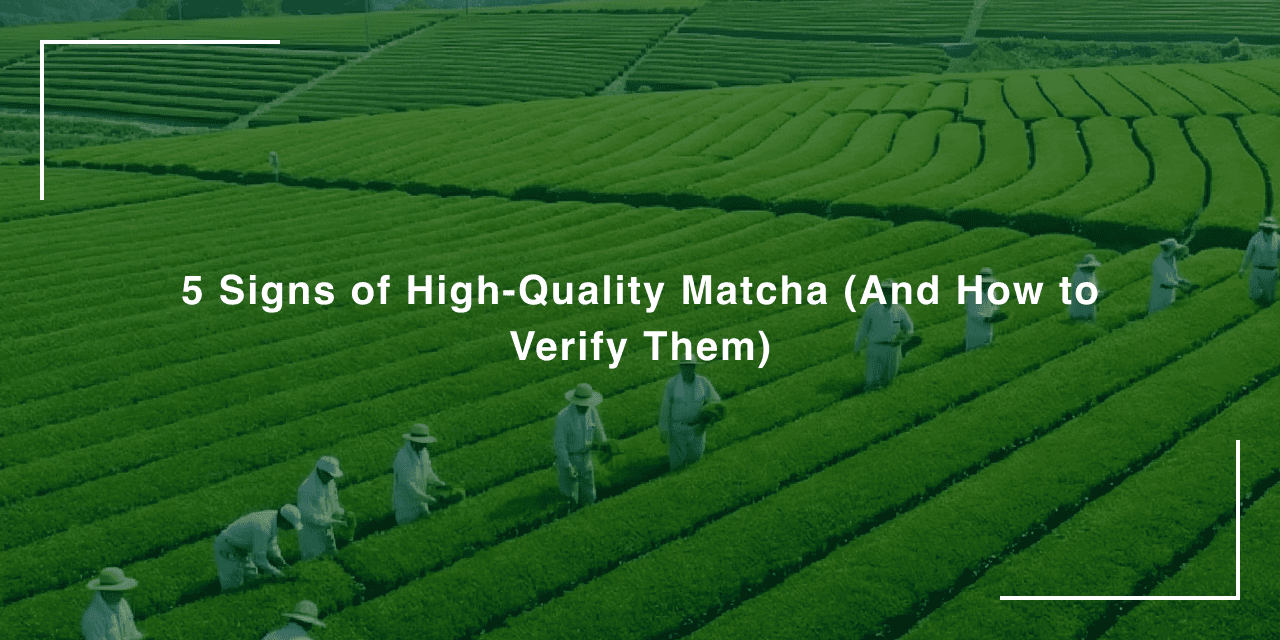
The electric green of premium matcha comes from chlorophyll concentration, which is artificially elevated through shade-growing (covering tea plants for 20-30 days before harvest). Without shading, tea leaves remain yellow-green.
When matcha oxidizes or degrades, magnesium ions detach from chlorophyll molecules, converting them to pheophytin — a brown pigment. This is why old or poorly stored matcha looks olive or brownish.
CIELAB Color Values: The Professional Standard
Color scientists use the CIELAB color space (L*a*b*) for objective measurement. For matcha quality control:
Parameter | What It Measures | High Quality | Low Quality |
|---|---|---|---|
L* | Lightness (0=black, 100=white) | 60+ (bright, vivid) | Below 50 (dark, dull) |
a* | Green-Red axis (negative=green) | -14 to -18 | -8 to -10 or higher |
b* | Yellow-Blue axis (positive=yellow) | 25-35 | 40+ (too yellow) |
The a* value is most critical. If a supplier can't provide a* values of -14 or lower, their matcha is likely under-shaded, oxidized, or contains older leaves.
Practical Test: The Smear Test
No spectrophotometer? Use this visual comparison method:
Materials: White uncoated paper, sample matcha, reference matcha (known quality)
Procedure:
- Place 0.5g of each matcha side by side on white paper
- Press your index finger firmly into the powder
- Smear downward in one stroke, pressing hard
Interpretation:
- High quality: Long, smooth stroke. Powder embeds into paper fibers. Waxy, glossy appearance. Color stays vibrant green throughout.
- Low quality: Short, patchy stroke. Powder flakes off. Dull finish. Color appears yellowish or olive when spread thin.
Red Flag: Artificial Coloring
Some suppliers add copper chlorophyllin to boost color in inferior matcha. Warning signs:
- Unnaturally bright, almost fluorescent green
- Color dissolves too uniformly in water (natural chlorophyll disperses gradually)
- Blue undertone rather than natural yellow-green
For large orders, request third-party testing for synthetic colorants.
Sign #2: Ultra-Fine, Silky Texture
Particle size directly affects mouthfeel, foam quality, and suspension stability. The difference between ceremonial and culinary grade is often measured in microns.
Particle Size Standards
Quality Level | Particle Size | Production Method |
|---|---|---|
Premium Ceremonial | 5-10 microns | Stone mill (40g/hour) |
Standard Ceremonial | 10-15 microns | Fine jet mill |
Culinary/Latte | 15-25 microns | Industrial mill |
Low Grade | 25+ microns | Coarse grind |
Human tongues detect grittiness at approximately 15 microns. Anything coarser creates an unpleasant sandy texture, especially noticeable in straight matcha or delicate desserts.
Practical Test: The Finger Test
This simple test leverages the sensitivity of your fingerprints.
Procedure:
- Pinch a small amount of matcha between thumb and forefinger
- Rub your fingers together, working the powder into your fingerprint ridges
- Assess the sensation
Interpretation:
- High quality (5-10μm): Feels like baby powder or cornstarch. Completely smooth. Powder clings to skin due to static electricity. You cannot feel individual particles.
- Low quality (15-25μm): Slight grittiness, like fine sand. Powder falls off fingers easily. Distinct particles detectable.
The Clumping Paradox
Counterintuitively, clumping indicates quality. Ultra-fine particles (5-10 microns) naturally aggregate due to Van der Waals forces and static electricity. If your matcha arrives perfectly free-flowing with no clumps, it's either:
- Coarsely ground (particles too large to clump)
- Contains anti-caking agents (maltodextrin, silicon dioxide)
Operational requirement: Always sift premium matcha before use. Clumps disperse easily with a fine-mesh strainer.
Sign #3: Fresh, Complex Aroma
Aroma reveals freshness and processing quality more reliably than any other sensory indicator.
The Chemistry of Premium Matcha Aroma
High-quality matcha has a distinctive "covered aroma" (覆い香, ooi-ka) resulting from shade-growing. Key volatile compounds include:
Compound | Aroma Character | Indicates |
|---|---|---|
Dimethyl sulfide | Marine, seaweed, nori | Proper shading |
β-ionone | Floral, violet, sweet | First-harvest leaves |
cis-3-Hexenol | Fresh-cut grass, green | Freshness |
Practical Test: Two-Stage Aroma Check
Stage 1 — Dry Aroma (powder)
Open the container and inhale immediately.
- High quality: Complex bouquet — buttery, milky, fresh grass, marine/seaweed notes
- Defects to reject:
- Hay or straw smell → oxidation or insufficient shading
- Musty or moldy → poor storage
- Metallic → equipment contamination
Stage 2 — Wet Aroma (after adding water)
Add 80°C water and inhale the steam.
- High quality: Sweet, intense aroma that "explodes" from the bowl
- Defects to reject:
- Strong roasted/burnt smell → excessive firing (hi-ire) to mask low quality
- Flat, weak aroma → old stock or poor leaf quality
Note: Some roasted character is acceptable for latte-grade matcha (pairs well with milk), but ceremonial grade should have zero roasted notes.
Sign #4: Umami-Forward Taste (Not Bitterness)
The biggest misconception: "Matcha is supposed to be bitter." Wrong. Premium matcha tastes like liquid umami — similar to dashi broth or aged cheese.
The Taste Equation: L-Theanine vs. Catechins
Component | Taste | High in... | Low in... |
|---|---|---|---|
L-Theanine | Umami, sweetness | Shaded, first-harvest | Sun-grown, later harvests |
Catechins (EGCG) | Bitterness, astringency | Sun-grown, summer harvest | Properly shaded |
Shade-growing prevents L-theanine from converting to catechins. The result: high-quality matcha can contain 2%+ L-theanine by dry weight, delivering intense savory-sweet flavor with minimal bitterness.
Practical Test: Professional Cupping Protocol
Adapted from ISO tea tasting standards:
Setup:
- Ratio: 2g matcha to 60-70ml water
- Temperature: 80°C (not boiling — high heat extracts excessive catechins)
- Equipment: Chasen (bamboo whisk) or milk frother
Evaluation Points:
Phase | High Quality | Low Quality |
|---|---|---|
Attack (first sip) | Immediate sweetness and umami | Sharp bitterness hits first |
Body (mid-palate) | Creamy, viscous, full | Watery, thin, hollow |
Finish (after swallowing) | Sweet aftertaste lingers 30-60 seconds | Astringent, mouth-drying, makes you want water |
The 30-second rule: If pleasant sweetness persists for 30+ seconds after swallowing, you have premium matcha. If your tongue feels dry and puckered, it's low grade regardless of the label.
Sign #5: Rich, Stable Foam
Foam quality matters for café applications and indicates proper particle size and freshness.
The Science of Matcha Foam
Two mechanisms create stable matcha foam:
- Saponins (natural surfactants in tea) reduce surface tension, forming bubbles
- Pickering stabilization — ultra-fine particles (5-10μm) physically coat bubble walls, preventing collapse
Coarse particles can't perform Pickering stabilization, so foam from low-quality matcha dissipates quickly.
Practical Test: Cold Water Suspension Test
This reveals both particle size and dispersion quality.
Procedure:
- Add 200ml cold water to a clear bottle or shaker
- Add 1 teaspoon of matcha
- Shake vigorously for 15 seconds
- Let stand for 5 minutes and observe
Interpretation:
- High quality: Uniform, opaque green suspension. Particles settle slowly like fine mist. Even after settling, bottom layer is smooth, not gritty.
- Low quality: Large particles fall immediately like rain. Clear liquid separates on top. Bottom sediment looks sandy or granular.
Bonus: Supplier Verification Checklist
Sensory tests confirm what you're buying. Documentation confirms you can trust the supplier.
Essential Documents to Request
1. Certificate of Analysis (CoA)
Every reputable supplier provides per-lot CoAs. Verify:
Test | Acceptable Range | Red Flag |
|---|---|---|
Total Plate Count | <3,000 CFU/g (strict) or <10,000 CFU/g | Higher counts |
Coliforms | Negative or <10 CFU/g | Any positive |
Salmonella | Not Detected | Any detection |
Lead (Pb) | <2.0 ppm | Higher levels |
Arsenic (As) | <1.0 ppm | Higher levels |
2. Pesticide Residue Report
Critical for international trade. For some common tea pesticides, EU limits are 600 to 2,500 times stricter than Japanese limits:
Pesticide | Japan MRL | EU MRL |
|---|---|---|
Acetamiprid | 30 ppm | 0.05 ppm |
Dinotefuran | 25 ppm | 0.01 ppm |
Always specify "EU MRL Compliant" for export or multinational clients.
3. Harvest/Production Date
Matcha degrades from the moment it's ground. Acceptable:
- Within 6 months of production for premium applications
- Within 12 months if properly cold-stored
4. Origin Certificate
Verify claimed origin (Uji, Nishio, Kagoshima) with traceability documentation. In a tight market, origin fraud increases.
Questions to Ask Every Supplier
- Can you provide CIELAB color values for this lot?
- What is the particle size distribution (D50 value)?
- Is this first harvest (ichibancha) or blended?
- How long was the shading period?
- When was this ground? How has it been stored?
- Do you have EU MRL compliance certification?
- Can I get a CoA with microbiology and heavy metals?
If they can't answer these questions, find a different supplier.
FAQ
How can I tell if matcha is artificially colored?
Three indicators: (1) Unnaturally fluorescent or neon-bright green — natural chlorophyll has depth, not intensity. (2) Color disperses too uniformly in cold water — natural matcha takes time to suspend. (3) Blue undertone rather than yellow-green. For certainty, request third-party spectral analysis showing natural chlorophyll a/b ratios.
Why does my "ceremonial grade" matcha taste bitter?
Either it's mislabeled (actually culinary grade), oxidized from poor storage, or you're using water that's too hot. True ceremonial grade has minimal bitterness. Try: (1) Use 80°C water, not boiling. (2) Check production date — anything over 6 months may have degraded. (3) Request a different supplier sample for comparison.
Is clumpy matcha bad quality?
No — the opposite. Ultra-fine particles (5-10 microns) naturally clump due to static electricity and molecular forces. Perfectly free-flowing matcha is either coarsely ground or contains anti-caking agents. Always sift before use; clumps should break apart easily.
What's more important: organic certification or taste quality?
Depends on your market. Organic certification verifies how the tea was grown (without synthetic pesticides or fertilizers), not its safety or flavor — traditional high-nitrogen fertilization (non-organic) often produces more intense umami. For the EU, organic certification is needed only if you sell the product as organic; conventional matcha must still meet EU pesticide limits. For taste-focused applications, conventionally grown premium matcha from reputable farms often outperforms organic alternatives.
How should I store matcha to maintain quality?
Unopened: Refrigerate (4°C) or freeze (-18°C). Opened: Transfer to airtight, opaque container; refrigerate; use within 30-60 days. Never store near heat sources (like espresso machines). Cold storage prevents the chlorophyll degradation that causes color loss and flavor deterioration.
Verify Before You Buy
Quality claims are easy to make. Verification separates professional buyers from those who get burned.
At First Agri, every product ships with:
- Full CoA including microbiology, heavy metals, and pesticides
- CIELAB color values for objective quality benchmarking
- Harvest and production dates — nothing over 6 months old
- Origin documentation with full traceability
Quality standards current as of September 2026. Testing protocols aligned with ISO and Japanese Tea Industry standards.