
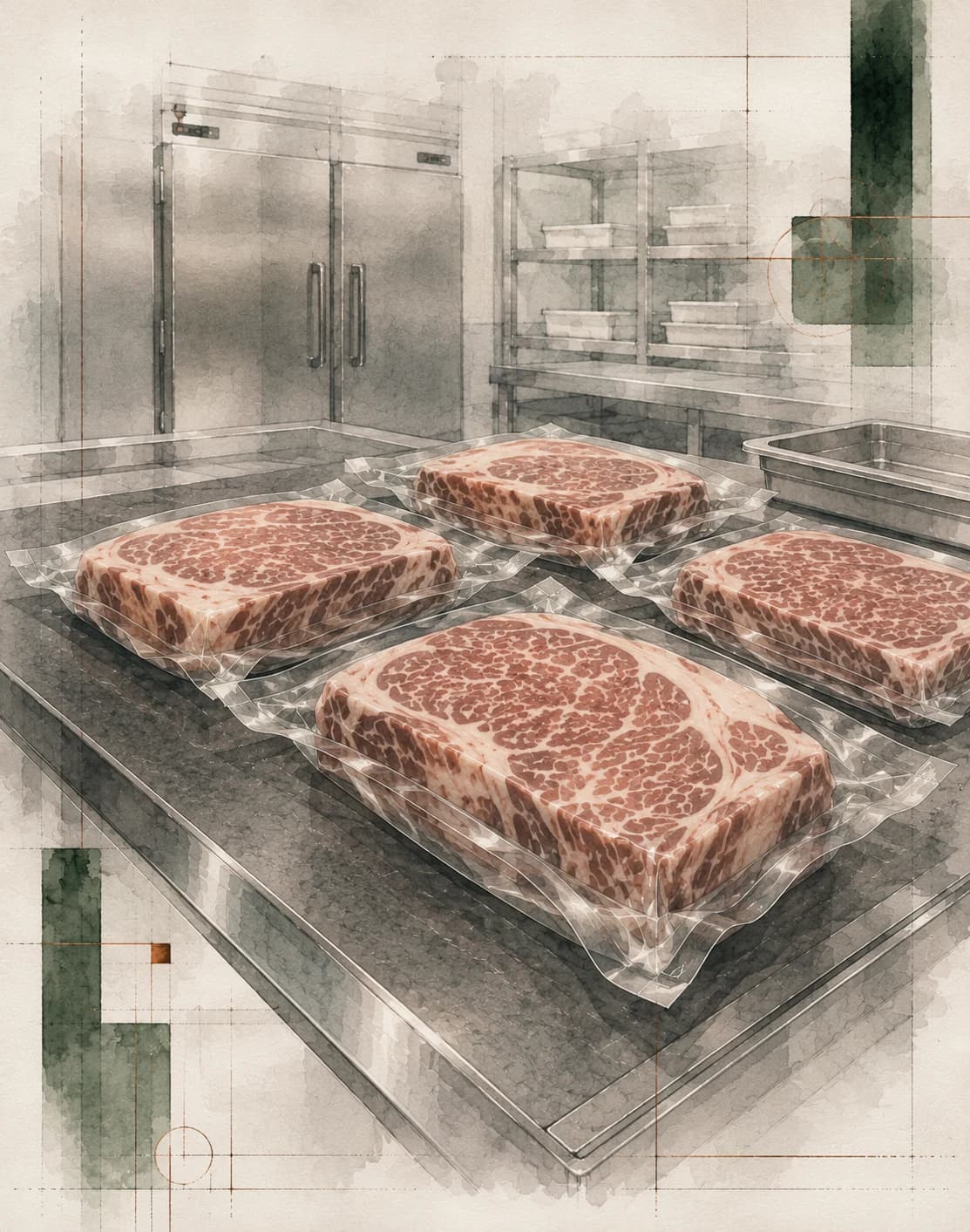
Japanese Wagyu bought by the cut is a catch-weight product. A ribeye is not a widget: two sub-primals from the same grade, the same supplier and the same week can differ by several hundred grams, and a carton packed to "6 pieces, 30 kg" will land at 29.4 kg or 30.6 kg more often than it lands at exactly 30. If your Hong Kong purchase order states a single fixed kilo figure per line and says nothing else, then every shipment is technically out of spec, and the argument about it starts after the chilled clock is already running.
This article is only about the acceptance clause: the tolerance band, the re-weigh point, the evidence, and the dispute rule. It does not tell you how often to reorder or in what cut mix — that decision is covered in the cut mix and reorder cadence article — and it does not count how many usable chilled days you have after arrival, which is the shelf-life day count article. If your open question is margin rather than acceptance, the quoted-kilo-to-sellable-pound ledger converts a quoted price into sellable weight instead.
Why one weight figure per PO line is not enough
Procurement systems usually want one number per line: quantity, unit, price. That works for a case of bottles. It does not work for a whole striploin, because two different people care about weight for two different reasons, and they need two different tolerances.
- The kitchen cares per piece. A steakhouse portioning 250 g steaks off a striploin needs each piece to sit inside a predictable range, because piece weight drives portion count, plate cost, and how many covers a carton serves. A line total that is perfect on paper but made up of one 6 kg piece and one 2 kg piece is a problem in the kitchen, not in accounts.
- Accounts care per line. Finance needs the invoiced quantity to sit close enough to the ordered quantity that the receipt matches the PO without a manual override, and needs to know in advance whether the invoice is raised at actual weight or at nominal weight.
Write both. A clause that states a per-piece band and a per-line band, and says explicitly which one governs invoicing, removes almost every catch-weight dispute before it happens.
Catch-weight vs fixed-weight lines: decide per cut
A fixed-weight line means the seller guarantees a stated weight per unit and you are invoiced for that weight. It is reasonable for portion-cut, individually wrapped items where the supplier can cut to a target and absorb the trim. It is not reasonable for whole primals and sub-primals.
A catch-weight line means the PO states a nominal weight and a piece count, the shipment is invoiced at actual delivered weight, and the tolerance band defines what "actual" is allowed to be. For Wagyu ribeye, striploin, tenderloin, chuck flap and short rib bought as sub-primals, catch-weight is the honest structure. Trying to force a fixed-weight line onto a sub-primal simply pushes the variance into a credit note later.
The practical test: if the supplier would have to trim usable meat off to hit the number, the line should be catch-weight.
The Cut Weight Tolerance and Acceptance Block
Below is a block you can paste into the PO as an annex and complete with your supplier. The point is not the specific figures — nominal piece weights differ by supplier, by animal, and by how the cut is specified — but that every column has an agreed answer before the first shipment.
Columns to fill per cut
- Cut and specification reference. Name the cut in both the supplier's terms and yours, and reference the written trim spec by document name and date, not "as per sample photo."
- Nominal piece weight. The target weight of one piece, stated as a range if the supplier cannot commit to a midpoint. Ask for the range your supplier can actually deliver rather than the range you would prefer.
- Per-piece tolerance. How far a single piece may deviate from nominal and still be accepted without comment.
- Per-line tolerance. How far the total delivered weight for that PO line may deviate from ordered weight.
- Invoicing rule. Actual weight or nominal weight. State that within-band variance is invoiced at actual weight and does not re-open unit price.
- Re-weigh location and scale. The named physical point and the named scale used if a weight is challenged.
- Evidence required. What must be captured for a challenge to be valid.
- Outcome. Accept at actual weight, re-weigh, partial credit, or reject.
Setting the bands without guessing
Do not copy a percentage from another category. Derive your bands from your own receiving records, using a procedure you can repeat:
- Take the last several shipments of each cut. Record every individual piece weight from the packing list or the receiving scale, not just carton totals.
- For each cut, find the lightest and heaviest piece and the spread between them as a percentage of the median piece weight. That spread is roughly what your current supply base delivers.
- Set the per-piece band slightly wider than that observed spread, then check whether the widest acceptable piece still portions into a workable number of covers at your plate size. If it does not, the answer is a tighter cut specification, not a tighter tolerance clause.
- Set the per-line band tighter than the per-piece band, because piece-level variance averages out across a line. A line of ten pieces should land closer to target than any single piece does.
- State the same bands to every supplier on your shortlist and see who declines. A supplier who refuses the band is telling you something useful before the first PO.
In our own handling experience — an operational observation, not a measured study — the piece-level spread on whole sub-primals is materially wider than on portion-cut items, and tenderloin behaves differently from ribeye because the muscle itself tapers. Confirm the achievable range per cut with your supplier in writing before you fix a number.
The handover moment: three branches, not two
Most acceptance clauses only allow accept or reject. That binary is what turns a 400 g discrepancy into a standoff on the dock. Chilled Wagyu at the airport cold chain is losing usable days while the two parties argue, and rejection sends the carton back into transit with no cold-chain custody benefit to anyone. Write three branches instead.
Branch one — within band. Accept, invoice at actual weight, no notification required, no price adjustment. This should cover the overwhelming majority of deliveries. Say so in the clause, because a clause that treats normal variance as an exception generates paperwork for nothing.
Branch two — outside band, condition sound. Take custody, move the product into your chiller, and trigger a documented re-weigh at the named point on the named scale within a stated window from handover. Evidence: a scale photograph with the tare noted, or a weight ticket, plus the carton ID visible in the same frame. Settlement is a credit or debit on the invoiced quantity, not a rejection. The product keeps moving; the money is corrected afterward.
Branch three — reject. Reserve rejection for the things that cannot be fixed by a number: broken cold chain, damaged packaging, wrong cut, wrong grade, missing or mismatched documentation, or trim that departs from the referenced spec so far that the cut is not the product you bought. Weight alone should almost never reach this branch.
Name who performs the re-weigh. If it is your receiving team on your scale, say whether the scale is certified and how often it is verified. If it is the forwarder or the cold store, say so and agree the charge in advance. An undefined "the parties shall re-weigh" clause is the same as no clause.
Trim: the tolerance nobody writes down
Weight disputes are often trim disputes wearing a different hat. A sub-primal trimmed with more fat cap weighs more and yields less, so the line can be within the weight band and still be short on sellable product. Two defenses belong in the acceptance block.
First, reference a written trim specification — fat cap depth, whether the chain or side muscle is on or off, bone in or out, tail length — by document name and version date, and attach it to the PO. Photograph agreements drift; documents do not. Second, state that trim non-conformance is assessed against that document and settled as a quantity credit on the affected pieces, not as a re-negotiation of the unit price for the whole line.
Clause sentences to delete
These common phrases contradict catch-weight invoicing. If they are in your template, they will be quoted back at you during a dispute.
- "Quantity delivered shall match the quantity ordered exactly." Delete, or restrict it to piece count rather than weight.
- "Buyer may reject any delivery not conforming in all respects to the purchase order." Too broad for catch-weight. Restrict rejection to the branch-three list.
- "Invoices shall be raised on ordered weight." This guarantees a mismatch with the delivered weight on every shipment.
- "Weight shall be as per supplier's packing list, final and binding." Removes your right to re-weigh at all.
- "Trim as per sample." Unenforceable once the sample is eaten.
- "Disputes to be settled by mutual agreement." Fine as a closing sentence, useless as a mechanism. Replace with a named re-weigh point, a named scale, an evidence list, and a time window.
A short worked example of the logic
Suppose you order a line of ten striploin pieces at a nominal 5 kg each, per-piece band set from your own receiving history, per-line band set tighter. The delivery arrives at 51.2 kg with one piece noticeably heavy.
Check the line first: if 51.2 kg falls inside the per-line band, branch one applies, you are invoiced for 51.2 kg, and there is nothing to discuss. Then check the pieces: if the heavy piece falls outside the per-piece band, that is a kitchen problem even though the line was fine, and it is logged against the trim specification rather than the weight clause. Two bands, two different conversations, neither of which becomes a credit-note argument. That separation is the whole purpose of writing the tolerance twice.
Before you sign the standing PO
Run this checklist against your draft:
- Is every line marked catch-weight or fixed-weight explicitly?
- Does every cut have both a per-piece and a per-line band?
- Is the invoicing basis stated in words, not implied?
- Is the re-weigh point a named place and the scale a named scale?
- Is the evidence list specific enough that a photograph either qualifies or does not?
- Is rejection limited to conditions that a re-weigh cannot resolve?
- Is the trim spec attached as a dated document?
- Does the clause say what happens to the chilled unit while a dispute is open, and who holds it?
Review the block once a year. Tolerance bands and catch-weight practice are commercial conventions rather than regulated figures, so they stay valid across seasons; what changes is your supply base and your cut list.
Have your bands checked against real cuts
A tolerance band is only useful if the cut can actually meet it. If you are drafting or renewing a Hong Kong standing PO, send us your cut list with the per-piece and per-line bands you intend to write, and we will tell you which are achievable for each cut, where the band needs to widen, and what quantity per shipment that implies. Talk to us about your acceptance terms.