
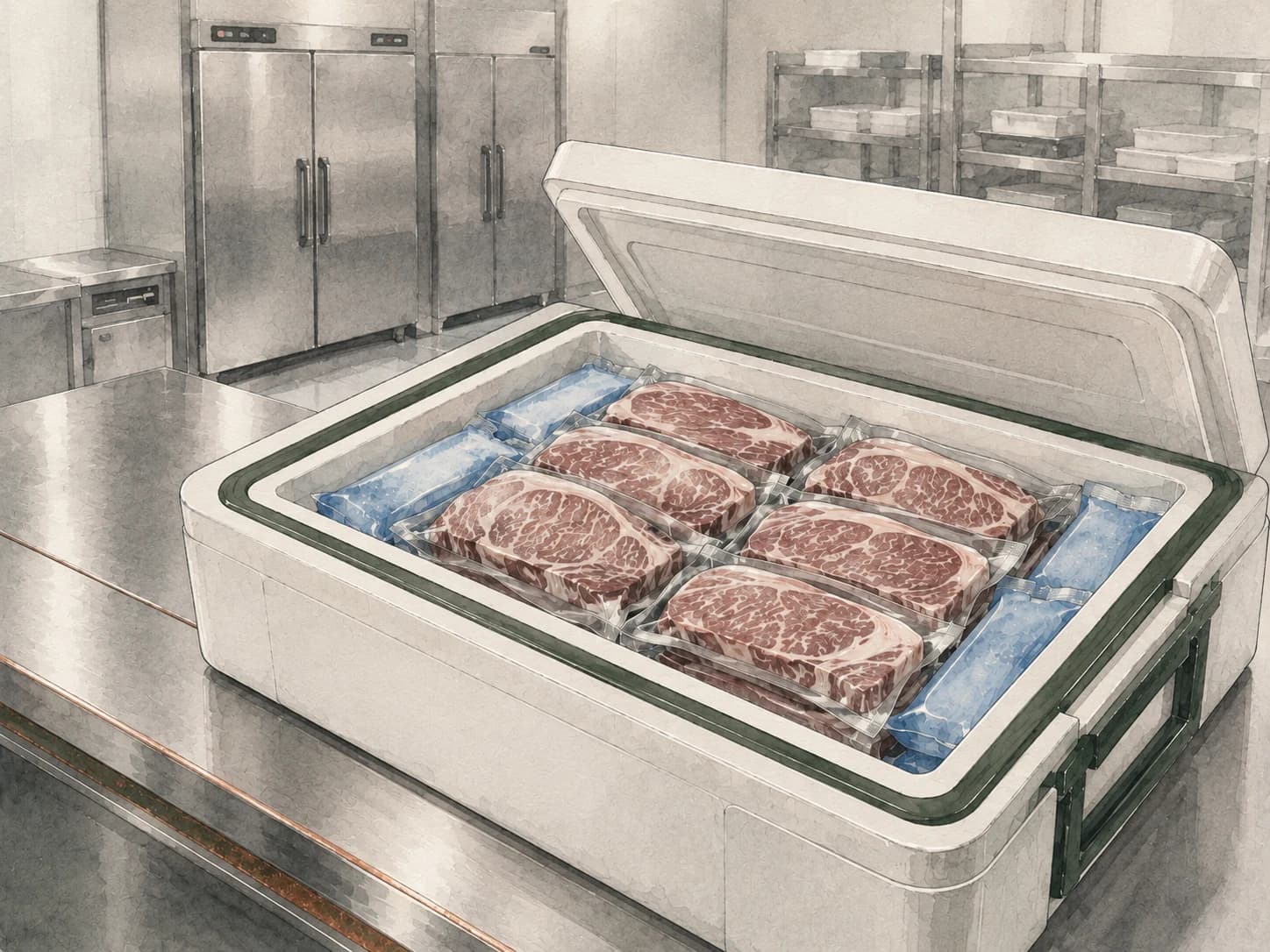
This article is about one narrow decision: how many hours each chilled Wagyu cut can tolerate between touchdown at Hong Kong International Airport and your own cold room door, and how that hour budget should decide which flight arrival slot you book the cut on. It does not re-count shelf life — for counting usable days from pack date, see the HK chilled shelf-life day count. It does not allocate how much of your year runs chilled rather than frozen — that is covered in the signal-season chilled share piece. And if what you need is a generic custody and temperature log form, the Vietnam handover custody and temperature record sheet covers that format for a different market.
Here the subject is the arrival window itself, priced per cut, so that a late-night arrival is not accepted for a cut that cannot carry it.
Scroll sideways to see the whole diagram
Why total shelf life is the wrong constraint in Hong Kong
Buyers who already import chilled Japanese Wagyu by the cut usually manage the calendar well: pack date, expected landing date, menu date. What tends to go wrong is narrower. A consignment lands inside its day count and still arrives at the cold room with a cut that has lost its chilled premium — surface darkening on a steak-ready striploin, purge in a thin-slice block, a tenderloin that now has to be sold down rather than plated.
The reason is that the day count treats the whole consignment as one object, while the airport handover does not. Between touchdown and your cold room there are several steps that each consume time unevenly by arrival slot: aircraft offload and transfer to the airline's cargo terminal, breakdown of the ULD, release processing by the handler, document checks associated with Hong Kong's import requirements for chilled beef, pickup by your broker or trucker, and the road leg to wherever your cold room actually is. Some of that time is spent in a controlled environment; some of it is not. The uncontrolled portion is what your cuts are actually paying for.
And cuts do not pay equally. A whole chilled striploin in a vacuum bag with a heavy muscle mass and limited exposed surface absorbs a few extra hours differently from portioned steaks or a thin-slice block, where the ratio of cut surface to mass is far higher and the pack is thinner. Treating both as "the same consignment" means the tolerant cuts subsidize nothing and the sensitive cuts quietly carry the loss.
The HKIA handover window ledger
The tool is a single table, one row per cut, filled in before the purchase order is issued rather than after the forwarder has booked whatever space was available. Every number in it is yours to set and verify — the point of the ledger is to make your own assumptions explicit and testable, not to import someone else's figures.
| Column | What goes in it | Where the number comes from |
|---|---|---|
| Cut and pack format | e.g. whole striploin, ribeye roll, tenderloin, chuck roll, portioned steaks, thin-slice block; vacuum pack and case format | Your PO line |
| Hours already consumed | Pack to departure: chilling, packing, domestic trucking, export handling, airport dwell before wheels up | Confirmed per shipment with your supplier and forwarder |
| Tolerable touchdown-to-cold-room hours | The hour budget you are willing to accept for this cut | Set by you, from your own QC records and your chef's or customer's acceptance standard |
| Arrival slot booked | Morning / afternoon / late-night arrival | Flight booking |
| Realistic release lag for that slot | Expected hours from touchdown to cargo released to your trucker, for that airline, handler and slot | Measured by you from past arrivals; confirmed with your broker |
| Road leg hours | Terminal to cold room, including traffic at that hour | Your trucker |
| Custody signature point | Who signs for the pallet, and where | Agreed in writing with broker and trucker |
| Surplus or deficit | Tolerable hours minus (release lag + road leg) | Arithmetic |
| Fallback decision | Accept / re-slot / split consignment / convert this cut to frozen | Your rule, applied to the deficit |
Scroll sideways to see the whole table
Setting the tolerable hours honestly
There is no published universal figure for how many hours a given Wagyu cut tolerates in an airport handover, and you should be suspicious of anyone who offers one. The variables are too local: initial core temperature at loading, vacuum pack integrity, case insulation, ambient apron conditions on the day, whether the cargo sits in a chilled holding area or on a dock.
So derive your own, in three steps.
- Measure what you already run. For the next several consignments, log touchdown time, release time, cold-room-in time and core temperature at receipt, per cut. You are not estimating; you are recording what your own lane does.
- Mark the outcomes. For each of those consignments, note which cuts were accepted at full value, which were discounted, and which were rejected or diverted to a secondary use. Your own markdown records are the most relevant evidence you will get.
- Draw the line per cut. The tolerable hour figure is the point below which your records show full-value acceptance, minus whatever margin your operation wants. Write it into the ledger and revisit it each season.
As a general matter of practice, cuts with higher exposed surface relative to mass — portioned steaks, tataki trim, thin-slice blocks — end up with shorter tolerable windows than whole primals in heavy vacuum packs. Treat that as a direction to test, not as a number to copy.
Worked example: the same consignment, two slots
The figures below are illustrative planning assumptions, not measurements. Substitute your own.
| Cut | Tolerable hours (buyer-set) | Morning slot: release + road | Result | Late-night slot: release + road | Result |
|---|---|---|---|---|---|
| Whole striploin, vacuum | 10 | 4 + 2 = 6 | Surplus 4 — accept | 7 + 2 = 9 | Surplus 1 — accept, thin margin |
| Ribeye roll, vacuum | 10 | 4 + 2 = 6 | Surplus 4 — accept | 7 + 2 = 9 | Surplus 1 — accept, thin margin |
| Tenderloin, vacuum | 8 | 4 + 2 = 6 | Surplus 2 — accept | 7 + 2 = 9 | Deficit 1 — re-slot |
| Portioned steaks | 6 | 4 + 2 = 6 | Breakeven — accept with escort | 7 + 2 = 9 | Deficit 3 — re-slot or freeze |
| Thin-slice block | 6 | 4 + 2 = 6 | Breakeven — accept with escort | 7 + 2 = 9 | Deficit 3 — re-slot or freeze |
Scroll sideways to see the whole table
The point of the example is not the hours. It is the shape of the answer: the same consignment passes cleanly on one slot and splits into accept-and-reroute on another. A buyer who books by price per kilo of freight alone never sees this split until the markdown appears.
Note also the "thin margin" rows. A one-hour surplus is not a pass in operational terms; it is a pass with no room for a delayed aircraft, a consolidated ULD shared with other importers' cargo, or a document query. Decide in advance what surplus you require before you call a row safe.
Documents, and where they sit in the clock
Document handling sits inside the handover window, not beside it. Hong Kong applies import requirements to chilled beef, including health certification from the exporting country and importer-side permissions administered by the relevant departments. Requirements and handling practice change; confirm the current position and the current forms directly with the Hong Kong authorities and with your own customs broker at the time you book, rather than relying on an arrangement that worked last season.
What matters for the ledger is procedural: a document query raised at 02:00 on a late-night arrival is generally resolved more slowly than the same query raised mid-morning, simply because fewer parties are reachable. If your lane depends on late-night slots, the practical mitigation is to have documents pre-checked and lodged ahead of arrival wherever your broker's process allows, and to agree in writing who is authorized to answer a query out of hours.
Putting the window into the PO, not the forwarder brief
The reason this ends up as a purchasing document rather than a logistics one is that the decisions it forces are commercial. Choosing a morning arrival slot for sensitive cuts can cost more in freight or restrict which flights are usable. Splitting a consignment so that the thin-slice block travels separately from the primals changes case counts and packing. Converting a cut to frozen changes its price, its menu use and its reorder cadence.
Those are all PO-level choices. Practical fields to carry into the order and the supplier conversation:
- Cut list with pack format per line, stated separately rather than as a single consignment description
- Arrival slot preference per cut, with an acceptable alternative
- Your tolerable touchdown-to-cold-room hours per cut, stated as your acceptance basis
- Named custody signature point and the out-of-hours contact who can answer a document query
- Agreed fallback per cut if the booked slot is missed: re-slot, split, or convert to frozen
- Temperature recording expectation at handover, and who reads the record
Lead times, pack formats, split-shipment arrangements and document sets are confirmed per shipment rather than assumed. Sample availability and terms are confirmed per inquiry.
Reviewing the ledger
A handover window ledger is not a one-time exercise. Release lags shift with airline schedule changes, handler contracts, seasonal cargo volume and whether your consignment is consolidated with other importers' freight. Re-measure the release lag column at least once a season, and immediately after any change of airline, handler, broker or cold room location — a move from an on-airport facility to a cold room in Kwai Chung or the New Territories can change the road leg materially, and every row's surplus changes with it.
Keep the markdown record alongside it. The ledger earns its place only if the deficits it predicts correspond to the losses you actually see, and the surpluses to the consignments that land clean.
Discuss your requirements
If you complete the ledger for your current cut mix, the result is most of what is needed to quote landed chilled terms per cut: the cut list with pack formats, your arrival slot preference, your tolerable handover hours and your fallback rule. Send it with a wholesale quote request and cut mix, pack format and flight slot can be priced together rather than separately. Discuss your requirements.