
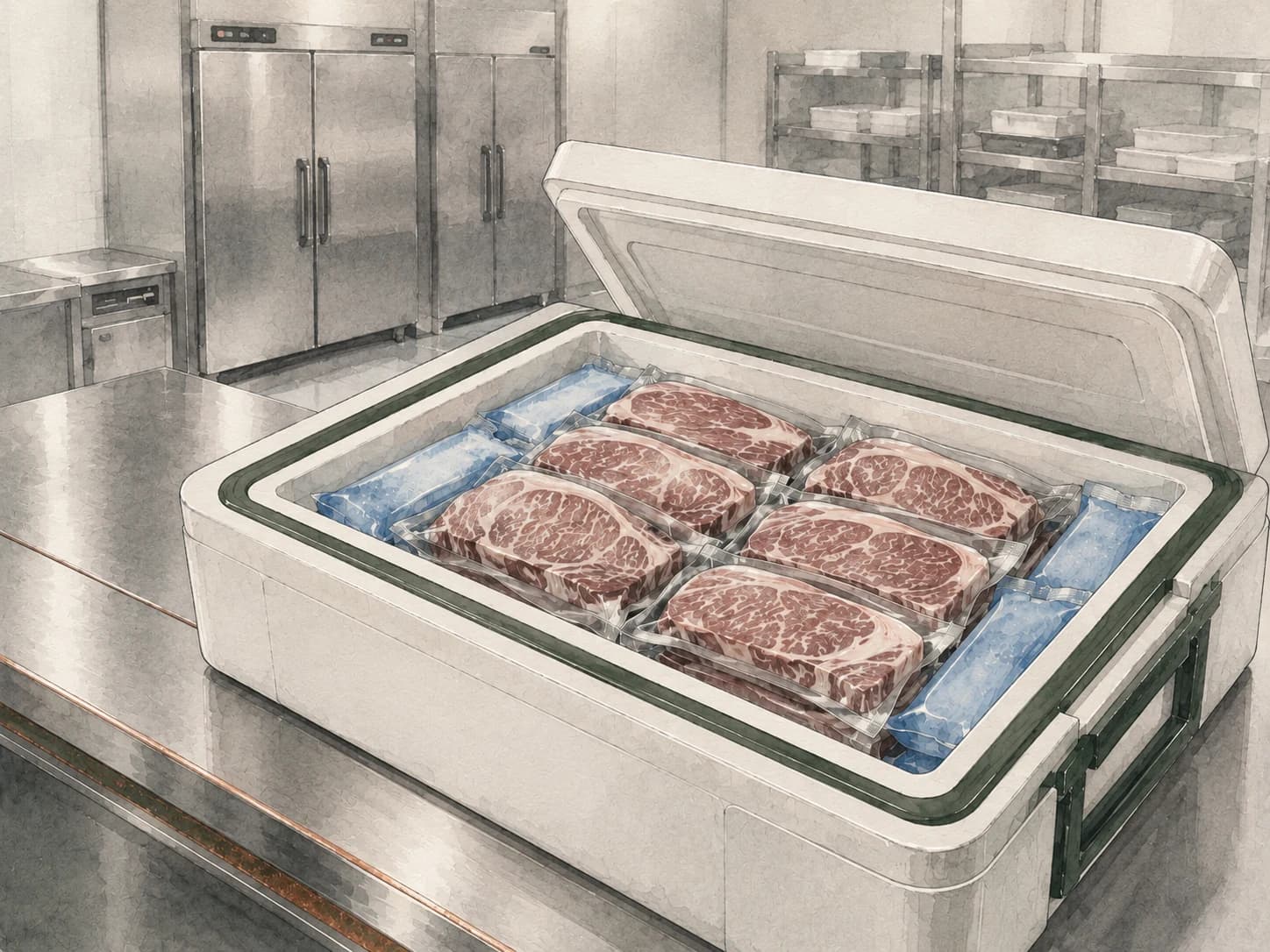
This article is about one variable: what happens to a chilled wagyu arrival when a tropical cyclone or black rainstorm signal suspends last-mile delivery in Hong Kong, and how to decide — before the May–October season starts — which cuts you order chilled and which you pre-position frozen. It is a seasonal allocation question, not a storage question.
If what you actually need is the number of usable days a normal chilled arrival gives you, that is covered in the chilled wagyu shelf-life day count. If you are setting how often to reorder across a cut mix, see cut mix and reorder cadence. If the open issue is whether a delivered piece matches the weight written on the PO, see cut weight tolerance and PO acceptance. Those three assume the box arrives on the day the PO says. This one assumes it sometimes does not.
The calendar risk most buyers have not connected to wagyu
Hong Kong operators plan banquets and covers weeks ahead. Chilled Japanese beef arrives by air into HKIA and moves by road to the hotel or the distributor's cold room. Every step after the aircraft doors — terminal handling, bonded trucking, the loading dock at your property, and the kitchen staff who would receive it — depends on the city running normally.
When the Hong Kong Observatory hoists a higher tropical cyclone warning signal or a black rainstorm warning, that normality stops in a staggered way: some staff are released, some roads become unusable, some receiving docks close. The precise operational effect on air cargo terminal handling and on bonded trucking differs by operator and by signal level, and it changes. Verify with your own forwarder and terminal handler what their stated suspension and resumption policy is, and confirm current signal definitions directly with the Hong Kong Observatory rather than relying on recollection from a previous season.
The wagyu consequence is specific. A frozen carton that sits one extra day in a terminal loses nothing you can taste. A chilled striploin that was already partway through its usable life when it landed loses a day it cannot get back — and then another, if the signal falls on a Friday and your receiving dock does not reopen until Monday. The loss is not the signal. The loss is that the cut was ordered chilled without asking what a suspension would cost that particular cut.
Why the decision has to be per cut, not per order
Two things differ across the cut list, and they pull in opposite directions.
First, remaining shelf life on arrival is not uniform. Primal loin pieces in intact vacuum packaging behave differently from portioned or trimmed items, and anything opened or re-packed resets the clock. In our handling experience (an operational observation, not a measured study), the cuts that get cut down fastest on arrival are also the cuts with the least tolerance for a delayed delivery.
Second, the plate difference between chilled and properly frozen wagyu is not uniform either. For a banquet application — sliced for shabu-shabu, portioned for a plated set menu, carved at volume — a correctly frozen and correctly thawed cut generally holds up in a way most of your guests will not distinguish. For an à la carte steak program where the kitchen is selling the cut on its own merits, the operator usually will not accept the same substitution.
Put those together and the rule falls out: the cuts that lose the most from a suspension (short remaining life, à la carte, thin margin per plate) are exactly the cuts where you have the least flexibility to go frozen. That tension is the thing to resolve in advance, with numbers, rather than in a panic on the morning the signal goes up.
The Signal-Season Chilled Share Worksheet
Build this once per cut, before the season. One row per cut you buy. Six columns.
- Remaining usable days on arrival (D). Take it from your own goods-in records for the last several consignments of that cut, not from a general figure. Measure from the moment it is signed for at your dock to the last day your chef will plate it.
- Covers per week using that cut (C). Your own forecast, split between banquet and à la carte.
- Frozen-acceptable share of those covers (F%). Decide this with your executive chef, in writing, before the season. For most operators this is high for banquet and set-menu covers and low or zero for à la carte steak.
- Suspension days observed (S). Count, from your own delivery logs, how many scheduled delivery days in each of the last three May–October seasons were lost or pushed because of a signal. Your own log is better evidence here than any citywide average, because it reflects your dock, your trucker, and your receiving hours.
- Exposure ratio (S ÷ scheduled delivery days in the season). This is the share of your chilled arrivals that historically met a suspension.
- Chilled share recommendation. Work it as: chilled share ≤ (1 − F%), then reduce further for any cut where D is short enough that losing two consecutive days would push it past service. Everything else goes frozen and gets pre-positioned.
Two outputs matter more than the split itself.
Latest safe arrival weekday. For each chilled cut, work backwards: first service day for that cut, minus the days you need for tempering, portioning and mise en place, minus one buffer day for a suspension that lands on the delivery date. If that calculation puts the arrival earlier than your supplier can realistically ship into, the cut should not be chilled during signal season. Avoid scheduling chilled arrivals so that any delay pushes receiving into a weekend when your dock is thinly staffed.
The fallback line. Write, per cut, what happens when an arrival lands inside a suspension. Which cut gets held back from the menu, which frozen item replaces it, who authorizes the swap, and at what hour the decision is made. A chilled loin landed on the morning a high signal is hoisted is not automatically a write-off — but it becomes one if nobody has pre-decided that it goes to the staff canteen, to a braised preparation, or into a secondary menu line that same week.
What to verify before you commit the season's plan
- Your forwarder's and terminal handler's suspension policy, in writing, including how quickly cargo moves after resumption and where your consignment physically sits in the interim.
- Your own receiving hours under signal conditions. Many write-offs come from the property side, not the import side.
- Current import documentation for chilled and frozen Japanese beef into Hong Kong. Requirements for health certification and import permits are set by the Hong Kong authorities and can change; confirm the current position with the Food and Environmental Hygiene Department and with your customs broker at the time you place the order, rather than assuming last season's paperwork still applies.
- Your frozen holding capacity. A frozen-forward allocation only works if you have the freezer slots to pre-position it. Count the slots before you count the cartons.
Getting the split priced
The worksheet ends with a number per cut: this much chilled, this much frozen, arriving by this weekday. That number is only actionable once you know whether a supplier can ship that mixed split, and what each cut costs landed in each format across the season. Those two answers change the split — sometimes a cut you planned to keep chilled is cheap enough frozen to justify moving the whole banquet volume across.
Bring your per-cut sheet and request a wholesale quote priced per cut for both chilled and frozen formats across the May–October window. Quote the volumes as you intend to order them — per cut, per format, per arrival week — so the price you compare is the price you will actually pay.