
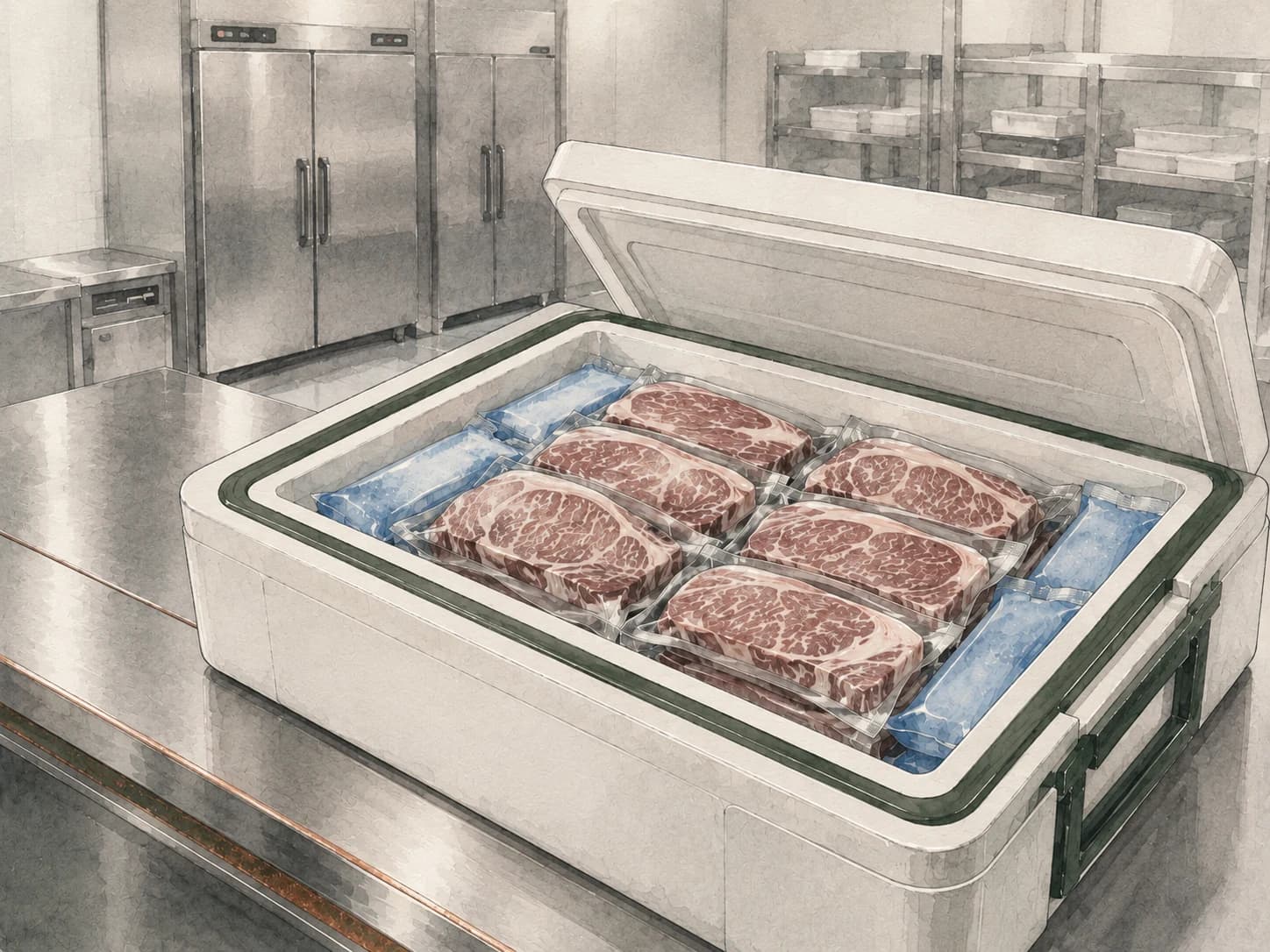
If you run a hotpot or shabu-shabu line in Taiwan, your beef decision is not really a beef decision. It is a block decision. The slicer — whether it sits in your own back-of-house or at a third-party processor — accepts a frozen block of a certain cross-section, at a certain core temperature, and returns slices of a certain thickness with a certain amount of torn, folded, and end-trim loss. Origin is chosen after that constraint, not before it.
This article covers that constraint for Japanese Wagyu: block cross-section and usable length per cut, the tempering window at the slicer, slice thickness that holds together at 1.2–1.8 mm, and how to convert a kilo price into a cost per eight-slice cover. It is written for buyers who currently run Australian or US beef on that line and have never costed Wagyu for it.
Neighboring articles handle adjacent questions. If your question is plated steak-cut portioning per cover in a banquet course, that is a different format and it is covered in the banquet course slot article. If you are weighing residual shelf days on chilled air freight, see the chilled day-loss ledger — it does not apply here, because thin-slice lines take frozen blocks by design. And if your open question is how to divide one shipment between parties rather than what physical block to order per cut, use the split-or-single consignment worksheet.
Thin-slice is a frozen business, and that changes which cuts matter
A steak program and a thin-slice program want opposite things from a carcass. A steak menu wants cuts that hold a thick portion and cook on a hot surface without falling apart: striploin, ribeye, tenderloin. A thin-slice line wants cuts that freeze into a dense, uniform rectangular solid, slice cleanly across the grain, and release their fat in hot broth within seconds.
That reverses the usual hierarchy. Cuts that struggle on a steak menu — chuck roll, chuck eye log, short plate, brisket point, top blade — are often the better choice for thin slicing. They carry intramuscular and seam fat that behaves well in broth, their muscle structure is more forgiving at 1.2–1.8 mm than a very lean cut, and they are usually priced below the steak-primal cuts that drive the headline Wagyu kilo figure.
Two consequences follow. First, comparing Wagyu to your current import on the basis of striploin kilo price answers a question you are not asking. Second, the cut that wins on your line depends on your slicer's achievable cross-section, so the spec has to be written before the cut is chosen.
The five block variables that decide everything downstream
Before any cost work, write down what your slicer actually requires. Most disputes about Wagyu thin-slice performance trace back to one of these five being left unstated on the purchase order.
- Block cross-section (mm × mm). This sets your slice face area, and therefore slice weight at any given thickness. A slicer set up for a 100 × 80 mm face produces a very different slice count per kilo than one running 120 × 60 mm.
- Usable block length. Every block loses both ends — the first face is uneven, and the last piece is too short for the carriage to hold. Shorter blocks mean the same end loss spread over fewer slices.
- Tempering state at the slicer. A block that is too hard shatters and produces crumbs; too soft and the slice stretches, folds, and loses thickness control. Each cut and each machine has its own usable band.
- Frozen-state delivery, with no re-forming. If a block is thawed and re-frozen, or pressed into shape from trim, slice integrity and drip behavior change regardless of the original cut quality.
- Grain orientation in the block. The block must be formed so the slicer cuts across the muscle fiber, not along it. This is a specification item, not something the slicer can fix later.
None of these are exotic requests in principle, but whether a given cut can be produced to a given cross-section, and in what minimum quantity, is confirmed case by case. Treat the spec sheet below as the question you put to the supplier, not as an assumed answer.
The Thin-Slice Block Spec Sheet, cut by cut
Use one row per candidate cut. Fill the first three columns from your own slicer's capability and your menu, and ask for confirmation on the rest. The values are not published constants; they are what you measure once and then reuse for every costing.
| Column | What goes in it | Where the figure comes from |
|---|---|---|
| Cut | Chuck roll, chuck eye log, short plate, brisket point, top blade, striploin end | Your shortlist; confirm availability per cut with the supplier |
| Target block cross-section | Width × height in mm at the slice face | Your slicer's carriage and your target slice weight |
| Usable block length | Length in mm, excluding both end faces | Measured on blocks you already run |
| Tempering window | Core temperature band in °C at which this cut slices cleanly | Measured in your own trial with a probe; machine-specific |
| Slice thickness achieved | mm, with the tear rate you accept at that setting | Counted on the trial run |
| End trim and broken-slice loss | Percent of block weight that does not reach the plate | Weigh rejects and trim from the trial block |
| Slices per usable kilo | Count at each thickness you offer | Calculated — see the worked method below |
| Cost per cover | Your landed cost per kilo divided across slices, times slices per cover | Calculated — see the worked method below |
Scroll sideways to see the whole table
Converting kilo price to cost per cover
This is the step that changes how Wagyu looks on a hotpot line, and you can run it today with your current beef before you ever request Wagyu figures. Work in this order, using your own numbers:
- Slice weight. Multiply the block face area (width × height, in cm) by slice thickness (in cm) by beef density. Using 1.05 g/cm³ as a working density for lean-and-fat beef is close enough for procurement arithmetic; a 10 × 8 cm face at 0.15 cm thickness gives 12 cm³, so roughly 12.6 g per slice.
- Gross slices per kilo. Divide 1,000 g by your slice weight. At 12.6 g, that is about 79 slices.
- Apply loss. Subtract your measured end-trim and broken-slice percentage. If your trial shows 8 percent total loss, you have about 73 saleable slices per kilo. Use your own measured figure here — loss varies by cut, machine, and operator, and a borrowed number defeats the purpose of the exercise.
- Cost per slice. Divide your fully landed cost per kilo — product, freight, duty, clearance, cold storage, and slicing fee if a third party does it — by saleable slices.
- Cost per cover. Multiply by slices per portion. An eight-slice cover at the example above consumes roughly 110 g of saleable product, or about 119 g of block input once loss is counted.
Run this twice: once for the beef you buy now, once for each Wagyu cut you are considering, using quoted landed figures rather than list prices. The comparison you get is between two cost-per-cover numbers on the same line, which is a different and more useful number than the kilo-price gap. Quote currency and landed figures are confirmed per inquiry, since product pricing and exchange rates move month to month.
Why the gap narrows
Three structural reasons, none of which require you to believe anything about Wagyu marketing. First, you are comparing a non-steak Wagyu cut against a premium steak-primal import, so the kilo-price starting points are closer than the headline suggests. Second, a cut with more intramuscular fat can often be served in a smaller gram weight per cover at the same perceived richness, which shifts the arithmetic in step five. Third, a block specified to your slicer's exact cross-section wastes less than a standard primal pack that has to be squared off before it fits the carriage.
Whether those three add up to something inside your accepted price band is a question only your own worked sheet answers. Some lines will find the gap still too wide for a full menu listing but workable for a premium tier or a seasonal set.
Purchase order wording that locks the block
Most thin-slice failures attributed to the beef are actually specification failures. The following fields are the ones worth writing explicitly. Whether each can be met for a given cut, volume, and shipping route is confirmed case by case — treat this as the text you negotiate against, not a guaranteed standard.
- Cut and grade stated per line item, not as a general description.
- Block cross-section in mm × mm with your accepted tolerance in both directions.
- Minimum usable block length in mm, stated as a minimum rather than a nominal figure.
- Grain orientation relative to the slice face, stated in words.
- Delivered frozen, never thawed and re-frozen, not re-formed or pressed from trim.
- Packing that keeps block geometry intact — no deformation under stacking in the container.
- Documentation set required for Taiwan clearance, listed by name, with the party responsible for each.
- Lot and traceability marking readable on the individual block, not only on the carton.
On the last two: import eligibility, documentation, and any facility- or prefecture-level conditions for Japanese beef entering Taiwan change over time, and the current requirements should be confirmed with the Taiwanese authorities and your customs broker before you commit to a purchase order. Do not carry forward a document list from a shipment of a previous year.
Running one trial that actually tells you something
A spec table cannot tell you how a particular cut behaves on your particular machine. Tempering behavior, tear rate, and the point at which slices start folding are properties of the cut, the blade, the carriage speed, and the operator together. One controlled trial produces more usable information than any amount of comparison reading.
A trial worth running looks like this: two or three candidate cuts, each delivered as a block at the cross-section you stated, sliced on your own line at your normal settings, with core temperature probed and logged at the moment of slicing. Weigh end trim and rejected slices separately from good slices. Count slices per block. Record the thickness setting and spot-check actual thickness with a caliper, because the setting and the result diverge as the blade dulls.
That gives you three of the spec sheet columns as measured values rather than estimates, and those three feed every costing you do afterward. Sample availability and terms are confirmed per inquiry.
Review schedule
Block geometry, tempering windows, and slice-thickness feasibility are physical processing characteristics that change slowly; re-measure when you change machines, blades, or cut, and otherwise review annually. Cost per cover changes far faster, because landed cost moves with product pricing, freight, and exchange rates — refresh those inputs each time you reprice the menu. Taiwan import conditions for Japanese beef should be re-checked at every annual review and before any new purchase order.
Next step
If you want to put candidate cuts and your slicer's cross-section in front of us and see what can be produced to that spec, Discuss your requirements. Tell us the cut shortlist, the block cross-section and minimum length your line needs, your target slice thickness, and your monthly volume, and we will work through what is feasible per cut.