
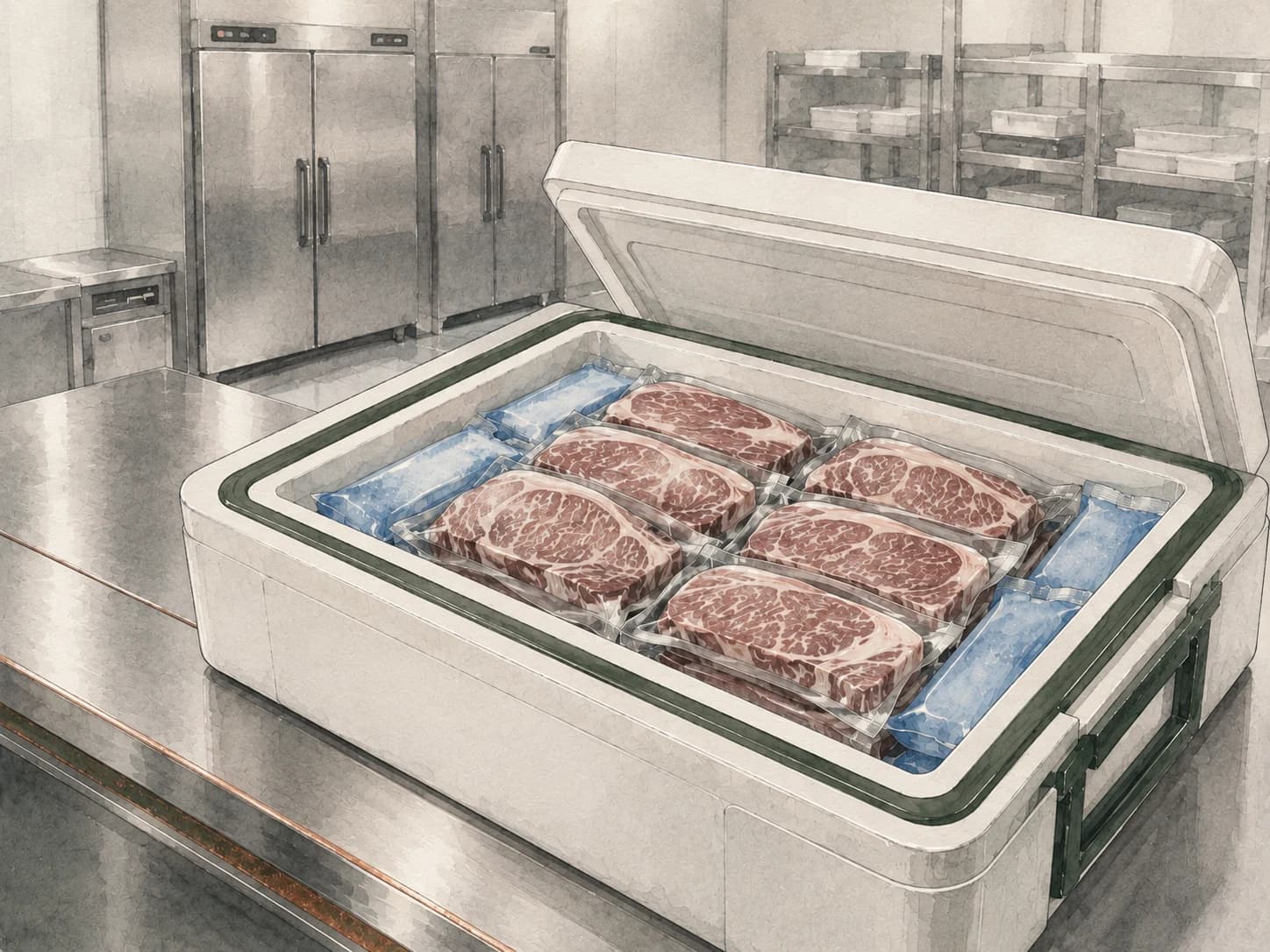
Your chilled Japanese Wagyu lot clears at LAX, JFK, or ORD. Within a few hours someone decides whether it sits at a port-adjacent public cold store and gets broken down there, or moves intact to your inland DC and gets broken there. In most US importer and restaurant-group operations, that decision is not made by the buyer who owns the PO. It is made by a broker or 3PL on standing instruction, and the buyer meets it later as a handling line on an invoice. This article treats that first-mile routing step as a decision variable you set per cut before the flight lands, and scores it in remaining chilled days and handling touches rather than freight dollars alone.
Three neighboring pieces sit on either side of this one. If the lot arrived with a temperature or condition exception, start with the arrival deviation triage ledger, because routing is irrelevant until the exception is resolved. If your problem is that quoted price per kilo does not match what you can actually sell per pound, that conversion is handled in the quoted-kilo-to-sellable-pound ledger. And once you are physically splitting the lot, label and lot identity matching belongs to the cut-to-lot split sheet. This article covers only the step between them: an intact, non-deviated chilled lot, and where it should be broken.
Scroll sideways to see the whole diagram
Why a single routing rule quietly costs you days
Most US buyers of Japanese Wagyu operate on one default. Either everything goes inland intact because the DC is where the pick-and-pack systems live, or everything breaks at the port because the first customer is local. Both defaults are defensible as policy and wrong as arithmetic, because the cuts inside one PO do not share the same clock.
A striploin or ribeye going into a weekly steak feature turns fast. Every day it spends in transit or in a holding bay is a day subtracted from the window in which your customer can merchandise it. A tenderloin reserved for a banquet eight days out does not benefit from arriving one day earlier; it benefits from being handled once rather than twice. Chuck or trim bound for a grind or secondary program is even less day-sensitive, and the cost of an extra break-and-repack event is the dominant term.
So the honest unit of account is not "what does the port cold store charge per pallet." It is: for this cut, how many remaining chilled days does the customer have at the moment of first sale, and how many times did the carton get opened to get there. Freight and storage costs still matter, but they are second-order next to a cut that reaches the customer with a third of its window already spent.
The two options, stated precisely
Port break. The lot moves a short distance to a port-adjacent cold store, the pallet is broken, cartons are separated by destination, and the fast-turning cuts ship to the first customer directly from there. The remainder is re-palletized and forwarded inland. You buy earliness for the cuts that need it, and you pay with one extra handling event for everything else in the lot.
Intact inland. The whole lot moves as received to your own DC, where it is broken once, inside your own systems, with your own labeling and inventory capture. You buy single-touch handling and clean record-keeping, and you pay with the inland transit days applied uniformly to every cut, including the ones that are losing merchandising window by the hour.
There is a third call worth naming explicitly, because buyers often reach it only by accident: split. Part of the lot breaks at the port, part continues intact. This is only available if the supplier packed the lot so the port-break cuts are separable at carton level without opening the inland-bound cartons. That is a packing instruction, not a logistics decision, and it has to be set before the lot is built.
The First-Mile Routing Ledger
One row per cut in the PO. Fill it before the flight lands, not after. The point is to hand your broker a decided rule rather than receive their default.
| Column | What goes in it | Where it comes from |
|---|---|---|
| Cut and carton count | Cut name, grade, number of cartons, weight | PO and packing list |
| Arrival date | Date the lot is available after clearance | Forwarder flight plan |
| Label chilled end date | The end-of-window date shown on the carton or supplier spec | Supplier label and spec sheet |
| Days consumed — port break | Short move, break, re-palletize, outbound to first customer | Your own measured timings |
| Days consumed — intact inland | Inland transit, receipt, break at DC, outbound | Your own measured timings |
| Handling touches | Count of times the carton is opened or the pallet rebuilt, per option | Count them, do not estimate |
| Re-label / repack events | Whether a new label or repack is created outside your DC | Your split sheet procedure |
| First-customer ship date | Earliest realistic outbound date under each option | Sales calendar |
| Remaining days at first sale | Label chilled end date minus first-customer ship date | Calculated, per option |
| Routing call | PORT BREAK / INTACT INLAND / SPLIT | Decided by the two rows above |
Scroll sideways to see the whole table
How to fill it without guessing
The ledger only works if the day counts are yours. Do not import an industry average. Build the numbers this way:
- Take the last three to five chilled shipments you received. For each, write the actual date the lot became available after clearance and the actual date the first carton of each cut shipped to a customer. The gap is your real days-consumed figure, including the waiting you do not usually count.
- Separate transit from dwell. A lot that sits two days waiting for a scheduled inland truck has consumed two days just as surely as one in motion. Record them separately so you can see which is fixable.
- Count touches physically. Walk one lot through both paths on paper, listing every event where a pallet is rebuilt or a carton opened. Most buyers find one more touch in the port-break path than they assumed, and one more in the inland path too, usually a cross-dock nobody mentions.
- Read the label window as a date, not a duration. Chilled Wagyu cartons carry a supplier-set end-of-window date. Work from that printed date rather than from an assumed number of days, because the date already accounts for the production and packing timeline you cannot see. If the convention used on your supplier's labels is unclear, ask them to state it in writing on the spec sheet.
- Compute remaining days at first sale per cut, per option. This single number is the output. A cut that lands with a comfortable window and sells in four days does not need the port; a cut that lands tight and sells immediately may lose half its usable window inland.
In our own handling experience — this is operational observation rather than measured study — the spread between the two options is usually small for cuts that sell slowly and large for cuts that sell on arrival week. That is exactly why a per-PO rule underperforms a per-cut rule: the average hides the cuts where the difference is real.
Reading the ledger into a call
Three patterns cover most lots.
Port break when the cut has a near-term committed customer in the entry region, the remaining-days figure under the inland option is materially worse, and the extra handling touch does not create a labeling problem you cannot control. Striploin and ribeye for weekly features land here most often.
Intact inland when the cut is spec-sensitive, when the first sale is far enough out that earliness buys nothing, or when any re-labeling outside your own facility would complicate your lot identity records. Tenderloin held for banquet dates and chuck or trim for secondary programs land here.
Split when both patterns appear in the same lot and the packing allows separation without opening inland-bound cartons. If the packing does not allow it, split is not a real option this time — note it and fix it on the next PO rather than improvising at the cold store.
Add one trigger to the sheet: re-check if arrival slips by more than one day. A routing call built on a Tuesday arrival can be wrong for a Thursday arrival, because the first-customer ship date usually does not move with the flight. Make the re-check automatic so the broker does not execute a stale instruction.
What stays outside this sheet
Deliberately, several things. Freight rate comparison between cold store operators is a procurement exercise, and running it inside this ledger will pull the decision back toward dollars per pallet. Vendor selection for 3PLs is a separate question. And the moment a lot arrives with a temperature or condition exception, this sheet stops applying — that lot goes to deviation triage, and routing is reconsidered only once the disposition is settled.
One more boundary worth stating: this sheet decides where the lot is broken. It does not decide how the resulting pieces are identified against lot and label records. Keep that in the split sheet, and keep the two documents cross-referenced by lot number so an auditor can follow one lot through both.
The part only the supplier can close
Once the ledger is filled, the open item is almost always upstream. A split call requires that the port-break cuts be packed and labeled so they are separable at carton level — the right cuts in the right cartons, marked clearly enough that a cold store crew can pull them without opening anything bound inland. Arrival-date targeting matters too: a lot built to land early in your selling week behaves differently from the same lot landing on a Friday, and that is set when the shipment is booked, not when it arrives.
Those are packing and cut-mix questions, and they are answered on the export side. If you want to set carton-level separation and arrival-date targeting for a specific PO and cut mix, discuss your requirements with us: Discuss your requirements. Sample availability and terms are confirmed per inquiry.