
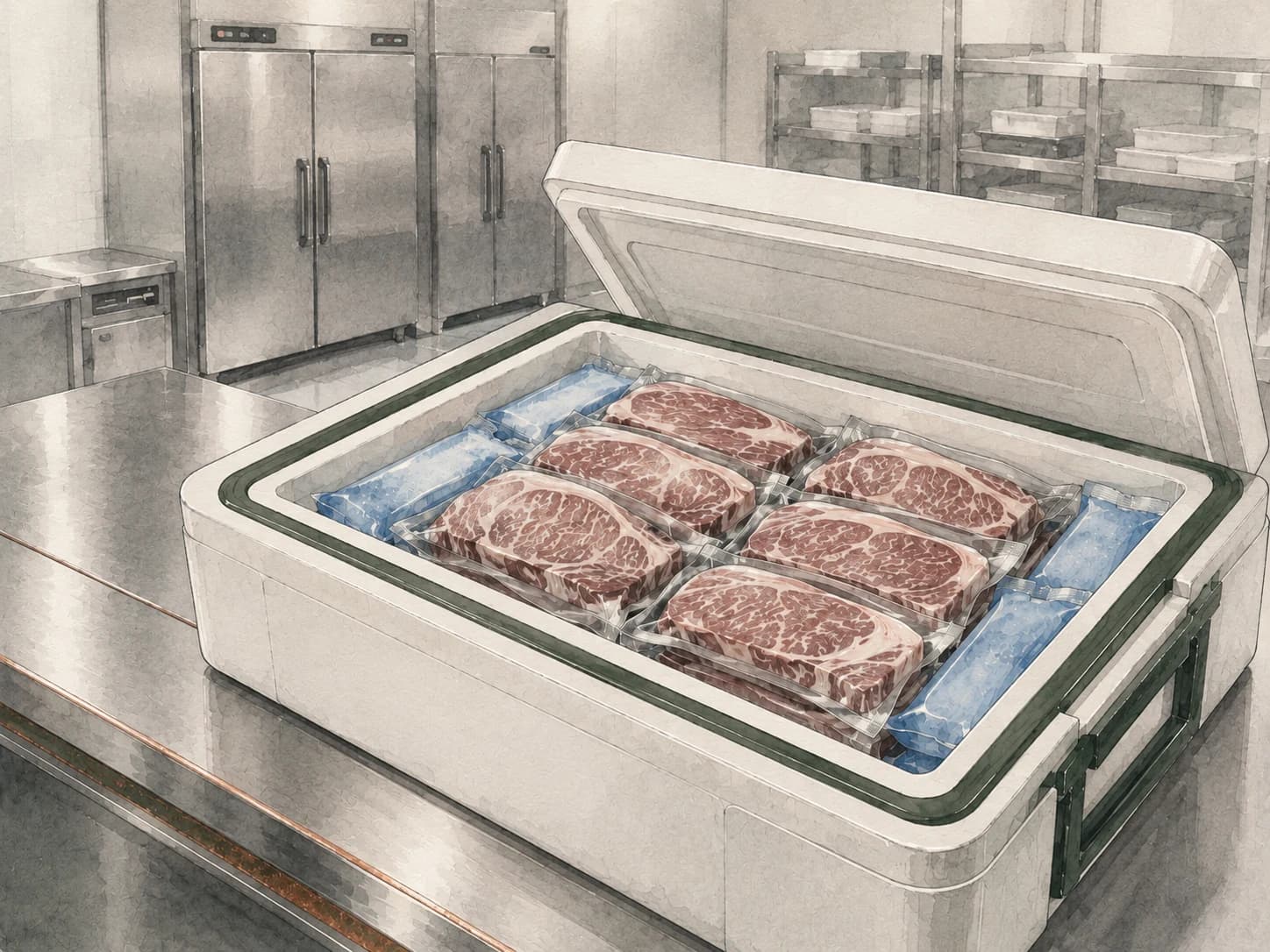
This article is for the Vietnamese operator whose imported premium beef line is not producing the gross margin the menu engineering promised, and who has not yet decided whether Japanese Wagyu belongs in the mix at all. It gives one calculation — earnings per freezer slot per day — and shows where a single Wagyu cut would and would not improve that number.
It deliberately stops short of the import mechanics. If you have already decided to bring product in, the paperwork side is covered elsewhere: HS code and customs valuation for the import dossier, permit lead time counted in working days, and handover custody and temperature records at receipt. Nothing below asks you to import anything. The output is a slot-level margin comparison you can run on stock you already hold.
The limiting resource is not the purchase price
Most premium beef programs in Ho Chi Minh City, Hanoi, and Da Nang are reviewed on landed cost per kilo. That is the wrong denominator for a multi-outlet kitchen, because the scarce thing is not money per kilo — it is a chilled or frozen position that is paid for every day whether it moves or not.
Two SKUs can have identical gross margin percentages and produce completely different results. A cheaper cut that sits 40 days before the carton is depleted ties up a slot for 40 days. A more expensive cut that clears in 12 days releases the same slot more than three times in the same period. Per kilo, the cheap cut may look better. Per slot-day, it usually does not.
This matters more in Vietnam than in some neighboring markets because of the currency mismatch. You buy in USD and sell against a VND menu price that you cannot reprice weekly. A slow slot does not just cost storage; it holds an FX position you did not intend to take. The faster a slot turns, the less exposed each purchase is to a rate you cannot control.
The Freezer Slot Earnings Worksheet
Build this as one row per premium beef SKU you currently hold. Use your own numbers only — do not use anyone's published benchmark, including ours, because trim practice and cover counts differ too much between operations for a benchmark to mean anything.
Block A: what you hold now
- SKU and cut name. One line per cut, per grade, per chilled/frozen state. Do not merge chilled and frozen versions of the same cut; they behave differently.
- Landed cost, VND per kilo. Invoice price converted at the rate you actually paid, plus freight, duty, clearance, and inland delivery. If you buy on consignment from a distributor, use the transfer price you are invoiced.
- Slot footprint. How many cartons of this SKU sit in storage at a normal reorder point, and what fraction of one pallet position that occupies. If you store in-house, express it as a share of your total usable cold volume instead.
- Days held to full depletion. From the date the carton enters your cold store to the date the last portion is sold. Pull this from four or five past cartons and take the longest, not the average — the longest is what sizes your slot requirement.
- Saleable portions per kilo after trim. Weigh what actually reaches the plate. Trim, fat cap removal, and end pieces come off here. If offcuts go to a second menu line, count them separately in step 7 rather than inflating this number.
- Menu price per portion, VND, net of VAT and service charge. Use the price that actually appears on the check at the outlet that sells the most of this cut.
- Secondary recovery per kilo, VND. What offcuts and trim earn, if anything. Enter zero if they are discarded. Be honest; an assumed recovery that never happens is the most common reason a slot analysis flatters a weak SKU.
Block B: the calculation
For each row:
- Revenue per kilo = (portions per kilo × menu price per portion) + secondary recovery per kilo
- Gross margin per kilo = revenue per kilo − landed cost per kilo
- Margin per carton = gross margin per kilo × kilos per carton
- Margin per slot-day = margin per carton ÷ days held to full depletion ÷ slot footprint in pallet positions
The last line is the number that ranks your SKUs. Sort the rows by margin per slot-day, worst at the top. In our handling experience with multi-outlet buyers, the ranking by this measure is rarely the same as the ranking by gross margin percentage — and that reordering is the whole point of the exercise. That observation is from our own dealings with buyers, not a measured study.
Block C: the candidate Wagyu cut
Now add one row for a single Japanese Wagyu cut you might test. Fill it the same way, with three differences:
- Landed cost is a quoted range, not a guess. Ask for the price of the specific cut, grade, and chilled-or-frozen state you would actually order, at the volume you would actually order. A per-kilo number pulled from a general price list will not survive contact with your own worksheet.
- Days to depletion is derived from cover counts, not from hope. Estimate how many portions of this cut the outlet realistically sells per week — not at launch, but in week six — and divide the carton's portion yield by that figure. If you cannot name the outlet and the weekly cover count, you do not have an input; you have a wish.
- Portions per kilo should assume conservative trim on your first carton. Kitchens cutting an unfamiliar premium cut for the first time typically lose more than they will after a month of practice.
The three-line decision rule
Compare the candidate row against your existing rows:
- Replace — if the candidate's margin per slot-day beats your worst existing row and the cover count you assumed is one the outlet already fills with a comparable premium item. You are swapping a weak slot, not adding storage.
- Add — if the candidate beats your median row and you have a genuinely empty slot, with no new storage cost. If the slot is not empty, this is a replace decision wearing a disguise.
- Do nothing — if the candidate only wins on gross margin percentage but loses on margin per slot-day, or if the assumed cover count is above anything that outlet has ever achieved for a premium beef line. Adding it would give you another slow SKU with the same problem.
Most honest worksheets produce "do nothing" for several cuts and a clear "replace" for one. That is a useful result. A Wagyu cut that fails your own slot test should not go on a standing order, and we would rather you found that out on a spreadsheet than on a pallet.
Where a Wagyu cut tends to help, and where it does not
The slot-day frame makes the pattern visible without needing any claim about Wagyu's superiority.
It helps when the slow slot is slow because of price ceiling, not demand. If an outlet sells its premium beef steadily but the menu price is capped by how the cut is perceived, a cut with a higher achievable price per portion clears the same volume of covers at a higher margin, with the same days held. The slot-day figure rises on the numerator alone.
It helps when portion size falls. Richly marbled cuts are generally served in smaller portions than lean imported steak cuts. More portions per kilo means more revenue per carton and fewer days to depletion for the same cover count — the number improves on both sides of the division at once. Check this against your own kitchen's intended portion weight before relying on it.
It does not help when the slot is slow because covers are missing. If the outlet simply does not have enough guests ordering premium beef, a higher-priced cut sits longer, not shorter. Days held goes up, and margin per slot-day falls even though margin per kilo rises. No cut fixes an empty dining room.
It does not help when trim discipline is weak. The gap between theoretical and actual portions per kilo is wider on premium cuts because the raw material is worth more. If your worksheet shows a large unexplained gap on existing SKUs, close that first; a more expensive cut will widen the same leak.
It does not help if you need to open a new slot for it. The whole argument rests on taking a position that is already paid for. A cut that requires new third-party cold storage carries that cost in its denominator and usually loses.
Inputs that move, and what to do about them
Three inputs in this worksheet change on their own schedule and should be re-entered rather than memorized:
- The USD/VND rate. Use the rate on your own settlement, not a headline rate. Re-run the worksheet if the rate moves enough to change the ranking of your bottom two rows.
- Import duty treatment. Japanese beef entering Vietnam may fall under more than one preferential schedule depending on origin documentation and tariff line. Tier structures and eligibility conditions change; confirm the currently applicable treatment with Vietnamese customs authorities or your licensed broker, and confirm again at the time of quotation. Do not carry a duty figure forward from a previous shipment without checking it.
- Wholesale price bands. These move with supply, grade availability, and the chilled-versus-frozen decision. That is exactly why Block C takes a quoted range instead of a printed number.
Everything else in the worksheet — slot turnover, yield after trim, cover counts — is structural. It will still be valid next year.
Bring the filled worksheet
You cannot finish Block C without a real per-cut price, and that price depends on the specific cut, the grade, whether you want chilled or frozen, and your order volume. There is no useful generic answer.
So finish Blocks A and B on your own stock first. Identify your worst-performing slot and the one or two cuts you would test against it. Then request a wholesale quote for exactly those cuts, at the volume and format you would actually order, and tell us which slot they are competing with. We quote the cuts you listed, so the number drops straight into the row you have already built.
If the worksheet then says "do nothing," that is a legitimate outcome, and it cost you a spreadsheet rather than a container.