
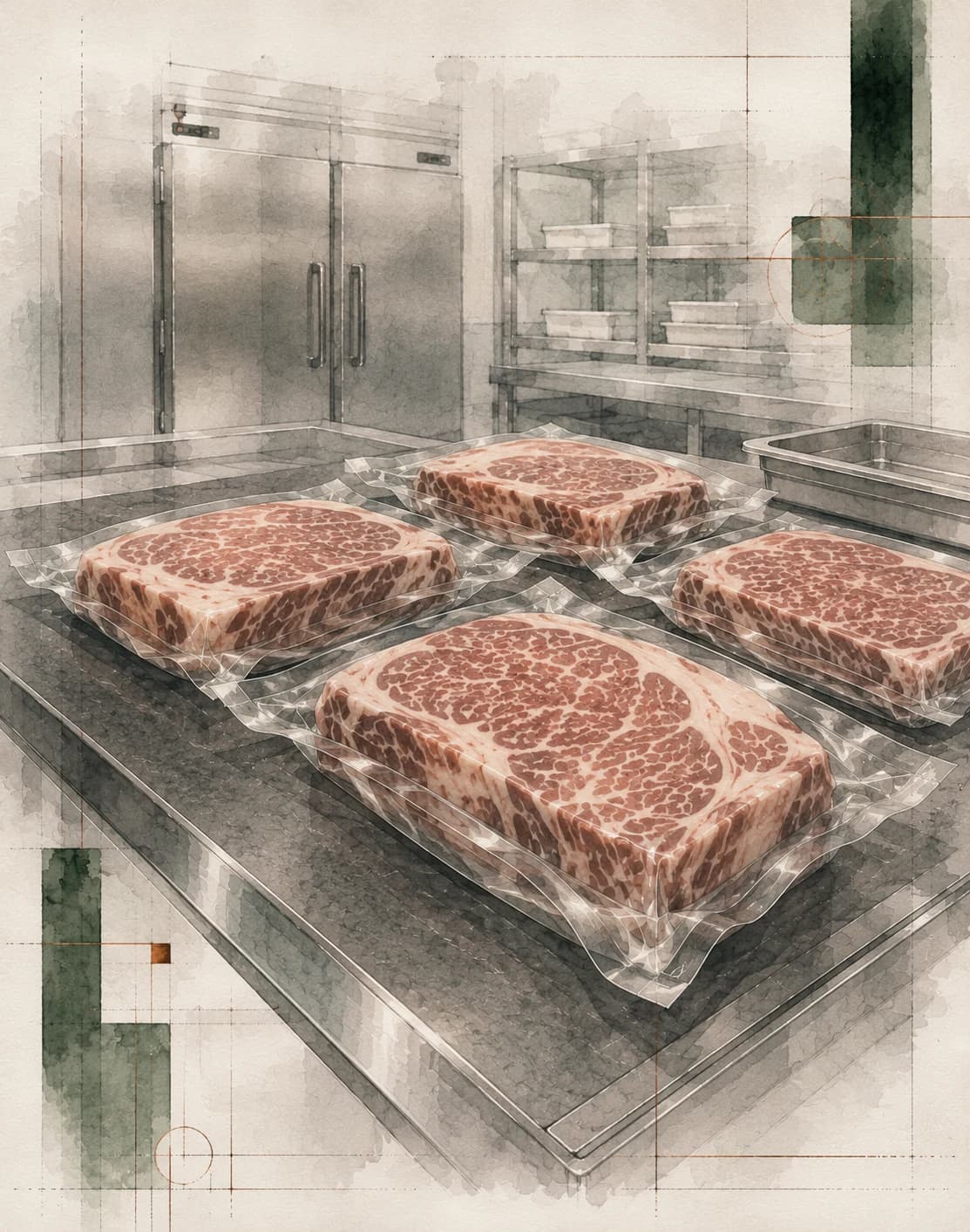
You have signed off the cut mix, the supplier is Japanese, and the first container is being booked. The remaining decision is not about the beef. It is about one line on the customs declaration: which HS line each cut is declared under, what value per kilogram sits against it, and whether the commercial invoice, packing list, Japanese export health certificate and certificate of origin say the same thing about that cut. When a Wagyu consignment sits at Cat Lai or Noi Bai, the cause is usually a wording mismatch between those four documents, not the product itself.
This article covers the declaration and valuation step for Vietnam: the chilled/frozen split, the declared value per cut, and the document-matching check you run before the vessel or flight leaves Japan. It does not re-cover the steps on either side of it. For counting the calendar days needed to get the import permit and establishment registration in place before you order, see the Vietnam permit lead-time day ledger. For temperature records and custody at handover after arrival, see the handover custody and temperature record sheet. If your buying entity imports into Australia instead, the field mapping there is a different regime with different certificate wording, and is handled in the Australian PO/permit/certificate field map.
The decision is made at PO time, not at the port
Two choices determine almost everything downstream, and both are made when the purchase order is written.
The first is state: chilled or frozen. This is a commercial and logistics decision — chilled usually moves by air with a short shelf window, frozen usually moves by sea with a longer one — but it also changes the customs classification. Fresh or chilled bovine meat and frozen bovine meat sit in different headings of the tariff schedule, and the state declared must match what the health certificate and the packing list say. A carton labeled frozen against a chilled declaration is the simplest possible reason to be stopped.
The second is the cut description. "Ribeye" and "striploin" are not interchangeable on paper even when the price is similar. Whatever name you put on the invoice is the name that must appear, in recognizable form, on the Japanese export health certificate and on the certificate of origin. Japanese exporters often have a house naming convention — roast, loin, rib roast, sirloin — that does not match the English your broker expects. Agree the exact string before the first PO is cut, not after the cartons are sealed.
Duty, VAT and preference: what to verify, not what to assume
Vietnamese tariff schedules and the applied rates for bovine cuts are revised periodically, and the list of approved Japanese establishments is maintained by the authorities and changes over time. Treat any rate you read in an article — including this one — as something to confirm. We do not publish duty or VAT percentages here, because a stale number in your dossier is worse than no number at all. Ask your licensed customs broker to quote the current-year applied rate against the specific HS line, in writing, and keep that written answer with the file.
Preferential treatment is the same kind of question. Japan and Vietnam are both parties to more than one trade agreement, and whether a given Wagyu cut qualifies for a preferential rate under any of them depends on the agreement claimed, the origin criterion met, and the certificate form issued by the competent authority in Japan. Which agreement is most advantageous for your cut and your shipment date is a question for your broker and for the Vietnamese customs authority, checked against the schedule in force on the date of declaration — not something to decide from a general article. Confirm the current position with the authorities or your broker before you claim preference.
Two practical points stand behind that check, and they are not rate-dependent. First, if you claim preference, the certificate of origin has to be consistent with the invoice it refers to — same consignee, same cut descriptions, same quantities. An otherwise valid certificate that describes a different cut mix is not usable. Second, in our handling experience, the certificate of origin is the document most likely to arrive after the goods on air shipments, because it is issued in Japan after the invoice is final (this is an observation from our shipping desk, not a measured figure). Decide in advance whether you will hold the declaration for it or clear at the standard rate and pursue a refund route, and ask your broker which option your file supports.
The VN declaration lock sheet
This is the durable part of the method. One page, one row per cut on the purchase order. Fill it before the PO is issued, circulate it to the Japanese exporter and to your broker, and freeze it.
Columns, left to right:
- Cut name as written on the invoice. The exact string, including grade and brand if they appear. This is the master value; every other document is checked against it.
- Wording required on the Japanese export health certificate. The product description the Japanese authority will certify. If it cannot match the invoice string word for word, write down the acceptable variant here and have your broker confirm it is acceptable before shipment.
- State: chilled or frozen. One value per row. If a single PO contains both, split it into two rows — never one row with both.
- HS line declared. Supplied by your broker against the current schedule. Record the date the broker confirmed it.
- Declared unit value per kilogram. The invoice unit price, in the invoice currency, on the invoice incoterm. One figure per cut, not a blended average across the order.
- Preference claimed: yes or no. If yes, record which agreement and which certificate form, and the expected issuance date in Japan.
- Who signs off. A named person on your side and a named person at the exporter. Not a department.
Typical rows for a first Wagyu order: ribeye, striploin, tenderloin, chuck roll, short plate, and trim. Trim is the row most often left blank and most often queried, because its description is vague and its unit value is far below the premium cuts on the same invoice. Give it a real name and a real price.
Pre-departure match check: eight points
Run this against scans of the four documents before the vessel sails or the flight departs. It takes one person under an hour, and a correction made in Japan costs a fraction of a correction made at a Vietnamese port.
- Consignee and importer details identical across invoice, packing list, health certificate and certificate of origin — including the legal entity name, address and tax code, with no abbreviation on one document and the full form on another.
- Cut descriptions on the invoice match the lock sheet master string, row for row, with no extra or missing cuts.
- Health certificate product wording matches the variant recorded in column two for every row, and the certificate covers every cut actually in the shipment.
- State is consistent: the word chilled or frozen appears the same way on the invoice, the packing list, the carton labels and the health certificate.
- Net and gross weights on the packing list reconcile to the invoice quantities per cut, and the totals reconcile to the health certificate.
- Carton and lot numbers on the packing list can be traced to the establishment number shown on the health certificate.
- Unit values on the invoice equal the lock sheet figures per cut, and the invoice total is arithmetically correct, including any discount or freight line.
- Certificate of origin, if preference is claimed, references the correct invoice number and date and repeats the same cut descriptions and quantities.
Any point that fails is fixed in Japan before departure. That is the whole value of running the check early: the exporter can reissue a document while the cartons are still in the cold store.
If customs raises a valuation query
High unit values attract questions. Wagyu is priced well above commodity beef, and a declared value that looks unusual against reference data may be asked about. Prepare a single response pack in advance so the answer goes back the same day rather than after a week of email:
- The signed purchase order showing the agreed price per cut per kilogram.
- The supplier's price confirmation or quotation on letterhead, dated before the PO.
- Proof of payment or the bank transfer instruction matching the invoice total.
- The lock sheet itself, showing that the declared value per cut was fixed before shipment and applied consistently.
- Grade and brand documentation for the cuts, which explains why the unit price sits where it does.
- Any prior clearance reference for the same cut and grade, if your company has imported it before.
The point of the pack is that every figure you give back is a figure you already committed to in writing before the goods moved. That is a far stronger position than reconstructing a price explanation after the container has landed.
Review this file once a year
The lock sheet and the eight-point check are durable; they do not expire. The HS line, the applied rates and the preference position are not durable. Put a review date on the sheet and re-confirm those three items with your broker each year, and again whenever you add a cut you have not imported before. Keep the broker's written confirmation attached to the sheet so the next person to sign a declaration knows when it was last verified and by whom.
Next step
Every column of the lock sheet needs a real input: a real cut name, a real state, and a real price per kilogram. Those come from the supplier, not from a template. If you are assembling a first Vietnamese dossier, request a wholesale quote for your specific cut mix and we will set out the per-cut unit prices and the invoice wording we will use, so the descriptions and declared values can be agreed in writing before your first purchase order is issued.